

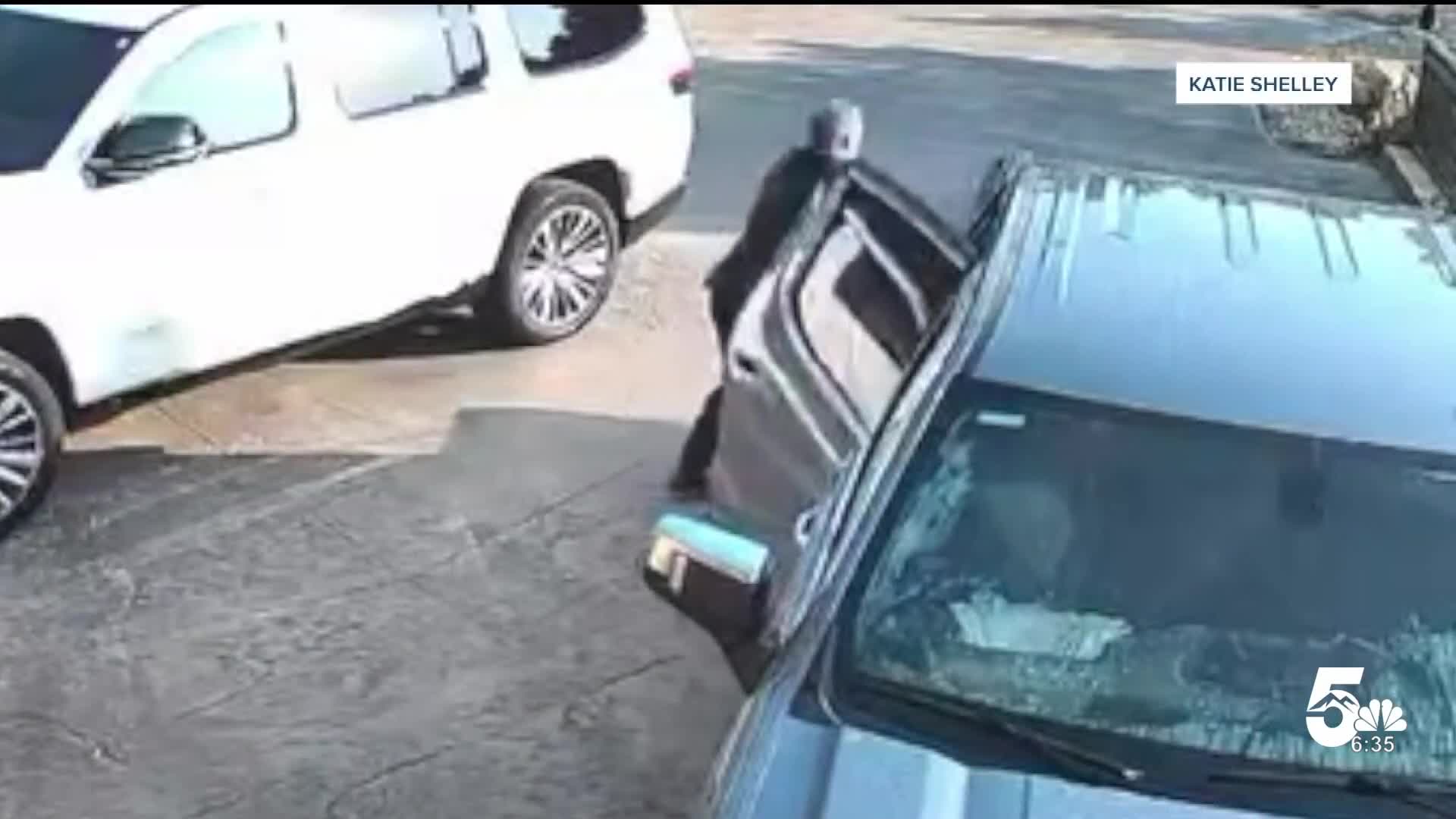



COLORADO SPRINGS, Colo. (KOAA) — A Colorado Springs couple is sharing a wild reminder to lock your car doors after a bear climbed into their vehicle and caused thousands of dollars in damage.
Katie and Clint Shelley have lived in their Broadmoor-area home for three years and have been married for 23 years. Clint, a retired active-duty Army oral surgeon who continues to serve in the Army Reserves, said he discovered the bear early one Sunday morning in July while heading to a church meeting. The Shelleys normally have their car doors locked, but one night that wasn't the case. Surveillance video showed an unexpected visitor easily opening their vehicle's door and getting inside without anyone knowing.
“I walked up and I saw my hazard lights on. I'm like, why are my hazard lights on?” Clint Shelley asked. “And I walked a little bit closer, and I saw the silhouette of a bear, and I'm like, Oh, there's a bear in the back seat of my car.”
WATCH VIDEO OF THE INTERACTION AT THE TOP OF THIS ARTICLE.
Shelley said he had seen videos of bears getting into vehicles before and initially thought the animal would simply leave.
“I was just trying to open up the door and kind of get on with my day, get to church,” he explained.
But the bear began moving around inside the vehicle as Shelley opened the door.
“It was a little bit difficult to open and the bear just started moving around, which got me a little bit nervous and scared,” he added. “So I tried a little bit harder, got it open, and he just started really moving around.”
Shelley decided it was time to run.
“I figured I'm not going to stick around to see what he's going to do, so I took off,” he said.
His wife, Katie, said she was still in bed when her husband came running into the house.
“He came running in and was like, there was a bear in my truck,” she said recalling that morning.
A few minutes later, he returned with another message.
“He said, you've got to see the damage that this bear did to my car because it was stuck inside,” Katie Shelley said.
The couple checked their surveillance cameras and saw the encounter unfold. Thankfully, insurance covered the damage left behind.
The experience also changed how the Shelleys approach bear safety. The couple also said they should have reported the encounter to Colorado Parks and Wildlife.
“I actually did think we probably need to call and let them know,” Katie explained. “I think Clint was the same way. We both thought, well, it's Sunday. Is anyone going to come over? But yeah, we should have reported it.”
The experience has left both of them with a greater appreciation for how easily bears can navigate human environments.
“I think we don't give them enough credit for their ability to get into homes, get into cars,” Katie stated. “They are probably more dangerous than we, you know, in this community give them credit for.”
Colorado Parks and Wildlife is urging residents to report bear sightings and conflicts as wildlife officials deal with an unusually high level of bear activity and conflicts across the state.
Tim Kroening, the area wildlife manager based in Colorado Springs, said reporting bear activity early can help wildlife officials prevent potentially dangerous situations from escalating.
“It's critical that anybody reports an incident if you have one with a bear,” Kroening said. “It's not only important for the bears to keep them safe and really start early on with notifying us if you have a bear around in your neighborhood, but as things, if things escalate.. it's really important for the safety of not only your family, but also your neighbors.”
Kroening said the goal is to keep bears wild and prevent them from becoming comfortable around people.
“We don't want the bears to get habituated to people,” he said. “That's when dangerous situations can end up happening.”
SOME PEOPLE FEAR REPORTING BEAR SIGHTINGS
Some residents have expressed concern that reporting a bear could result in the animal being euthanized. Kroening said failing to report a conflict is irresponsible, while emphasizing that euthanasia is not an automatic response. He said wildlife officials have a responsibility to protect both people and wildlife, and sometimes that means removing or euthanizing an animal.
“Sometimes we do end up having to euthanize or remove animals, but we do that for the safety of everybody, and it's not a decision that we make lightly,” Kroening said. “A lot of factors go into those decisions. We have policies around those decisions, but they're made for a reason.”
Kroening said residents should report more than just obvious conflicts. That includes bears getting into trash, pet food or other food sources, as well as bears simply passing through neighborhoods.
“We really are looking for anything and everything,” he said.
“If there's any sort of conflict or interactions with people, if they're getting into any food sources that could be trash, that could be pet food, anything along those lines, for sure we've got to know about it,” Kroening said.
Even sightings without an obvious conflict can help CPW identify patterns, he said.
“We collect all of that data. It goes into a map and a database for us so that we can actually see, our officers are looking at their areas of responsibility and are seeing patterns that may be developing,” Kroening explained.
NEARLY 300 BEARS HAVE HAD TO BE EUTHANIZED THIS YEAR
Colorado has experienced a high number of bear conflicts this year amid difficult environmental conditions, including drought, late freezes and wildfire. Kroening estimated Colorado's bear population at between 17,000 and 20,000 animals. While nearly 300 bears have been euthanized this year, he said that represents less than 2% of the statewide population.
Kroening said bears still have access to natural food sources, including berries, acorns and insects, but the availability of food has been affected by this year's conditions.
"Our bears are doing well in Colorado, and they will definitely rebound well next year,” he added.
DO YOUR PART
As bears prepare for hibernation, Kroening urged residents in bear country to take extra precautions around homes. That includes securing trash and removing other potential food sources.
“There's really no reason to have bird feeders out this time of year,” he said, recommending residents wait until bears have started hibernating before putting them back out.
Kroening also urged people not to simply watch a bear in their yard.
“Make loud noises. Say, hey bear, hey bear, get out of here, clap your hands, clap some pots and pans,” he said.
He said residents can also use an air horn or a homemade rattle can, a pop can filled with gravel and sealed with duct tape, to help haze a bear from a safe distance.
Click here for more "Bear Wise" information.

Right to Hunt and Fish? Amendment 83
____
Watch KOAA News5 on your time, anytime with our free streaming app available for your Roku, FireTV, AppleTV and Android TV. Just search KOAA News5, download and start watching.
