

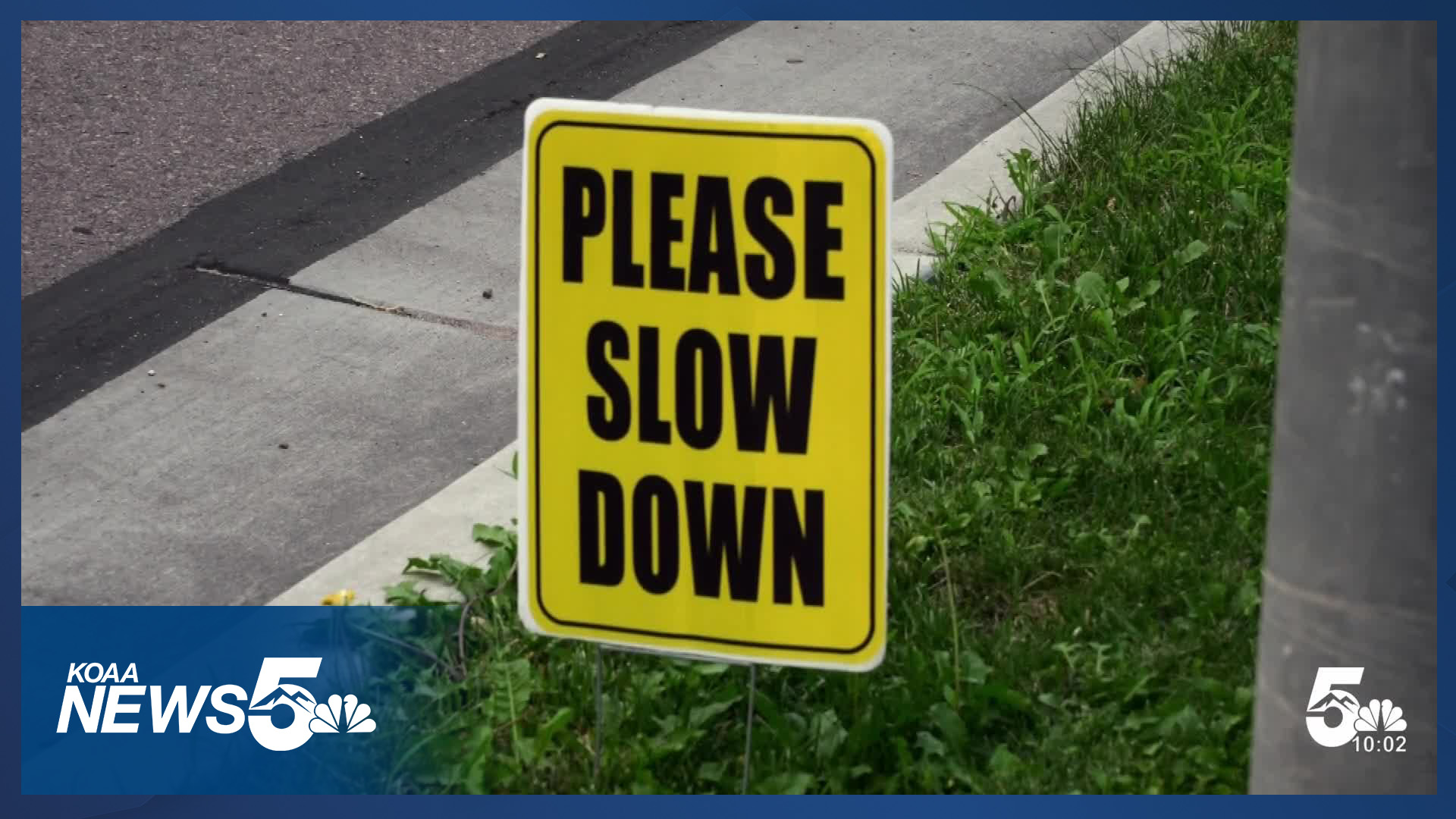


COLORADO SPRINGS, Colo. (KOAA) — Residents along North Nevada Avenue in Colorado Springs' Old North End neighborhood say speeding drivers have made their street dangerous for years, and they want more than incremental fixes.
Speed limit signs along the corridor post 30 miles per hour, but neighbors say drivers routinely blow past that limit by wide margins.
-
Watch News5's previous reporting on road safety in the Old North End below:
Jaime Socotch, an Old North End resident, said the consequences have been devastating.
"There's way too many people who live here who have horror stories of people literally dying in their arms," said Socotch.
Socotch said she has seen drivers traveling far beyond the posted limit.
"This is a residential neighborhood, but people see two lanes of flat pavement. They're in a hurry. They think that they're justified in going 45, 50, 60, 70, 80 miles an hour," said Socotch.
The danger has become so routine that residents have developed an unsettling habit.
"Everyone running out on their porches every time we hear a crash is kind of a morbid ritual that happens," said Socotch.
Socotch said the crashes are not just small fender-benders.
"It's very unusual for a residential neighborhood to have cars coming over the curb, hitting your house, flipping over an intersection, hitting city buses," said Socotch.
The city recently installed a speed feedback sign along the corridor. A speed feedback sign captured a driver traveling 36 miles per hour, six miles over the limit, during a previous visit to the area. But Socotch said she has seen drivers going much faster than that.
Socotch said she appreciates the new sign but does not believe it will solve the problem long-term.
"People get used to the signs and then they start ignoring them, so it's not a long term way to make change," she said.
The city's traffic engineer, Todd Frisbie a statement, which you can read below:
The data we've collected continues to show that the speed mitigation measures, including the dynamic speed limit signs, implemented on North Nevada Avenue are working. Through the end of 2025, we've seen consistent and sustained reductions in operating speeds across the corridor. During daytime hours, 85th and 95th percentile speeds have decreased by approximately 2-4 miles per hour in both directions and across both weekdays and weekends. Near the Fontanero Street intersection, where the traffic signal operates in a 'rest on red' mode overnight, we've observed even greater reductions of approximately 406 miles per hour during nighttime hours.
While a few miles per hour may seem modest, transportation research consistently shows that small reductions in vehicle speeds can improve safety by increasing driver reaction time and reducing crash severity. Our goal is to make meaningful, measurable improvements based on data, and that's what we're seeing on this corridor.
North Nevada Avenue is one of the city's most unique transportation corridors. It serves neighborhoods, businesses, schools and regional traffic, so any long-term changes must balance safety, mobility and the corridor's role in the broader transportation network. As outlined in ConnectCOS, we recognize the unique character of the Old North End and continue to evaluate the corridor using current traffic data.
We must coordinate any future improvements with other major transportation investments planned for this area, including the Fillmore Bridges replacement, the future reconstruction of North Nevada Avenue between Lilac Street and University Village, Platte Avenue improvements, and the proposed North Nevada Economic Opportunity Zone. Larger corridor changes will require careful planning, coordination and identified funding sources.
We'll continue monitoring traffic conditions, evaluating additional opportunities where they are supported by data, and making improvements that enhance safety while maintaining the corridor's important transportation function.
Socotch said that improvement does not go far enough.
"The speed going down by 2 to 3 miles an hour is not enough. That's not going to save lives," she said.
Neighbors have raised concerns about speeding on North Nevada Avenue with the city for more than a decade. Now, Socotch said she wants to see a more dramatic structural change by converting North Nevada Avenue to a single lane, similar to what was done on nearby Cascade Avenue.
"The only thing that's going to stop people is the one lane," said Socotch.
She said there is a big misconception about turning North Nevada Avenue into a one lane.
"There's a misconception that there's a lot of traffic on this street and there's continuous flow all the time and going down to one lane is going to cause backups and that's just not the case based on how the traffic signals work," said Socotch.

___

Child Shot Thursday Morning in Colorado Springs, Suspect Arrested
____
Watch KOAA News5 on your time, anytime with our free streaming app available for your Roku, FireTV, AppleTV and Android TV. Just search KOAA News5, download and start watching.
