

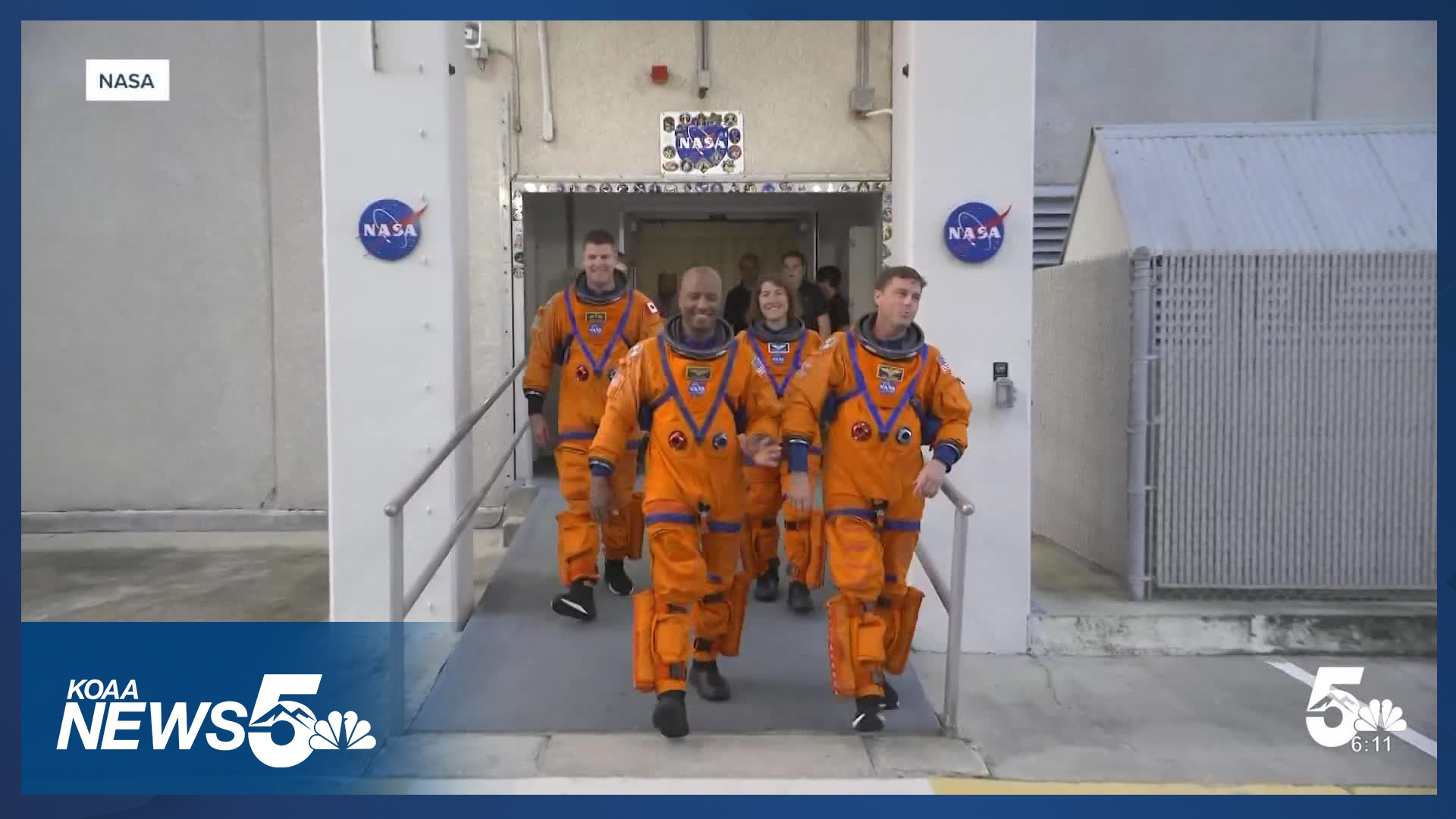



CAPE CANAVERAL, Fla. (KOAA) — An important chapter in history is expected to be written on Wednesday as NASA officials say the Artemis II mission marks a critical step toward returning humans to the moon and eventually establishing a long-term presence there.
Dr. Kelsey Young, NASA’s Artemis II lunar science lead, described the mission as both a technical milestone and a scientific opportunity.
- Watch NASA's stream of the mission in the video player below
“Artemis II is first and foremost a test flight,” Young told News5. “It is the first crewed flight of the Orion vehicle. We flew it in Artemis I, but without astronauts on board. So first and foremost, we want to characterize vehicle performance.”
The mission will send four astronauts aboard the Orion spacecraft on a 10-day journey, including a lunar flyby. While NASA gathered extensive data during the uncrewed Artemis I mission, Young emphasized the importance of testing the spacecraft with humans on board.
“We really want to characterize its performance with humans on board,” she said, noting that future Artemis missions will rely on the same vehicle.
Beyond engineering goals, Artemis II will also contribute to lunar science. During a roughly six-hour flyby of the moon, astronauts will observe, document and describe the lunar surface. The mission represents a massive collaborative effort involving government, commercial and international partners. While Young did not cite a specific number of contributors, she underscored the scale of the operation. Companies with ties to Colorado, like Lockheed Martin, L3Harris, and Boeing, are all part of the mission.
“The cliché about human spaceflight is absolutely true — that human spaceflight is a huge team sport,” she said. “We really need our commercial partners to make this a success.”
Young also praised the four-person crew, highlighting both their preparation and enthusiasm.
“We are so fortunate to have this crew,” she said. “They are so prepared. They are so excited. They are so passionate and enthusiastic about the moon and lunar science.”
Looking ahead, Artemis II is part of a broader vision that includes building a sustained human presence on the moon, often referred to as a “moon base.”
“The moon base is one of the agency’s plans to establish a long-term sustained presence on the lunar surface,” Young said. “It will allow us access to really unlock a lot of the high-priority science questions.”
For Young, the mission carries personal significance as well.
“I just feel really grateful to be here and to be even such a small part of this amazing mission,” she said. “Of course I feel excited and of course I'm a human being, so I feel a little bit nervous, but honestly, we are prepared.”
NASA is encouraging the public to follow along with the mission through continuous online coverage, including livestreams and additional resources. Click here to watch.
She added that the moon’s universal visibility makes the mission especially meaningful.
“The moon is something that connects people all over the world,” Young said. “Everybody all over the world can step outside at night and see the moon and connect with it.”
Young expressed hope that Artemis II will inspire a new generation, much like the Apollo missions did decades ago.
“I’m so optimistic that the Artemis program will do the same,” she said.
During the mission, Young will serve in a newly established role as a science officer in mission control at Johnson Space Center, reflecting NASA’s increased emphasis on integrating science into human spaceflight.
“It’s a really exciting time,” she said. “So please come join us as we take this ride.”
The mission will send astronauts Reid Wiseman, Victor Glover, Christina Koch and Canadian Space Agency astronaut Jeremy Hansen on a roughly 10-day, 685,000-mile voyage that will carry them thousands of miles beyond the far side of the Moon before returning to Earth.
While in transit, the astronauts will carry out a demanding schedule of tests and demonstrations. They will manually pilot Orion for the first time, evaluate how the spacecraft handles in deep space, and practice essential operations for future lunar missions. The crew will also conduct scientific investigations and test how humans can live and work far from Earth, including exercise routines and emergency procedures.

Right to Hunt and Fish? Amendment 83
____
Watch KOAA News5 on your time, anytime with our free streaming app available for your Roku, FireTV, AppleTV and Android TV. Just search KOAA News5, download and start watching.
