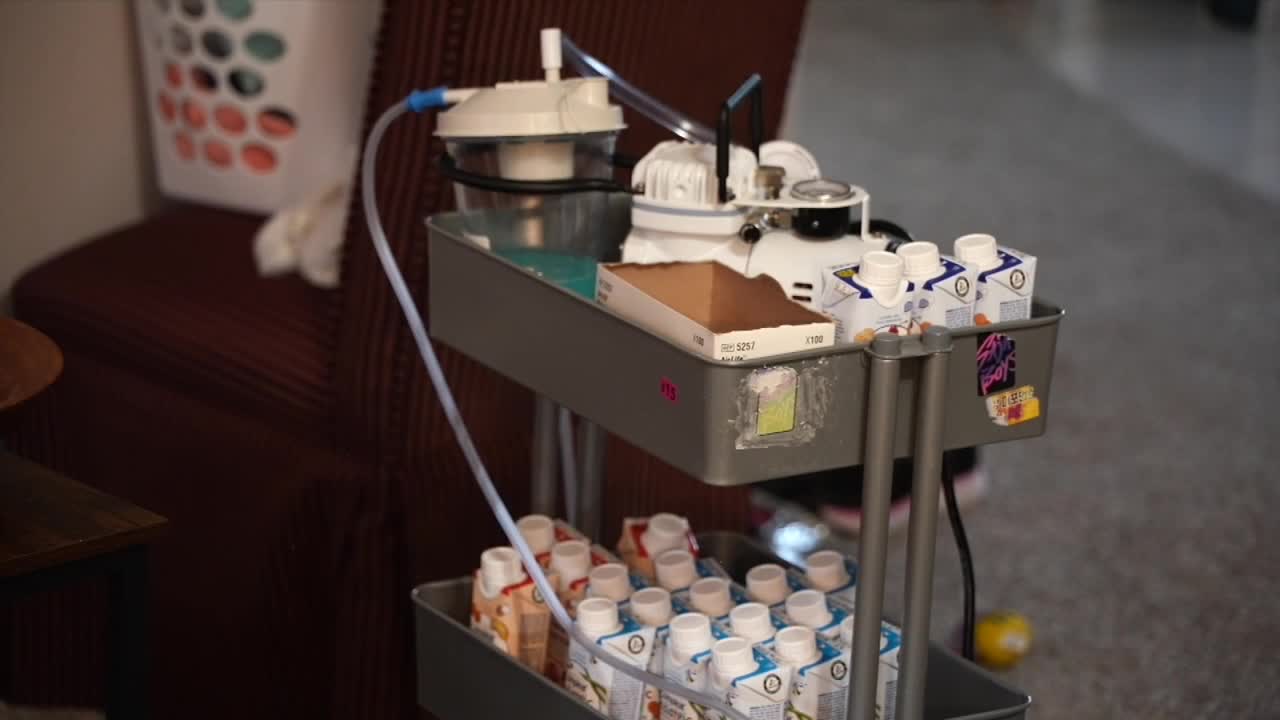


COLORADO SPRINGS, Colo. (KOAA) — Colorado's Department of Health Care Policy and Financing (HCPF) is removing the live-in caregiver exemption from Electronic Visit Verification (EVV) requirements while also implementing cuts to the Community First Choice (CFC) program — changes projected to save more than $50 million in general fund savings.
Parent caregivers say the new policies will make an already demanding job harder and could leave some families without critical services.
EVV is a system used to document what Medicaid services a caregiver is providing and when.
Watch News5's original reporting on the EVV live-in caregiver exemption removal proposal:
Live-in caregiver Laura Johansson says the requirement to log hours doesn't reflect the unpredictable, around-the-clock nature of her work.
"The caregiving doesn't happen on a schedule," Johansson said.
She described the difficulty of being required to clock in and out for care that happens continuously.
"You have to be clocked in to provide the care. Like that's not always feasible. That's not always the way that life works. Life doesn't just work on a schedule like that for anybody," Johansson said.
Johansson says the removal of the exemption could be detrimental to her daughter Sydney's care. She says fear is spreading among families in similar situations.
"People are definitely getting really nervous. Between our hours being cut progressively throughout the course of the next year to losing certain cares that we provide that are still gonna need to be provided and then we're not gonna get paid," Johansson said.
Brittny Tarango Guzman, another parent caregiver, says the change signals mass uncertainty — especially for families caring for medically complex children.
"It states that it should be minimally burdensome. It would be a big burden for many families that have medically complex children. It would just be a very big burden to remember to clock in and out on time," Tarango Guzman said.
She said the change isn't necessary. The removal of the exemption is up to the state. The removal isn't required federally.
"It's going to create administrative burdens on agencies, on families, more stress on families, and it could compromise care," Tarango Guzman said.
Colin Laughlin, office director for the Office of Community Living at the Department of Health Care Policy and Financing, said even though states can choose their own fates when it comes to the removal, it feels like now is the time.
"We have spoken to our federal partners and we believe that this exemption and some of the programs, the enhanced reliance and focus on electronic visit verification allows us to get ahead of some of the things that we've seen in other states," Laughlin said.
The EVV change isn't the only policy shift affecting parent caregivers. News5 previously spoke with families about the Community First Choice program, which allows the state to provide certain home and community-based services to parents. HCPF has since said some of the proposed cuts to CFC will be implemented.
Among those cuts: a 10-hour weekly cap on homemaker hours — reduced from 21.5 hours a week established in the first round of cuts. The current 7-hour weekly limit on paid homemaker services will be extended for legally responsible people to include family caregivers. The personal care services will have a weekly soft cap at 40 hours which is reduced from 47.5.
Services including the community connector and mentorship program will be removed in the second round of cuts. Other services cut include :
- Primary Caregiver Education
- Mental Health Counseling
- Substance Abuse Counseling
- Extraordinary Cleaning
- Adaptive Therapeutic Recreation Equipment
- Recreational Fees and Passes
Parent caregiver Jo Remund says the financial impact could be devastating.
"That literally will leave me and my two children homeless because I will not have money. I will not have money because I cannot go and get a normal 9 to 5 like anybody else," Remund said.
Watch News5's original reporting about Community First Choice and parent caregiver concerns:
"How am I going to be doing that? How am I going to survive? How are my kids going to survive?" Remund said.
For Madison Kelly, the cuts hit even closer to home.
"My daughter's losing access to a lot of these therapies that have helped her so much to be able to talk in word sentences now," Kelly said.
She said her biggest fear is that her daughter won't get out into the community as often.
"Having a child with special needs who has all of these dreams and with all of the cuts coming down from Medicaid, just not being able to say yes to everything is incredibly heartbreaking," Kelly said, "We're starting to have to step back and say, unfortunately, we can't do this and we can't do that. And I don't think that the state is understanding fully how it's affecting these children directly."
HCPF projects all the cuts combined will save more than $50 million in general fund savings. Removing the EVV exemption alone makes up $12 million of that total. And removing community connector makes up $21.9 million of the total.
Colin Laughlin says the department expects EVV savings to come from improved accuracy — not from families making mistakes.
"We're assuming that our live-in caregivers, our family caregivers are actually going to be more accurate in following that particular process," Laughlin said.
He says there are misconceptions about how the change will work in practice, noting that families will have flexibility to correct their documentation.
"We do have the flexibility for someone to come in afterwards and correct or even enter that that documentation the first time. We want to prioritize that critical care first," Laughlin said.
But parent caregivers say they worry their correction requests will get lost in the paperwork — and that the added administrative burden will only worsen existing burnout.
"Now I have to find another job to be able to cover my bills and how does that save me from being burnt out?" Johansson said.
HCPF says it anticipates the changes to be implemented in September 2027. But there will be a three month soft cap until the hard cap takes effect January 2028.
KOAA will continue following along.