
COLORADO SPRINGS, Colo. (KOAA) — A leaked database reveals the widespread scale of the Trump administration’s efforts to reshape American history in a more positive light, with dozens of exhibits in multiple Colorado National Park sites flagged for possible alteration or removal.
The leaked documents–which appeared at the start of the month on two separate sites–were first reported by the Washington Post and verified by the outlet with current federal employees. The documents show hundreds of National Park Service (NPS) materials flagged for review to ensure compliance with Trump administration orders issued last year.
KOAA has been able to verify portions of the database through sources within the sphere of the NPS, but not the entirety of the documents.
“The administration’s orders to suppress truth, history and science at our national parks continues to sow chaos and confusion across the country,” said Tracy Coppola, Colorado Senior Program Manager with the National Park Conservation Association (NPCA).
“This database makes it clear that dedicated national park staff are facing enormous pressure to police and report, putting them in an impossible situation, and diminishing the national park experience for millions of visitors,” she said.
WHAT'S BEEN FLAGGED
Out of Colorado’s 13 NPS sites, seven said they had “nothing to report” in terms of possible interpretive materials that might need to be altered or removed.
But for the others, like Rocky Mountain National Park or Mesa Verde National Park, multiple signs discussing climate change or the impact of white settlers on Native Americans were questioned by park leaders on whether they complied.
One Mesa Verde park official wrote in the database about a wayside panel that includes a discussion about Ute tribal lands, questioning if the sentence "Under continued pressure from white settlements, additional negotiations between the federal government and the tribe further reduced Ute lands, resulting in today's reservation boundaries” is in compliance.
At Sand Creek Massacre National Historic Site, where one of the darkest chapters of Colorado and U.S. history occurred, numerous signs and exhibits were flagged in the database.
But, in what appeared to be an effort to prevent any changes to the site, the park officials who wrote it stressed everything was created in accordance with the federal law that established the site and with input and approval by their tribal partners.
The full list of Colorado’s NPS sites and what has been flagged for review and possible removal can be found further down this article.
Colorado’s park sites don’t appear to be impacted as much by the Trump administration scrutiny as parks in other locations around the country.
At the National Monument honoring Emmett Till, a Black teen who was kidnapped, tortured, and murdered in 1955 after reportedly whistling at a white woman in Mississippi, park staff questioned how much of the site itself might violate the federal orders.
“Without this exhibit to share the difficult Till story, the new NPS site would be almost completely devoid of interpretation,” park staff wrote.
An unnamed spokesperson for the Department of the Interior, which oversees the National Park Service, said “the narrative being advanced is false and these draft, deliberative internal documents are not a representation of final action taken by the Department.”
“We are aware that internal working documents were edited before being inappropriately and illegally released to the media in ways that misrepresented the status of this effort,” the spokesperson said. “Employees who altered internal records and leaked in an effort the[sic] hurt the Trump administration will be held accountable.”
WHAT LED TO THIS
Nearly a year after President Trump issued his “Restoring Truth and Sanity To American History” Executive Order, the controversial process to remove “negative” aspects of U.S. history appears to remain ongoing, despite seemingly slow progress.
Trump’s order dictated that public lands remove or alter “content that inappropriately disparage Americans past or living.”
The broad order was reiterated by Interior Secretary Doug Burgum in May, which led to controversial QR codes to appear at every NPS site around the country, encouraging visitors to report anything that might come across as “negative” about American history or that didn’t focus on “the beauty, abundance, and grandeur of the American landscape.”
The orders brought widespread condemnation from National Park advocates and scientists, leading to a federal lawsuit filed last month to halt the process altogether. Critics argued these broad orders would lead to a whitewashing or revisionist history.
A note on the websites that published the database said: “This data belongs to the American people, who need to know what is being done in their name. Donald Trump, [Director of the Office of Budget and Management] Russell Vought, Doug Burgum, and the rest of this corrupt administration are trying to use your public lands to erase history and undermine science.”
HOW THE ORDERS HAVE TAKEN SHAPE
This year, the effects of the orders have begun to materialize. First, in a dramatic way at Independence National Historic Park in Philadelphia, where panels detailing George Washington’s slaves were abruptly removed and then shortly ordered reinstated by a federal judge.
The orders have also placed additional burdens on an already depleted NPS staff in Colorado and nationwide, said Tracy Coppola with NPCA.
“All of this comes at a time when park staff are already at an all-time low, with 25% fewer staff due to administrative cuts in 2025,” Coppola said. “Government censorship in our national parks violates the very ideals our country was built on. That’s why NPCA and our partners filed a lawsuit to stop these actions.”
The Association of National Park Rangers was also a party to that lawsuit. Bill Wade, executive director of the group, reiterated the "chaos" the orders have caused.
“The time that they had to spend to go through and review all of the interpreting programs, the exhibits, the brochures, the videos,--has put a lot of effort and time on the part of park rangers when they really should have been doing other things,” Wade said.
Wade’s father was a park ranger at Mesa Verde for his whole career and is himself a former superintendent of Shenandoah National Park in Virginia.
In response to the flagged materials about climate change at Mesa Verde, Wade said he wasn’t surprised.
“There seems to be two major categories of concerns that the administration has. One, of course, is the stories about things like slavery and LGBTQ and some of the things like that that they don't particularly support,” said Wade. “And then the other is the broader area of science and in particular climate change.”
Wade said he feared the implications of erasing this history or science from the National Parks would have a grave effect on the rangers.
“When park rangers are asked now to give different versions of those stories or withhold that true and accurate story, I think it really borders on being very frustrating to them,” he said.
The lawsuit that the NPCA and Association of National Park Rangers joined to halt the process filed a motion for a preliminary injunction on Wednesday.
Alan Spears, Senior Director for Cultural Resources at the NPCA said they filed the motion “to halt the administration’s censorship campaign and require the Department of the Interior to restore all exhibits and resources it has removed so far.”
ALL COLORADO NATIONAL PARK SITE MATERIALS FLAGGED FOR REVIEW, COMPLIANCE, AND POSSIBLE ALTERATION OR REMOVAL FOLLOWING PRESIDENT TRUMP AND SECRETARY BURGUM PUBLIC LANDS ORDERS
NOTE: Not everything in the database has or will be altered or removed. Some of the notes from park staff highlight other issues found in their interpretive materials, including out of date scholarship, sun damage, and vandalism. Everything in the database for Colorado has been included below. It’s unclear at what point in time this database was created and disseminated.
When downloaded, the database holds hundreds of numbered folders, each with photographs, along with a spreadsheet of corresponding NPS park codes for each numbered folder. The spreadsheet included the comments made by park staff.
By utilizing the historic NPS Park office codes, each folder was matched with the appropriate Colorado NPS site.
Amache National Historic Site
AMCH
410
Media Enhancements: Signs and Waysides
Description Changes: Waysides at AMCH are worn, do not comply with ADA standards, and are not reflective of the most recent scholarship.


Bent’s Old Fort National Historic Site
BEOL
1061
Media Enhancements: Signs and Waysides
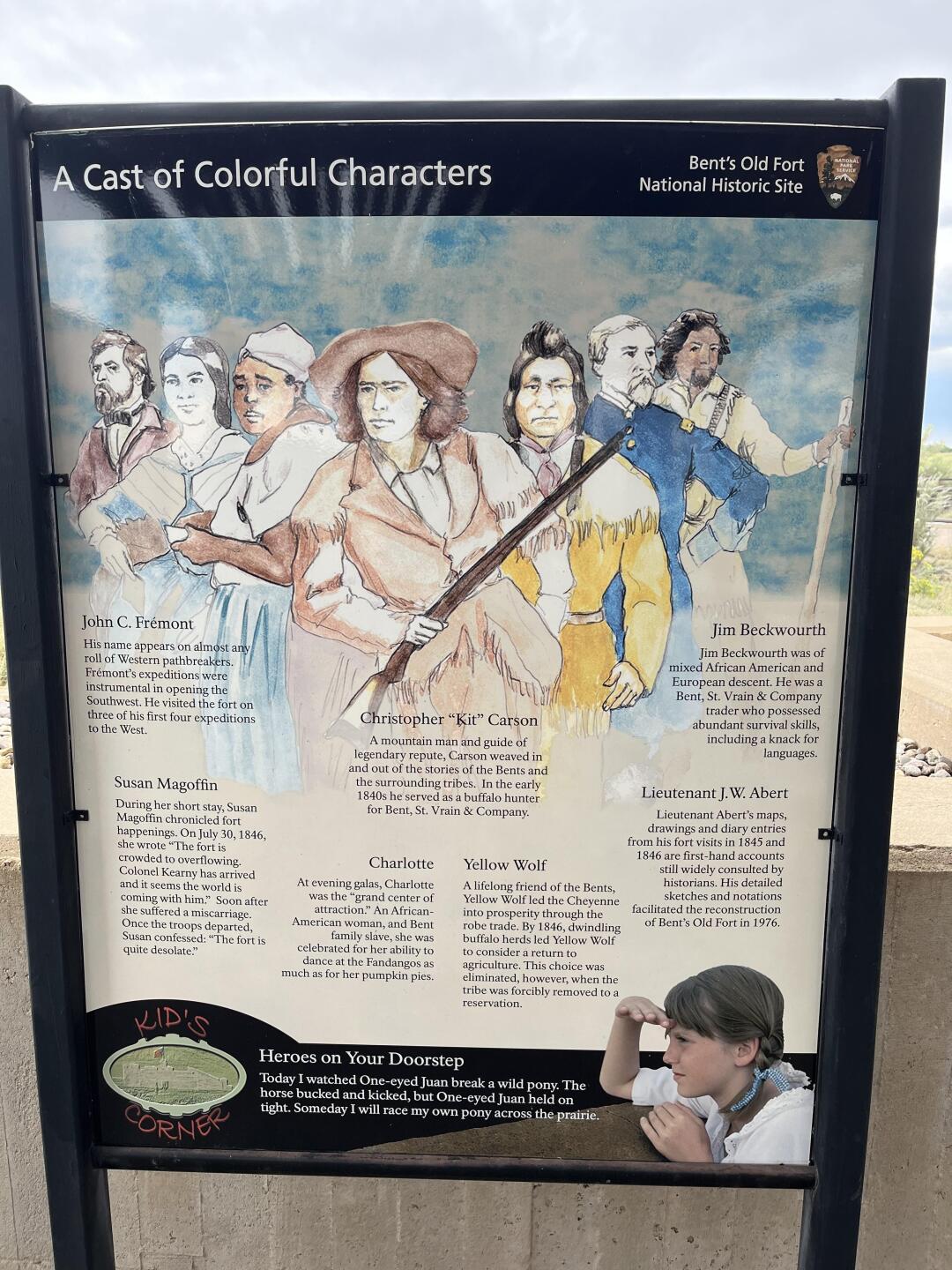
Description Changes: This 2009 exterior wayside panel is entitled "A Colorful Cast of Characters" and features short descriptions of seven individuals along with a watercolor illustration of these same individuals. There is no clear theme connecting these seven individuals to the fort. There is a text box below labeled "Kid's Corner" with short text about a Mexican individual breaking horses.
This panel and others in the park are scheduled to be redesigned and replaced in a project formulated to begin in FY27.
302
Film–Needs Repair/Replacement
Description Changes: The 2005 park film was previously shown in room 103 of the reconstructed fort. By the time the fort was placed under restricted access due to a series of structural and safety risks in December 2024, the electronic system used to operate the film was no longer operating reliably due in large part to the presence of heavy dirt inside the reconstructed fort. The film script is also no longer in alignment with scholarship about commerce on the plains up to and after the US-Mexico War.
Black Canyon of the Gunnison National Park
BLCA
Nothing to report
Colorado National Monument
COLM
Nothing to report
We do not have any content that conflicts with SO 3431 or EO 14253.
Curecanti National Recreation Area
CURE
Nothing to report
Dinosaur National Monument
DINO
607
Media Enhancement: Signs and Waysides
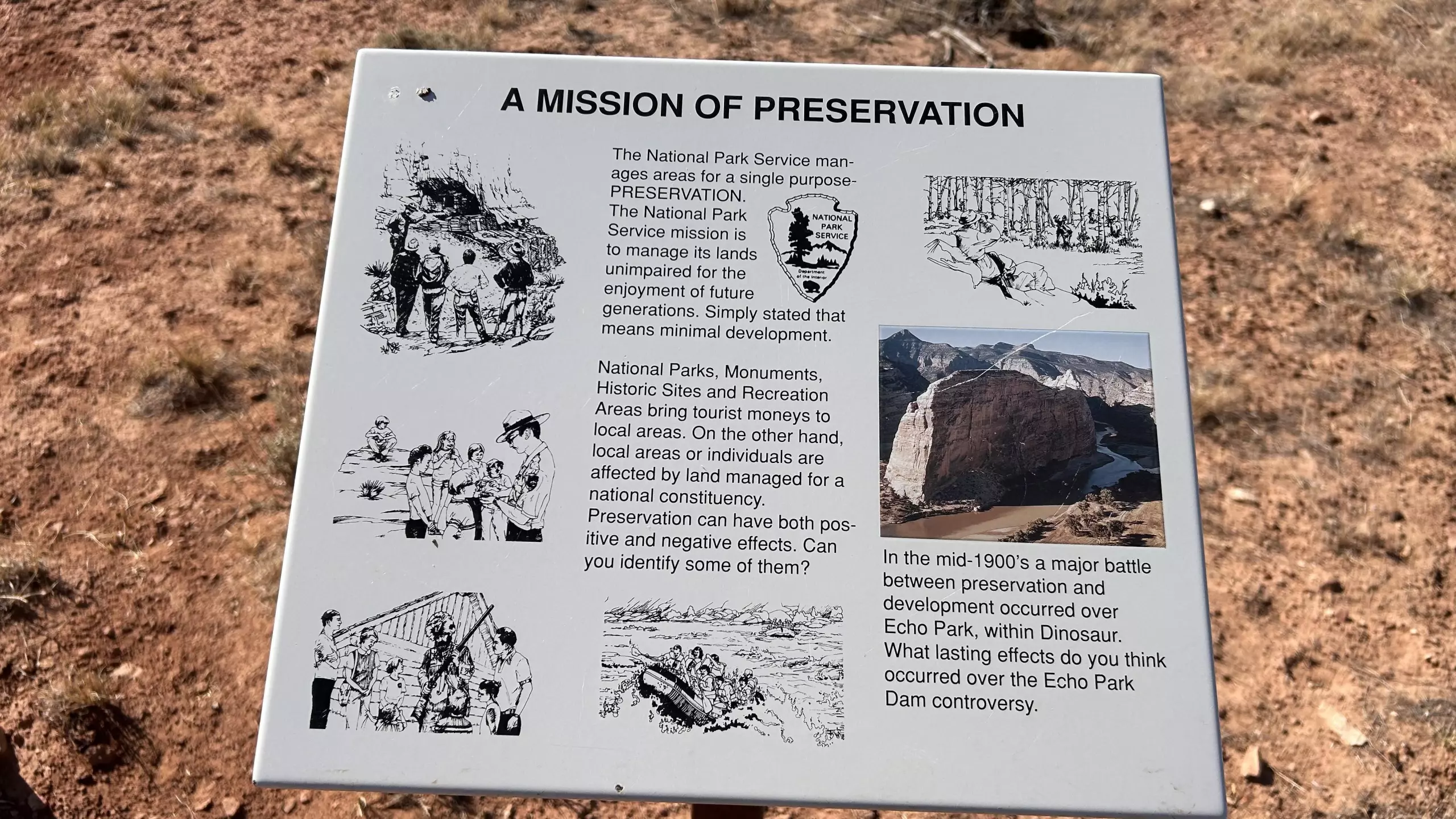
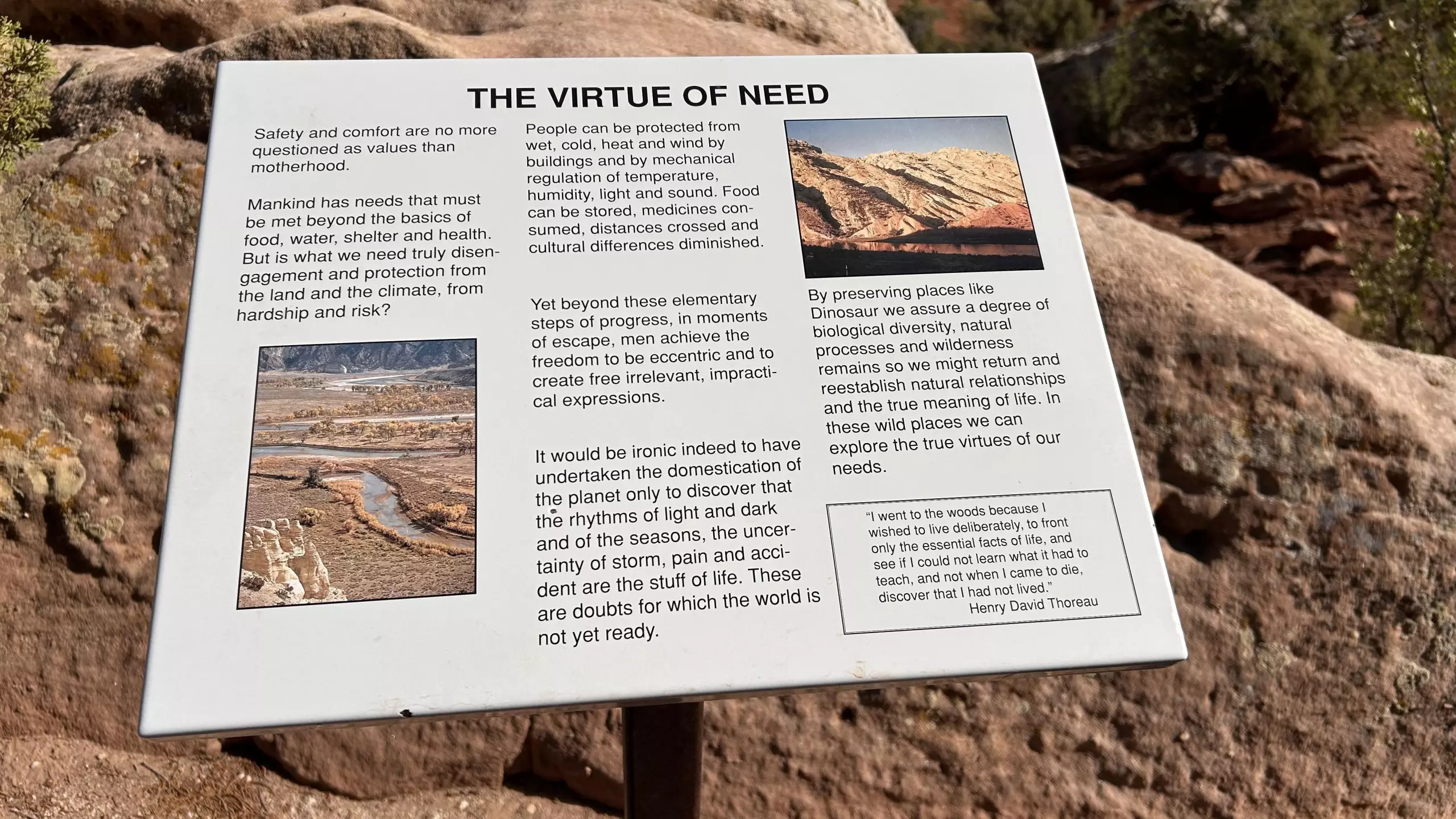
Description Changes: Desert Voices Trail - There is a series of outdoor waysides (40 total) that was installed on the Desert Voices Trail in 1992. While most of the porcelain enamel waysides are in fair condition, the content is from a different time period and does not meet current standards for interpretation. Some of the content is inaccurate and the approach for may of the waysides was to address issues instead of the resources, scenery and stories visible to the visitor. Recommendation is to remove these wayside exhibits and replace with newly design ones that focus on the resources and scenery immediately visible to visitors. The content, style and methods should be done in a way to engage more visitors.


Florissant Fossil Beds National Monument
FLFO
485
Nothing to report
Great Sand Dunes National Park and Preserve
GRSA
Nothing to report
Hovenweep National Monument
HOVE
Nothing to report
Mesa Verde National Park
MEVE
647
Media Enhancement: Publications; Signs and Waysides
Publications Produced: Needs Review: Contains content that may conflict with SO 3431 or EO 14253
Description Changes: MEVE-601_Mesa Recovers from Fire - The wayside panel discusses the ecological impacts of fire at Mesa Verde. The main text states, "The current increase in climate temperatures will make further recovery even more difficult, threatening biodiversity." A map caption adds that 70% of the park has burned since it was established, noting: "Although fire has always been a part of the Mesa Verde ecosystem, recent fires are occurring more often and are more devastating than in the past." The panel is grounded in current scientific research and is consistent with agency climate communication guidance.
MEVE-603_The Ute Homeland - This wayside panel highlights the historic and ongoing connection between the Ute Mountain Ute Tribe and ancestral lands in the park. It includes discussion of a land exchange and visual depiction of reservation boundary changes. One sentence states: "Under continued pressure from white settlements, additional negotiations between the federal government and the tribe further reduced Ute lands, resulting in today's reservation boundaries."
MEVE-805_Kodak House Overlook - This briefly references early documentation of the site and states, "By then, it had already suffered the detrimental effects of the search for artifacts by earlier explorers."
Petroglyph Point & Spruce Canyon: A Field Guide to the Natural & Cultural History of Mesa Verde National Park. This trail guide, published by the Mesa Verde Association, includes a section titled Wildfire and the Future. It notes: "PJ forests have flourished here for thousands of years, but over the last few decades, drought and warming temperatures have killed over a third of Mesa Verde's pinyon pines and 10% of junipers. Look for stressed and dying trees along the trail. The pinyon jay and other species that depend on this unique forest have also seen steep declines. Rapid changes in climate now threaten to wipe out some of the key species in the web of connections at the heart of this rich ecosystem."
Native American Testimony: A Chronicle of Indian-White Relations from Prophecy to the Present, 1492-2000. This book, authored by Peter Nabokov and sold through the Mesa Verde Association, presents primary-source testimonies and historical letters from both Native and federal perspectives. Some content includes strong language or personal views that may meet review criteria under SO 3431. As a curated retail item, it is identified as a non-NPS interpretive product.


Rocky Mountain National Park
ROMO
944
Media Enhancement: Interior / Exterior Exhibits; NothingToReport; Signs and Waysides
Description Changes: The exhibits at Kawuneeche Visitor Center has outdated exhibits that are planned to be replaced in FY26/FY27. We've worked with HFC through this process.
There are five waysides that may conflict with SO 3431. They are attached below.


Sand Creek Massacre National Historic Site
SAND
1071
Media Enhancement: Signs and Waysides
Description Changes: These ten exhibit panels are located along the park's Bluff Trail. Some of the panels utilize maps and graphics that are difficult to read, no longer accurate due to boundary changes, or do not meet the NPS design standard.
These and all other wayside exhibits at SAND have gone through an extensive tribal consultation process, as required by the park's enabling legislation, Public Law 106-465. A wayside exhibit replacement project is currently formulated for FY26 in which all wayside exhibits in the park will be reviewed for content and redesigned along with renewed Tribal consultation.
584
Media Enhancement: Signs and Waysides
Description Changes: Numerous wayside panels have out of date graphics orsunbleach damage and are partly unreadable. One panel needs redesign so as to redsuce the likelyhood of continued persistent vandalism.
1062
Media Enhancement: Signs and Waysides; Signs and Waysides; Signs and Waysides
Description Changes: This wayside exhibit panel, entitled "Night March to Sand Creek" prominently features a photograph of Colonel John Chivington. This panel is located at an orientation pullout along a county road and has unmonitored visitor access 24 hours a day. Because of the open access of this location, the picture of John Chivington is often a target for vandalism, leading to the regular replacement of this panel due to damage.
This and all other wayside exhibits at SAND have gone through an extensive tribal consultation process, as required by the park's enabling legislation, Public Law 106-465. A wayside exhibit replacement project is currently formulated for FY26, and relocating the picture of John Chivington to a location elsewhere in the park less likely to be vandalized is a high priority.
1064
Media Enhancement: Signs and Waysides
Description Changes: These four exhibit panels are located in the primary visitor orientation area. Three of them date to the beginning of park operations in 2008 and do not meet NPS graphic design standards.
Two panels feature a sepia toned parchment background and cursive fonts. These panels provide the unedited text of two letters written by massacre participants describing what they witnessed. As they presently exist they are difficult to read. A third panel served as an introduction to the two letters and is text heavy. The fourth panel directs visitors to look toward the park's maintenance build and needs to be revised and relocated to a more appropriate location within the park, probably at the village overlook area. The final panel is an orientation to the park that features an obsolete park map with an incorrect legal boundary shown.
The two panels that display the text of letters written in 1864 by Silas Soule and Joseph Cramer are especially important to our Tribal partners and representatives, and at their request these panels repeat the full text of each letter.
These and all other wayside exhibits at SAND have gone through an extensive tribal consultation process, as required by the park's enabling legislation, Public Law 106-465. A wayside exhibit replacement project is currently formulated for FY26 in which all wayside exhibits in the park will be reviewed for content and redesigned along with renewed Tribal consultation.
1067
Media Enhancement: Signs and Waysides
Description Changes: These exhibit panels are located along the park's Monument Hill Trail. Some of the panels utilize maps and graphics that are difficult to read, no longer accurate due to boundary changes, or do not meet the NPS design standard.
These and all other wayside exhibits at SAND have gone through an extensive tribal consultation process, as required by the park's enabling legislation, Public Law 106-465. A wayside exhibit replacement project is currently formulated for FY26, in which all wayside exhibits in the park will be reviewed for content and redesigned along with renewed Tribal consultation.


Yucca House National Monument
YUHO
Nothing to report
Email Senior Reporter Brett Forrest at brett.forrest@koaa.com. Follow @brettforrestTV on X and Brett Forrest News on Facebook.
Brett can also communicate via encrypted apps like Signal. Due to the sensitive nature of ongoing reporting from federal actions, he is willing to take steps to protect identities.