


PALMER LAKE, Colo. (KOAA) — El Paso County has more lightning-related deaths and injuries than any other county in Colorado, according to National Weather Service data — and the Palmer Divide is a major reason why.
The area's higher elevation compared to surrounding plains makes it one of the first places to attract lightning on a stormy day. On many days, it receives storms when the rest of El Paso County stays dry.
I spoke with hikers, bikers, and runners at Monument Hill on Tuesday to find out how familiar people are with lightning safety — and what I found is that while many know the basics - some common misconceptions still exist.
One person described how quickly conditions can change on the Palmer Divide.
"We were out for 15 minutes before the wind changes and like within a half hour there were dark gray clouds and lightning above our heads," they said.
When asked what they would do if lightning started striking nearby, another person said they would seek cover under an open nearby structure, reasoning that lightning would strike something taller.
That's actually a common misconception. While being at a higher elevation does increase risk, lightning seeks the path of least resistance to the ground — not necessarily the tallest object. Lightning forms through an initial pathway called a stepped leader, which makes incremental jumps toward the ground from the cloud, and from the ground to the cloud. This leader jumps in sections of a couple hundred feet...meaning they only locally scan the immediate environment for that pathway. The cloud leader can't "see" the ground from the cloud. It only finds the ground contact when it's within 1-2 steps of the ground. Being at a higher elevation reduces resistance of the air, and makes a strike more likely. But it does not stop lightning from striking lower elevation zones.
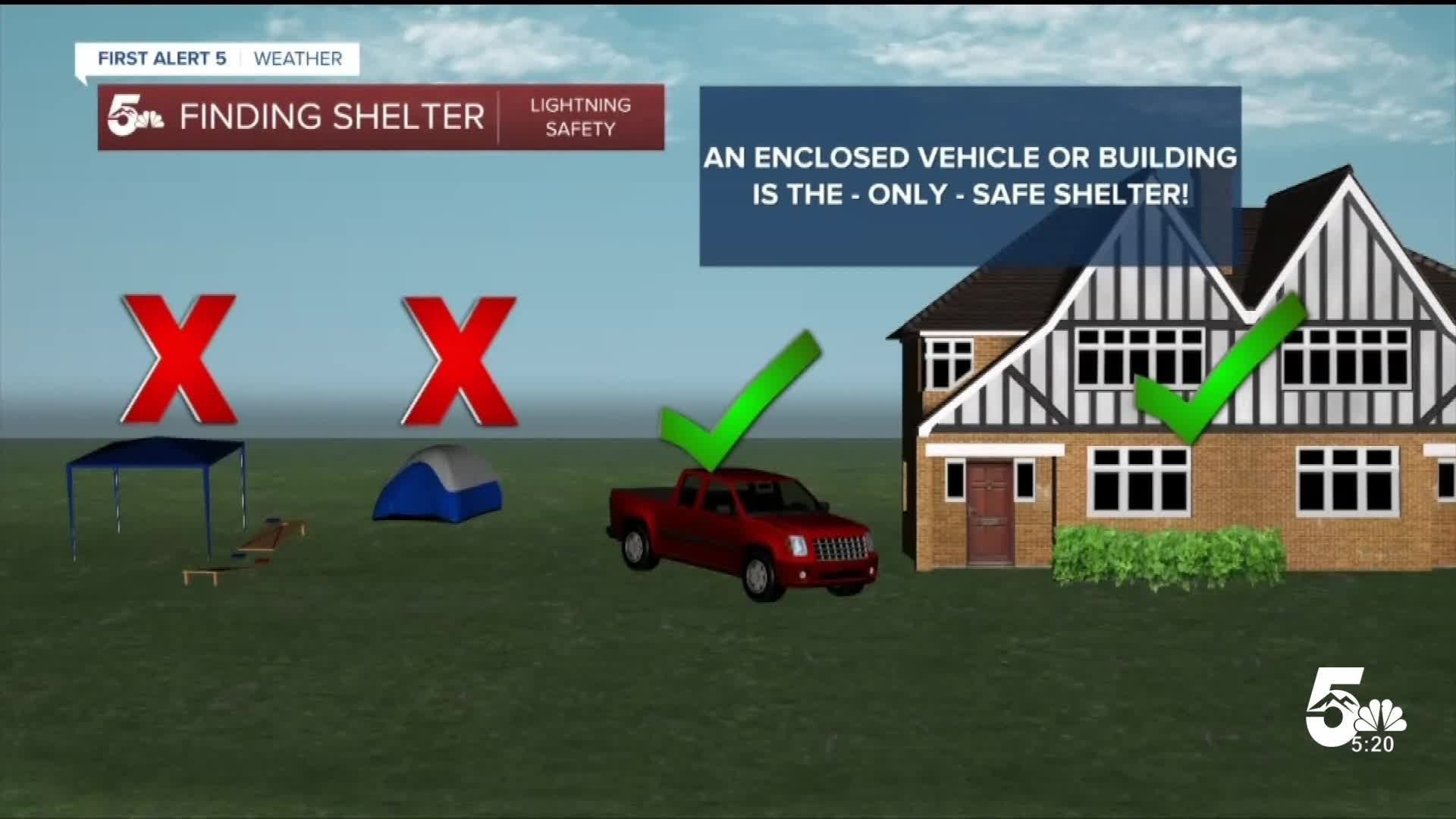
Therefore: sheltering under an awning, overhang, tent, or open structure does not provide protection.
Here's what outdoor enthusiasts in the area need to know:
- There are no safe places outside during a thunderstorm — that includes under awnings or overhangs, in a tent, or in natural caves.
- Always check the forecast before heading out. If storms are possible, plan to reach shelter before they arrive. If a storm is overhead, that's too late to be taking shelter.
- Remember: when thunder roars, go indoors. Lightning can strike many miles from the storm itself.
- If you can hear thunder, you are in danger.
The key to staying safe in the summer is getting a head start on the weather. Thunderstorms thrive on heat from the sun and are most common in the afternoon. Starting and ending outdoor activities early goes a long way toward staying safe.
____
Have a question or story idea you would like the First Alert 5 Weather team to consider? Email: weather@koaa.com
Watch KOAA News5 on your time, anytime with our free streaming app available for your Roku, FireTV, AppleTV and Android TV. Just search KOAA News5, download and start watching.
