


COLORADO SPRINGS, Colo. (KOAA) — Over the last few days, the First Alert 5 team has talked a lot about cloud ceilings. That refers to the height of the clouds above the ground.
Cloud ceilings are important for far more than just a cool visual for flyovers. They can tell you what's coming in the forecast and impact everything from flight plans to the potential for severe weather.
The term "ceiling" comes from aviation, where clouds can act as a literal ceiling, blocking a pilot's view. Simply put, the cloud ceiling is the lowest altitude where clouds cover more than half the sky — the point where the sky becomes mostly cloudy.
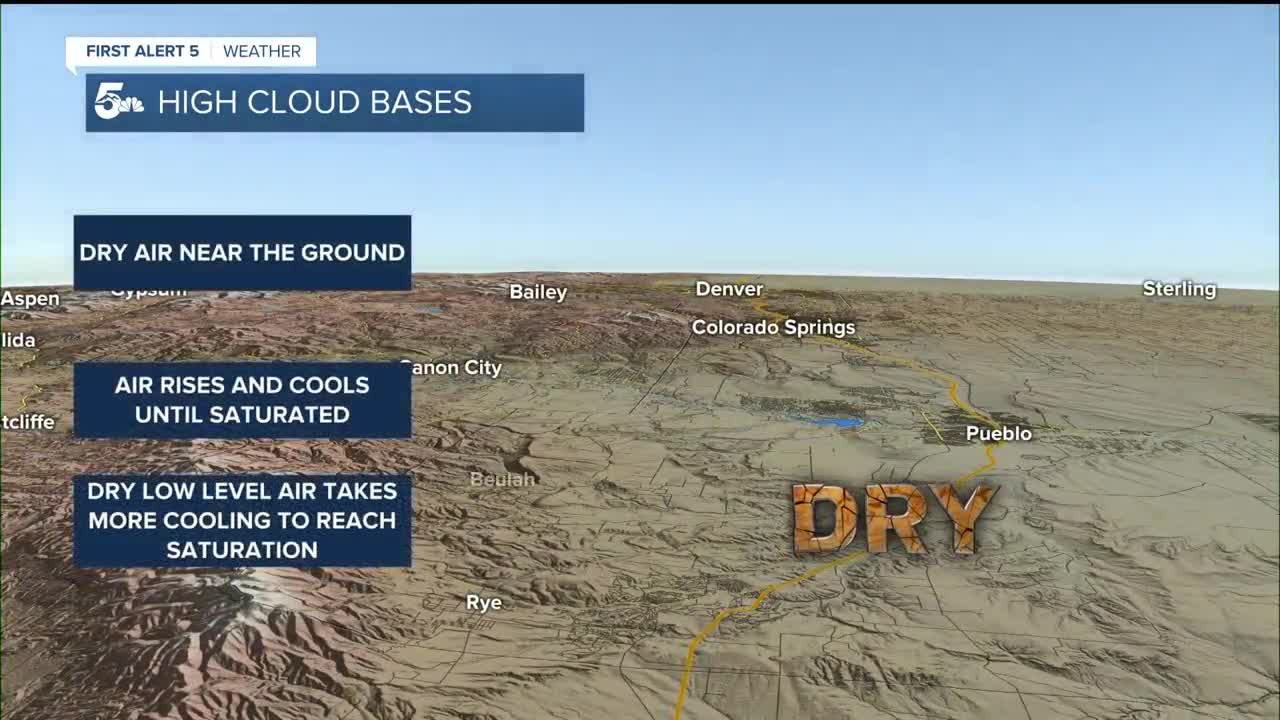
In Colorado, the semi-arid climate means the air near the ground is usually very dry. Because dry air has to rise much higher before it's cool enough to form a cloud, the state is known for having very high cloud bases.
But when moisture returns, cloud ceilings drop — and those low ceilings have major impacts.
At the airport, low cloud ceilings are a major cause of flight delays. When the ceiling drops below 1,000 feet, airports operate under instrument flight rules. This reduces the number of planes that can land and take off, causing backups and delays.
For severe weather, low cloud ceilings also play a critical role. For a tornado to form, the funnel cloud needs to reach the ground. A lower cloud base makes that path much shorter. This is technically measured using the dew point depression: the difference between the dew point ("how much water is in the air?") and the temperature. When the difference is less than 20 degrees, the cloud base tends to be sufficiently low for funnel clouds to reach the ground more easily.
Colorado's typically high cloud bases are why gusty winds often accompany a summer shower. Rain evaporates into the drier air beneath, cooling the air and causing it to then sink like a rock and produce gusty outflow winds. But when clouds are low, there's a better chance for flight delays — and the storms that day (could) pack a bigger punch.
____
Have a question or story idea you would like the First Alert 5 Weather team to consider? Email: weather@koaa.com
Watch KOAA News5 on your time, anytime with our free streaming app available for your Roku, FireTV, AppleTV and Android TV. Just search KOAA News5, download and start watching.
