

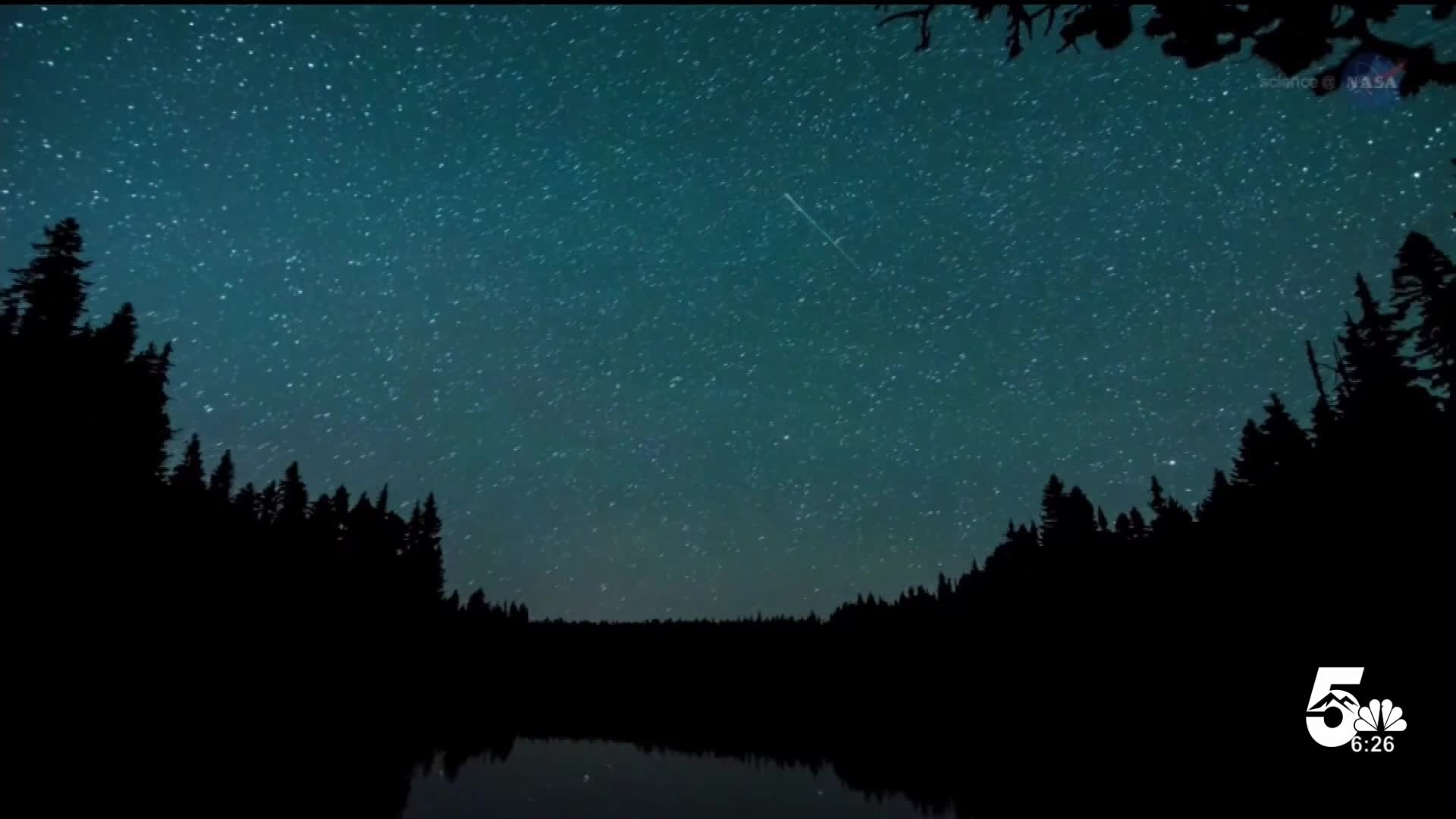

COLORADO SPRINGS, Colo. (KOAA) — Stargazers are in for a treat as the Perseid meteor shower, one of the year's most spectacular celestial displays, peaks tonight under the darkness of a new moon.
The Perseids are caused by the Earth passing through the debris trail of the Comet Swift-Tuttle. These tiny particles, ranging from the size of a grain of sand to the size of a pea, will enter the atmosphere at a blistering 130,000 miles per hour, creating bright streaks of light across the night sky. At that speed, you could get from Colorado Springs to Denver in 2 seconds!
"A meteor shower is a situation where, as everybody knows, the Earth goes around the sun," says Bryan Gibson, Director of Astrophotography for the Colorado Springs Astronomical Society. "As it goes around the sun, it goes in an orbit, but other things orbit around the sun too, and in this case comets... as it's going around, it will get close to the sun, it leaves a lot of particles, breaks apart. And as the earth goes through that path, then we have the showers."
This year's shower is particularly special due to its timing with the new moon, which will provide darker skies and a better viewing experience. While the shower officially peaks in the evening, the best time to see it in Southern Colorado will be in the early morning hours.
"The International Meteor Organization says the best time is between 8 and 10 at night," Gibson explains. "However, in our case, Perseus's area, the Perseus constellation is right at the horizon. It's too low, and 80% of them are going to miss us, plus the light pollution. So that means hold off later at night if you want to try to image it or watch for a longer period of time."
Instead, your best bet is to heat out between 2 a.m. and 5 a.m. For those hoping to get away from city lights, Gibson suggests looking at a Bortle scale map online to find the darkest skies. The southeastern plains will offer some of the best viewing opportunities.
For those wanting to capture the moment, Gibson has some advice. While a good iPhone app can work, a DSLR camera with a wide-angle lens is a better option. He suggests a high ISO setting (around 3200) and an exposure time of 10 to 15 seconds.
"Angle it about 40 to 70 degrees from the radiant," he says, referring to the point in the sky where the meteors appear to originate. "Look up, don't look on the horizon."
But you don't need any special equipment to enjoy the show.
"Don’t bring a lot of flashlights…don’t bring your telescopes," Gibson advises. "Bring your eyes…some warm clothes…and a nice chair you can lay back on…and a friend to be able to share it with."
____
Have a question or story idea you would like the First Alert 5 Weather team to consider? Email: weather@koaa.com
Watch KOAA News5 on your time, anytime with our free streaming app available for your Roku, FireTV, AppleTV and Android TV. Just search KOAA News5, download and start watching.
