



COLORADO SPRINGS, Colo. (KOAA) — While temperatures have taken a tumble in the last week, do not let that fool you. Each day, the sun is currently gaining about 0.4 degrees of maximal height in the sky, also known as the solar zenith angle.
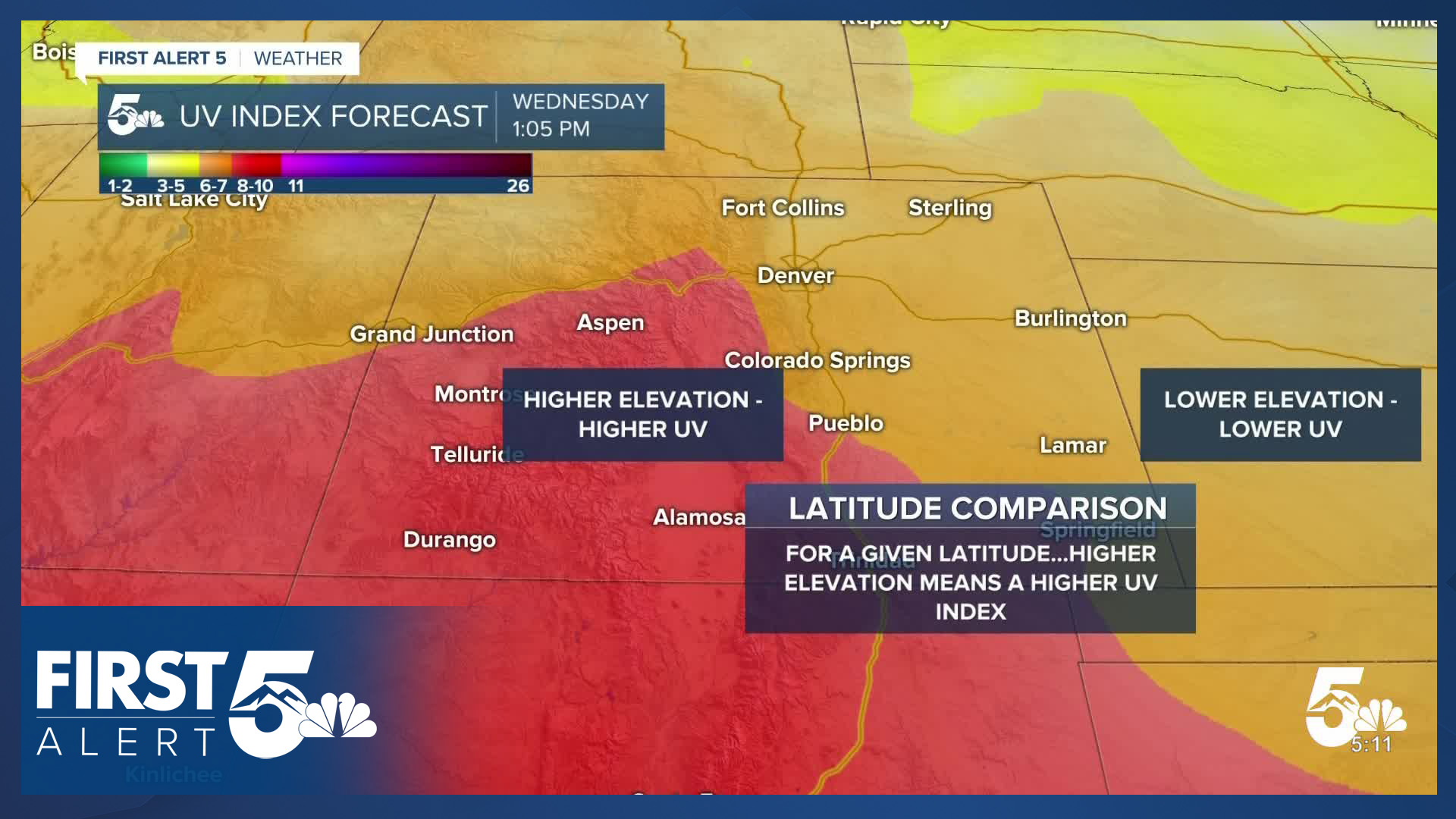
The UV index is a term you hear all the time, but like dew points, it can be difficult to actually understand. Thanks to Colorado’s high elevation, our UV index spikes faster than other areas at our same latitude. That means you can now get a sunburn very quickly.

UV is short for ultraviolet. It is a type of invisible, high-energy light that gets emitted by the sun. While you cannot see it with your eyes, this light damages your skin when it hits it. That damage can cause a sunburn, skin cancer, and various other health issues.
UV light is divided into categories A, B, and C, with each letter corresponding to higher energy - and therefore, more damaging light. The ozone layer high in the atmosphere blocks almost all of the C-type, and most of the A-type will reach the ground year-round. The B-type strongly depends on how high the sun is in the sky, and this is the type we are therefore most concerned about for health risks. That does not mean UV-A is harmless. Type B is the primary type responsible for sunburns.
The more direct the light from the sun, the more type B radiation (wavelengths of 280-320 nm) hits the ground and you. There are two main drivers that determine how direct the light from the sun is.
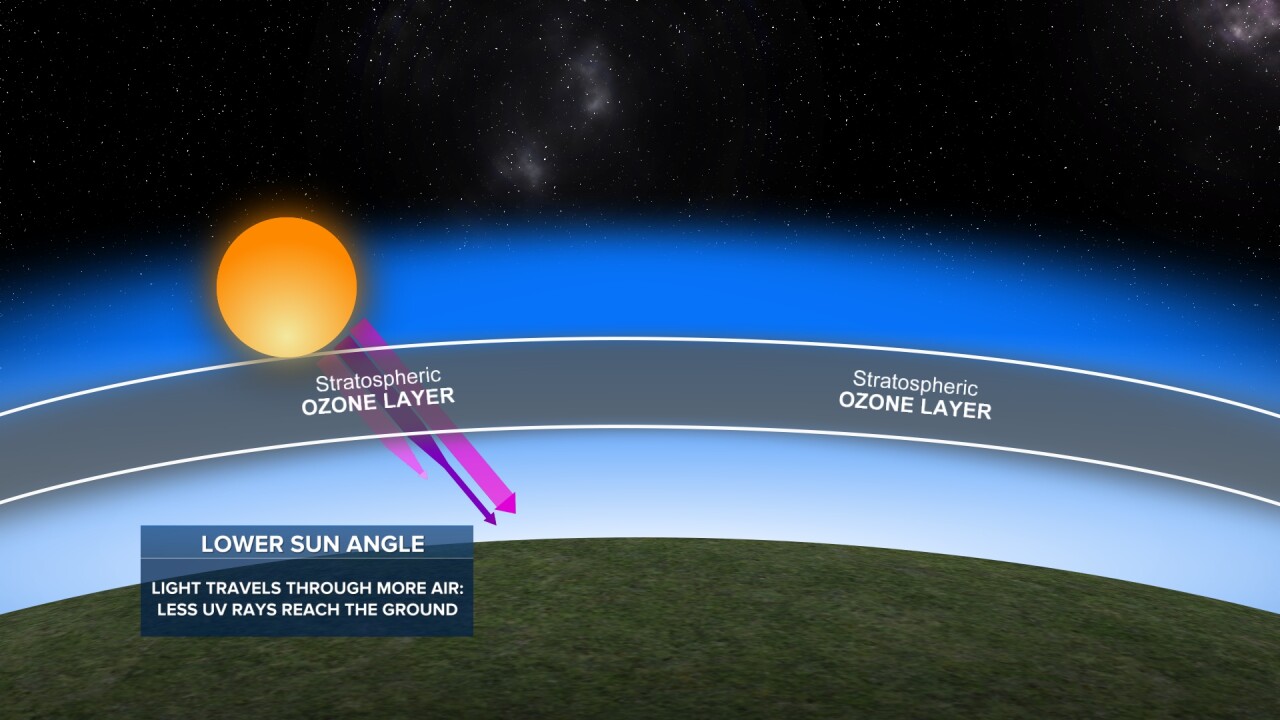
First is how high the sun is in the sky — known as the solar altitude. It's the angle above the horizon to the center of the sun. The closer to straight overhead the sun is (90 degrees), the less distance that light is traveling through the atmosphere to reach you. The gases in the atmosphere absorb short wavelength light like UV-B - with ozone absorbing most UV-B rays, and a few other particulate gasses also playing a role.
So: the more direct the light is, the less atmosphere, which means less of this light gets absorbed and more of it hits the ground (and you).

The second factor is your elevation above sea level, and it is for the same reason. As you gain elevation, there is less atmosphere between you and space, so the scattering and absorption effects of the atmosphere are weaker.
That is why Colorado’s elevation is so critical. Colorado Springs sits more than 6,000 feet above sea level, with Pueblo at around 4,700 feet. In Colorado Springs, the intensity of sunlight is about 20-22 percent stronger than at sea level. In Pueblo, it is about 15 percent stronger. In the mountains, it can be about 50 to 60 percent stronger than at sea level!

The UV index is a standardized way to measure how quickly the sun will damage your skin. The scale ranges from 0 to 11-or- higher. If the UV index doubles, the time for your skin to burn chops in half. At a UV index between 8 and 10, the burn time for fair skin is only about 10 to 25 minutes.
The index includes the effects of altitude and cloud cover. Altitude increases UV exposure, while cloud cover decreases it, but does not eliminate it. It gets calculated by estimating the amounts of UV-A, B, and C light hitting a given location, and multiplying each by a weight factor. C is most harmful - and has the most weight, followed by B, followed by A. This all gets added together and converted into the index you see.
The important things to know about UV index are that it is not tied to temperatures, the risk isn't higher in Colorado because you're "closer to the sun" - it's because of the lower air pressure - and the UV index can be significant on a cloudy day. But - on a clear day, the UV index in Colorado Springs and Pueblo is now above an eight. We are now eight days away from a solar zenith (peak solar angle) above 60 degrees. We are not far from seeing peaks in the UVI 9 range.
What this means for you: if you are hiking and the temperature is 40 degrees up in the mountains, your skin is being blasted in the way it would if you were on vacation in the Bahamas.
Even though it does not feel hot, you should be applying SPF 30 or greater sunscreen regularly now if you are going outside for more than 10 minutes in the middle of the day.
____
Have a question or story idea you would like the First Alert 5 Weather team to consider? Email: weather@koaa.com
Watch KOAA News5 on your time, anytime with our free streaming app available for your Roku, FireTV, AppleTV and Android TV. Just search KOAA News5, download and start watching.
