

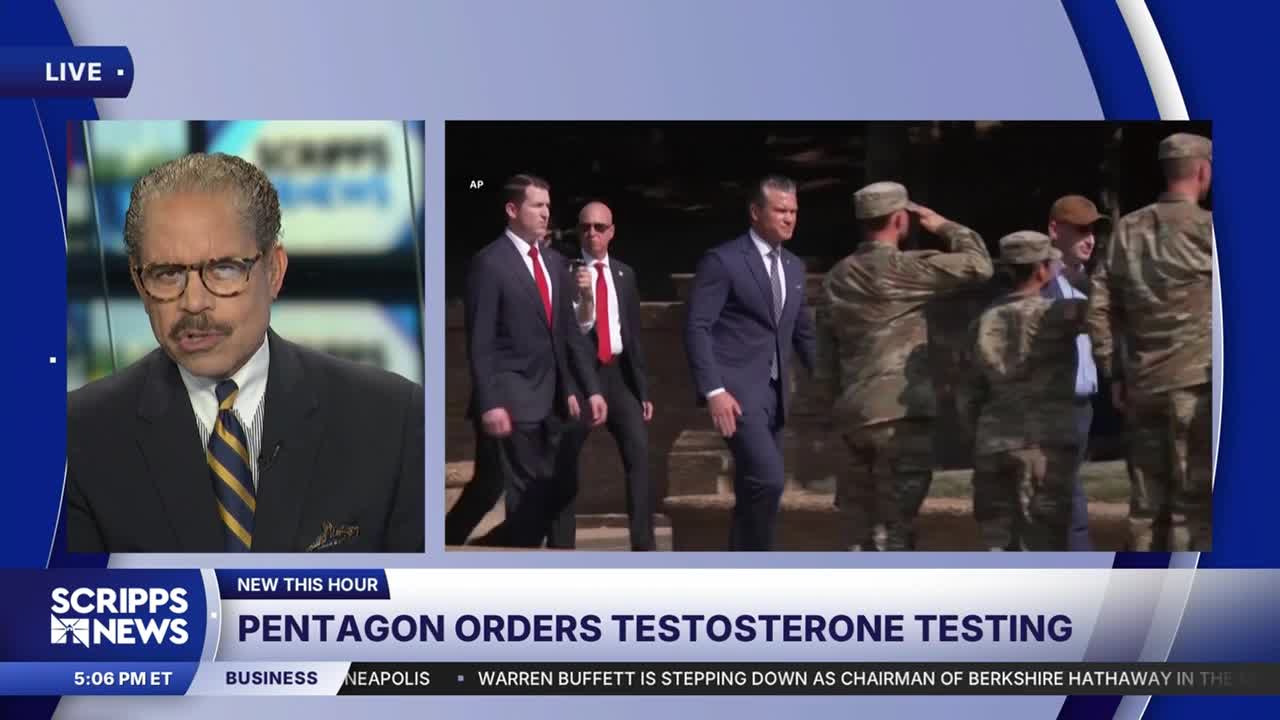


The Department of Defense released guidance this week requiring military service members older than 30 to undergo testosterone screenings, which officials say are “meant to ensure that service members remain at peak performance levels throughout their careers.”
The screenings will be part of routine physical exams.
Service members with symptoms of low testosterone, such as brain fog or low libido, will be screened twice to determine whether their levels fall between 300 and 600 nanograms per deciliter, or ng/dL.
Service members with normal total testosterone levels who still show symptoms will have their free testosterone tested. Some men can experience symptoms of low testosterone despite having normal total testosterone levels if their free testosterone is low.
RELATED STORY | Medicare will start covering weight-loss drugs on July 1 for the first time
Testosterone replacement therapy, or TRT, will be among the treatments offered. The Pentagon said other treatments also could be available to help boost testosterone levels.
“While we invest heavily in our weapon systems, platforms and gear, our most decisive tactical advantage will always be the individual warfighter,” Defense Secretary Pete Hegseth said. “We have a sacred duty to maintain that advantage, which is why we must constantly look for new ways to optimize your performance, your resilience and your long-term health.”
The Pentagon’s guidance says male service members younger than 30 will be screened upon request or when clinical indicators are identified by a health care provider.
What is a normal testosterone level?
Most men reach peak testosterone levels in their late teens and 20s, but levels generally begin to decline around age 30. According to the Cleveland Clinic, the typical testosterone level for men ages 30 to 34 ranges from 359 to 498 ng/dL.
The Cleveland Clinic says low testosterone can cause symptoms including low sex drive, brain fog and loss of muscle mass.
The Food and Drug Administration does not approve testosterone replacement therapy for men with low testosterone unless it is linked to an associated medical condition.
RELATED STORY | America's supplement habit: 80 percent of adults are taking at least one
The guidance says service members without symptoms will not undergo blood testing for low testosterone.
Risks of TRT
Although testosterone replacement therapy has been promoted as a way to improve men’s health, it also carries risks. Those risks can include infertility, acne, sleep apnea and increased blood thickness.
