

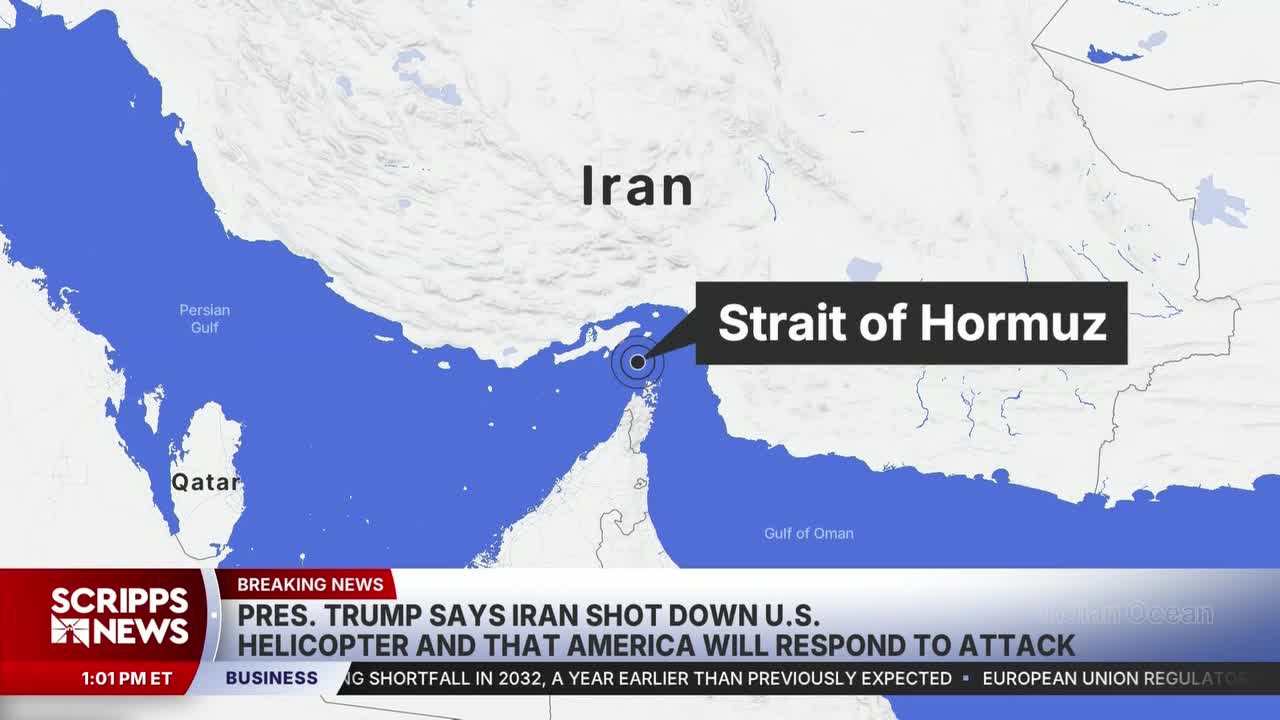


President Donald Trump said Tuesday that Iran was responsible for downing an American military helicopter near the Strait of Hormuz and that the U.S. “must” respond to the attack.
The president made the comment in a social media post after a drone boat rescued the crew of the Apache attack helicopter that crashed near the strategic waterway, which Iran has effectively closed during its war with the U.S. and Israel.
It was the first known drone rescue at sea by the U.S. military, said Capt. Tim Hawkins, a spokesman for U.S. Central Command. He said the unmanned boat located the two aviators and brought them to shore after they spent about two hours in the water.
Since the U.S. and Israel began striking Iran on Feb. 28, the war has shaken the global economy, driven up energy prices around the world and made many basics, including food, more expensive. Officials have been unable to turn the April ceasefire into a deal to permanently end the conflict, particularly as Israel intensifies and expands its military campaign in Lebanon against the Iranian-backed militia Hezbollah.
Trump, speaking to journalists at John F. Kennedy International Airport in New York after watching the NBA Finals on Monday night, acknowledged the crash.
RELATED STORY | Trump demands Israel and Iran stand down as new hostilities threaten ceasefire
“The pilots are fine. Yeah,” Trump said. “Nobody injured. We are going to issue a report tomorrow. But the pilots are fine.”
The New York Times first reported that a U.S. Army Apache attack helicopter went down near the strait in unclear circumstances. The U.S. military's Central Command and the Defense Department did not immediately respond to requests for comment from The Associated Press.
Apache helicopters have been a key asset for the American military as it enforces a blockade on Iranian crude oil shipments and tankers, seeking to pressure Tehran into reaching a deal. The helicopters also have been used by the United Arab Emirates to shoot down Iranian drones during the Iran war.
Trump insists an Iran deal is coming
Trump also expressed renewed optimism over negotiations with Iran.
“We have a good chance” of signing a deal in “two or three days," Trump said. But he didn’t provide any details on why there was reason for new optimism. Trump has repeatedly predicted that a deal is near over the two months since the U.S. and Iran agreed to an initial ceasefire.
“We’re very close to having a very, very good, strong, powerful deal,” the president said. “If we go and bomb — which we could do very easily if we want, and we spend another two or three weeks bombing — they’ll have nothing left whatsoever. But you won’t have the strait open for months.”
He added: “If we do the bombing, you know, a lot of people are going to be killed. Who wants to do that? I don’t.”
Mediators, led predominantly by Pakistan, have been trying for weeks to get a deal across the line. However, both Iran and the U.S. have taken hard-line positions.
The U.S. wants to see Iran give up its stockpile of highly enriched uranium, which is believed still to be entombed in the country after American airstrikes in the 12-day war in 2025. But Iran is refusing that and demanding relief from sanctions. It also wants the release of frozen assets even before a final agreement is in place, something rejected by Trump.
Before Trump’s comments on negotiations, Iranian parliament speaker Mohammad Bagher Qalibaf said Monday that Trump’s remarks so far on a possible deal “contradicted the agreed-upon sections, showing that (the U.S. is) neither seeking a ceasefire nor dialogue.”
The continued fighting between Israel and Hezbollah remains a major Iranian priority as well. Lebanon’s army chief, Gen. Rodolphe Haykal, traveled to Pakistan on Tuesday. There, he met Pakistan’s army chief, Field Marshal Asim Munir, who has been a key figure in the Iran-U.S. talks.
RELATED STORY | Iran denounces US strikes as a sign of bad faith, with impact on peace talks unclear
Haykal's visit comes as Lebanon's government takes an increasingly hard line on Hezbollah, but remains unable to disarm the powerful militia. Hezbollah thanked Iran on Tuesday for attacking Israel “in defense of our Lebanese people,” suggesting that the Lebanese government should take this opportunity to improve relations with Tehran.
Israel issues warning for Tyre, Lebanon
Meanwhile Tuesday, the Israeli military issued an evacuation warning for Lebanon’s southern port city of Tyre, including the Christian quarter, which has so far been spared in the destructive airstrikes on the port city.
Last week, Israel warned the Christian neighborhoods in Tyre that it believed Hezbollah members were among them. Many Lebanese Shiite Muslims fled to those areas as Israeli strikes hammered the Mediterranean coastal area over the past two weeks.
After last week’s warning, the Lebanese army deployed to the Christian district of Tyre in an effort to prevent Israeli attacks there and to show that Hezbollah has no armed presence in the area. But Avichay Adraee, the Israeli military’s Arabic-language spokesperson, posted on X on Monday that the Israeli military “will have to act against their terrorist activities in the neighborhood soon.”
