



President Trump is renewing his threats to target Iran's civilian infrastructure, including power plants and bridges, if Iran does not allow vessels to pass through the Strait of Hormuz.
In a social media post over the weekend, President Trump said "Tuesday will be power Plant Day and bridge day. All wrapped up in one in Iran. There will be nothing like it."
On Monday a journalist asked President Trump if there were any targets that would be off limits if the U.S. undertakes more strikes against Iran.
"We have a plan because of the power of our military," President Trump said. "Every bridge in Iran will be decimated by 12 o'clock tomorrow night. Every power plant in Iran will be out of business, burning, exploding and never to be used again. I mean, complete demolition, by 12 o'clock. And it will happen over a period of four hours if we want it to. We don't want that to happen. We may even get involved with helping them rebuild their nation. And you know what? If that's the case, the last thing we want to do is start with power plants, which are among the most expensive thing, and bridges."
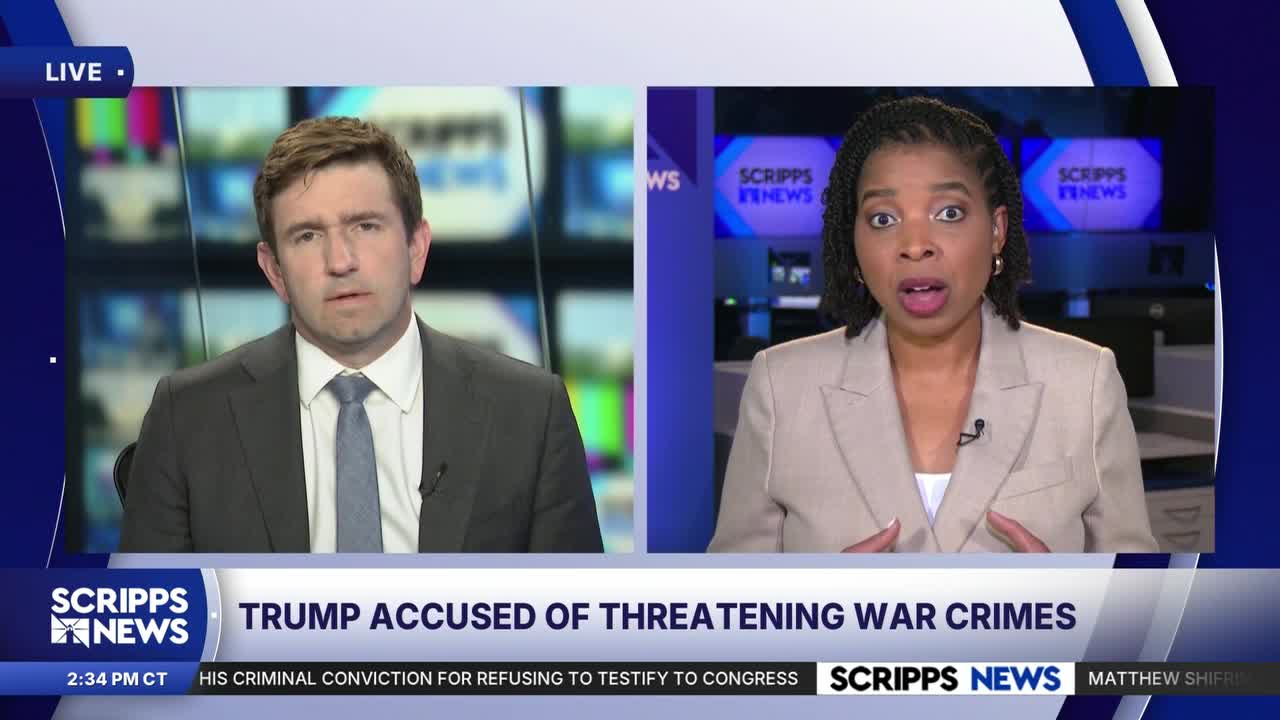
International law experts are concerned about the president's choice of targets, and his choice of words. They have led to allegations that President Trump is threatening to commit war crimes.
Experts are also concerned that Iran may be committing war crimes as well. They pointed out the fact that Iran has targeted hotels, for example, where civilians are staying.
RELATED NEWS | Trump addresses reporters after ominous threat to strike Iran's infrastructure
U.S. officials may face legal backlash if the country goes forward with strikes against civilian infrastructure.
The United States is party to international laws that seek to prevent war crimes. The Department of Justice may press charges against officials that have broken those laws.
It is not clear whether President Trump himself may face such charges, due to a Supreme Court decision from 2024 which held that presidents retain immunity for official acts.
But legal experts say other members of the administration and armed forces may be more liable.
Cody Corliss, a former war crimes prosecutor for the United Nations, is one of more than 100 international experts who signed a letter expressing concern over potential war crimes in Iran.
Scripps News' Ava-joye Burnett: Could members of the armed services face prosecution for carrying out orders from their higher-ups?
Cody Corliss: Potentially, yes. And if you probably recall that certain members of Congress said "you should not carry out an unlawful order." Remember Secretary of Defense Hegseth was very angry, for example, at Senator Kelly when he said that. But that's truth. Soldiers should not carry out unlawful orders, orders that are manifestly unlawful or orders that are war crimes. Choosing to carry out a manifestly unlawful order can expose one to criminal penalties.
