

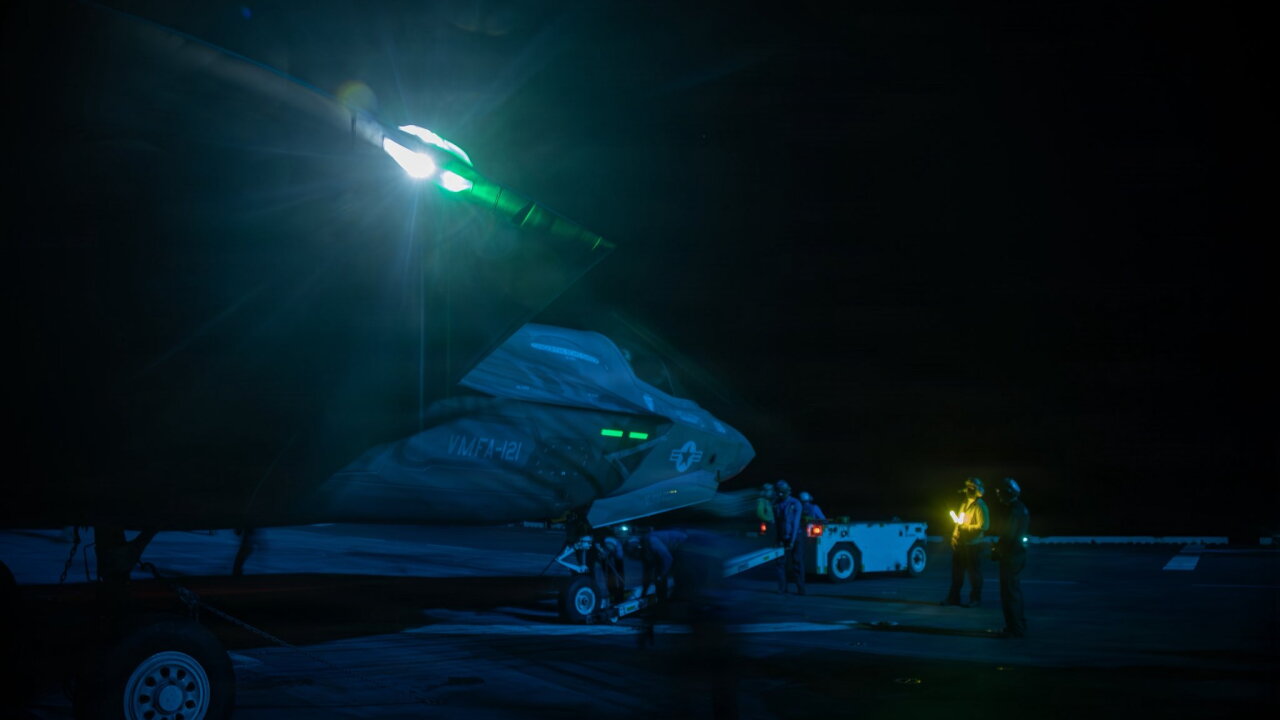


Weeks before Marines with the 31st Marine Expeditionary Unit (MEU) found themselves flying combat missions over the Middle East and boarding ships to enforce a naval blockade against Iran, they were conducting joint exercises with Japanese forces in the western Pacific.
The unit, the Marine Corps' only permanently forward-deployed expeditionary force, was dispatched early in 2026 on a short-notice mission in the South China Sea, and then on to participation in Exercise Iron Fist — an annual bilateral training event bringing together U.S. Marines and sailors alongside elements of the Japanese Ground Self-Defense (GSD) to strengthen interoperability and enhance combined amphibious capabilities.
In early March, the MEU received orders to sail for the Middle East as tensions with Iran escalated into open conflict.
What followed was a rare opportunity to employ many of the capabilities Marines spend years training for but seldom use in combat, former commander Col. Chris Niedziocha said Wednesday, sharing insights from the recent operation with a select group of reporters including Scripps News at the Pentagon Wednesday.
"If I was going to give you one thing to take away from this, it's how flexible the Marine Expeditionary Units and Amphibious Ready Groups are," Niedziocha said.
The deployment became part of Operation Epic Fury (OEF), the U.S. military campaign against Iran that evolved from an initial strike operation into a months-long effort to secure shipping lanes, protect maritime traffic and enforce a blockade of Iranian ports. According to Niedziocha, the 31st MEU flew roughly 1,600 combat and combat-support flight hours, participated in five days of strikes into Iran and spent weeks conducting combat air patrols and maritime security operations around the Strait of Hormuz.
RELATED STORY | Iran war has cost the US more than $38B, budget office says
Life at sea — and at war
For Marines who had spent months preparing for a possible Pacific contingency, the deployment became a crash course in the realities of a modern conflict: long logistics lines, intensive munitions consumption, constant surveillance by enemy drones and rapidly evolving technology.
Some of their most consequential work occurred at sea.
Niedziocha said the unit conducted four maritime interdiction operations during their deployment. Three culminated in Marines boarding vessels; in one case, the Marines seized a ship and maintained custody of it for roughly two weeks before repatriating the crew.
The boardings formed part of a broader U.S. maritime pressure campaign. According to an inspector general report released Tuesday, U.S. forces enforcing the blockade redirected more than 140 compliant vessels, disabled 10 non-compliant ships and conducted additional interdiction operations targeting suspected sanctions violators and smuggling networks.
Before Marines ever set foot on a vessel, Niedziocha said, the MEU relied heavily on drones and intelligence assets to establish patterns of activity and maintain surveillance.
"We believed there was a good chance that we were going to do boardings," he said. "I felt manned, trained and equipped to do the VBSS [vehicle, board, search and seizure]."
The deployment also illustrated the logistical strain created by sustained military operations in the region, coinciding with scrutiny of conditions aboard U.S. vessels operating in the region. Earlier this year, reports from sailors aboard the USS Abraham Lincoln highlighted complaints about food shortages and quality-of-life challenges during extended operations.
Niedziocha pushed back on suggestions that his Marines experienced similar conditions.
While acknowledging that food aboard ships can become repetitive during long deployments, he said Marines and sailors under his command never fell below the Navy requirement of 2,400 calories per day.
"Can food on ships sometimes be monotonous? Yeah, absolutely," Niedziocha said. "But at no point did it ever reach the level that I think was portrayed."
RELATED STORY | Trump says Iran War will end after the midterm elections
The costs of sustaining the fight
According to Niedziocha, among the biggest leadership challenges overseeing the OEF deployment was managing uncertainty during a mission whose duration and tactics changed repeatedly as the conflict evolved.
Before entering the Middle East, one ship in the Marine task force temporarily remained behind to load additional munitions, spare parts and personnel tailored to the mission, before later catching up with the rest of the formation. Niedziocha described a constant effort to keep logistics aligned with rapidly changing operational demands.
His experience mirrors concerns now emerging in government reviews of the war.
A Congressional Budget Office analysis of the Iran war released Tuesday estimated the conflict has cost the Pentagon roughly $38.1 billion through Aug. 1. More than half of that total, $21.7 billion, stemmed from replacing expended munitions, including $13.1 billion worth of missile-defense interceptors used against Iranian missiles and drones.
Meanwhile the inspector general report concluded that wartime consumption had created "strategic inventory shortfalls" and exposed industrial-base bottlenecks in munitions production. Officials cited persistent constraints in the manufacture of solid rocket motors, explosives and propellants and warned that expanding production would require "significant lead time."
Niedziocha suggested some of those lessons were visible from the field — particularly the rapid push to utilize lower-cost defensive systems to counter Iranian fire, as expensive interceptors were rapidly consumed in the early days of the conflict.
"You still need the very high-end systems," he said. "But you need a lot of capable systems, not necessarily at that level."
RELATED STORY | Ukraine to share drone-hunting tactics with Gulf nations facing Iranian attacks
Drones, AI and the future of warfare
The deployment also exposed Marines to many of the technologies military planners believe could shape future wars.
Niedziocha described Iranian forces as innovative users of drones and surveillance systems, saying American forces routinely operated under observation from Iranian unmanned aircraft and intelligence assets. He compared the resulting adaptation cycle to the "cat and mouse" game that emerged during the Iraq and Afghanistan wars.
“You always want more,” the colonel said of his unit’s ability to respond to such threats. “Nobody's ever said ‘I'm good,’ but in terms of what we had to do, I never felt like I had a real capability gap there.”
The conflict also helped accelerate the military's adoption of artificial intelligence.
Commanders working in the Middle East routinely received AI-generated summaries based on operational reporting, Niedziocha noted, praising the Pentagon's Maven analytical system for dramatically reducing the manpower required for intelligence analysis and staff work.
"What took 100 people 10 hours would take 10 people one hour," he said.
For Marine Corps leaders, the deployment represented not only a response to a regional crisis but also served as a test of concepts the service has spent years developing as it prepares for future conflicts in the Pacific.
Niedziocha said Marines established expeditionary positions ashore, employed sensing capabilities from expeditionary advanced bases and used forward arming and refueling points to extend the reach of aircraft operating in theater.
Those efforts also highlighted the importance of host-nation support — particularly in a conflict that has reshaped longstanding diplomatic understandings in the region.
Niedziocha pointed specifically to the importance of U.S. coordination with the United Arab Emirates, where American forces relied on host-nation cooperation for portions of their mission, echoing findings from the inspector general report, which highlighted how U.S. operations in the region depended heavily on host-nation access, basing agreements and logistics support across the Gulf.
"You do everything through, with and by your allies and partners," Niedziocha said. "You can't want it more than they do."
The 31st MEU ultimately handed off responsibilities to the 11th MEU before returning to Okinawa on July 22, where Marines immediately began preparing for the unit's next deployment cycle.
For Niedziocha, the experience demonstrated the value of keeping expeditionary forces forward-positioned. For Pentagon planners, it could also provide an early glimpse into what a larger future conflict might demand.
That's especially true today, Tuesday’s CBO report warned, as rebuilding stocks of missile-defense interceptors consumed during the conflict is estimated to take at least five years, and as the United States now has fewer interceptors available should a crisis emerge elsewhere, including in the Indo-Pacific.
"The MEU is designed for crisis response," Niedziocha said. "The team adapted, never lost sight of the mission, and performed flawlessly under the most dynamic circumstances."
