

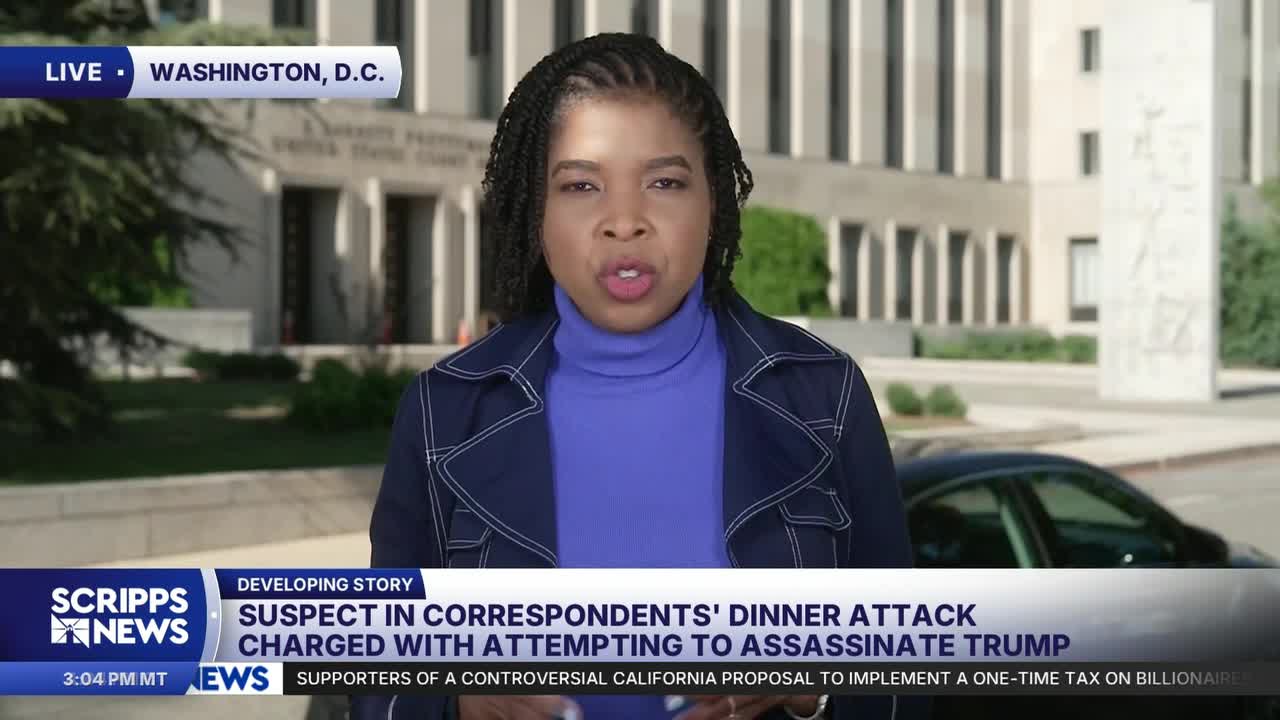


The alleged gunman who opened fire at the White House Correspondents' dinner on Saturday has been charged with attempted assassination of President Donald Trump.
An affidavit released Monday, containing sworn testimony from an FBI agent, alleges 31-year-old Cole Thoms Allen of Torrance, California, reserved a room at the Washington Hilton hotel on April 6, then traveled by train via Chicago to Washington. He checked in the day before the White House Correspondents' Dinner, which took place on Saturday, April 25.
According to the affidavit, Allen sent a message to family members explaining his intentions and justification. In it, he nicknames himself "Friendly Federal Assassin."
Allen did not speak during his court appearance on Monday. Prosecutors successfully argued to keep him detained pending additional hearings, including a detention hearing that will take place on Thursday.
RELATED STORY | Alleged manifesto reveals suspect targeted Trump officials at Correspondents' Dinner
Authorities apprehended Allen before he could enter the ballroom where more than 2,000 guests, including President Trump and many cabinet members in the line of succession were gathered.
One officer was shot in their bullet-resistant vest amid the chaos but is expected to recover. Inside the ballroom, attendees heard shots before Secret Service agents stormed the stage to protect Trump and others.
Scripps News learned that Allen sprinted through a security checkpoint and left behind a manifesto expressing a desire to target top Trump administration officials. Family members told investigators Allen had a tendency to make radical statements.
White House dealing with latest attempt on Trump's life
Acting Attorney General Todd Blanche said it appears Allen traveled by train from Los Angeles to Chicago and then to Washington, D.C., checking into the event's hotel two days prior. Along with attempted assassination of the president, Allen has also been charged with one count of discharging a firearms during a violent crime and one count of transportation of a firearm in interstate commerce.
RELATED STORY | 'I'll never forget': Trump dinner performer details mayhem as shooting unfolded
On Capitol Hill, lawmakers immediately began questioning security. Republican Sen. Chuck Grassley said in a statement on social media that he plans to set up a briefing with Secret Service leadership regarding security protocols and related law enforcement activities. Other questions raised include whether the magnetometers used for the event were properly placed and whether the perimeter was truly secure.
