

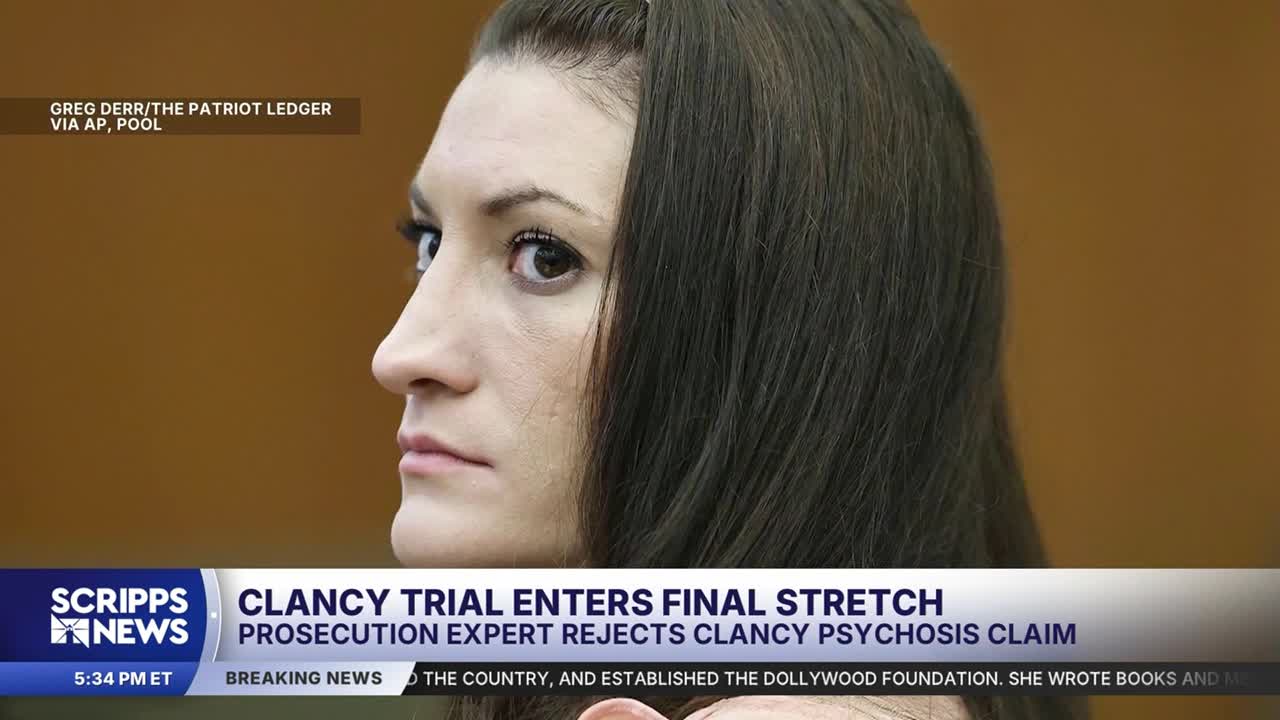


The prosecution's final witnesses in the Lindsay Clancy murder trial Tuesday attempted to cast doubt on claims that she was suffering from postpartum psychosis and that a voice ordered her to kill her three young children.
Dr. Gregory Saathoff, a forensic psychiatrist at the University of Virginia and a senior psychiatrist for the FBI's Behavioral Analysis Unit, said Clancy told him during two video interviews earlier this year that she began hearing a voice on Jan. 24, 2023, after getting a call from her then-husband, Patrick Clancy, while he was out running errands. Saathoff said Lindsay Clancy told him the voice did not stop until she had strangled Callan, Dawson and Cora Clancy in the basement of their Massachusetts home.
RELATED STORY | Judge denies motion for mistrial in Lindsay Clancy case after dispute over religious testimony
Clancy's mental health is a key issue at her trial. Defense attorney Kevin Reddington does not dispute that Clancy, 36, killed the children but says she shouldn’t be held criminally responsible because she had postpartum psychosis, a rare mental illness linked to the stress, sleep deprivation and hormonal changes that follow childbirth. Clancy then also tried to kill herself.
She has pleaded not guilty to murder charges.
EDITOR’S NOTE: This story includes discussion of suicide. If you or someone you know needs help, the national suicide and crisis lifeline in the U.S. is available by calling or texting 988.
Prosecution's experts say they don't believe Clancy heard a voice
Saathoff, who has treated thousands of patients with psychosis, said he found Clancy's account unconvincing.
He found it unusual that Clancy said the voice stopped once she was done strangling the children, that the voice was constant rather than intermittent and that she never previously reported hearing a voice to her medical providers. She also gave a different timeline to other evaluators about when she first heard the voice that day, he said.
“Committing the act is not curative of the voice,” Saathoff said of the voice stopping abruptly. “I’ve not ever seen that.”
Earlier Tuesday, forensic psychologist Kirk Heilbrun told jurors he also didn’t believe Clancy’s claim that she experienced what mental health providers call a command hallucination. Instead, he concluded she took her children's lives so they wouldn’t “suffer” after she killed herself.
“Everything I did as part of this evaluation, the evidence much more strongly, in my opinion, supported the second explanation, which was the serious suicide attempt accompanied by killing the children out of love,” Heilbrun said.
Defense raises doubts about psychologist assessment
Clancy’s lawyer, Kevin Reddington, challenged Heilbrun about his conclusions, including whether he had made up his mind before he interviewed Clancy this year at the state hospital in Tewksbury where she stays.
“Would you agree with me, sir, that before you met with Lindsay in Tewksbury, you pretty much had an idea this woman was a beast, killed her three kids, didn’t you?” Reddington asked.
Heilbrun disagreed with that characterization, adding that he “did his best to have an open mind.”
Reddington also highlighted earlier testimony from Clancy’s friends and family, including Patrick Clancy, that she was “an incredible mother taking care of her kids.”
“Bringing her life experience, which you’ve testified yesterday, that she never had any abuse in her life, was raised by a loving mother and father, good student, hard worker, great mother, good friend, wonderful wife,” Reddington said. “She then randomly decides to kill her children by strangling them. Those are the facts we’re dealing with?”
Clancy was suffering from a mental disease
Heilbrun told jurors that Clancy had bipolar disorder and depression, conditions made worse by her insomnia and adverse reactions to prescribed medications. But he concluded that Clancy was “criminally responsible” for the killings.
“She retained an awareness of the illegality of killing others, including her children,” he said. “Her moral awareness of this killing was influenced by her strong desire to die and, if she was dead, not to leave her children behind.”
Prosecutors say the former labor and delivery nurse planned the killings and contrived to get her husband out of the house by sending him to pick up medicine for one of their children and dinner for the family.
Heilbrun testified that Clancy's actions while Patrick Clancy was out involved a set of choices that she had to make and ran counter to her claim that they involved no decision-making on her part.
“This is difficult but important to say. There are many ongoing decisions that have to be made to accomplish a killing like this in 18 to 20 minutes,” Heilbrun said. “For example, why the basement? Who among the children goes first? What do you say to the kids to keep them from panicking?”
Saathoff is expected to resume his testimony Wednesday. That will be followed by closing arguments, possibly as early as Thursday.
