

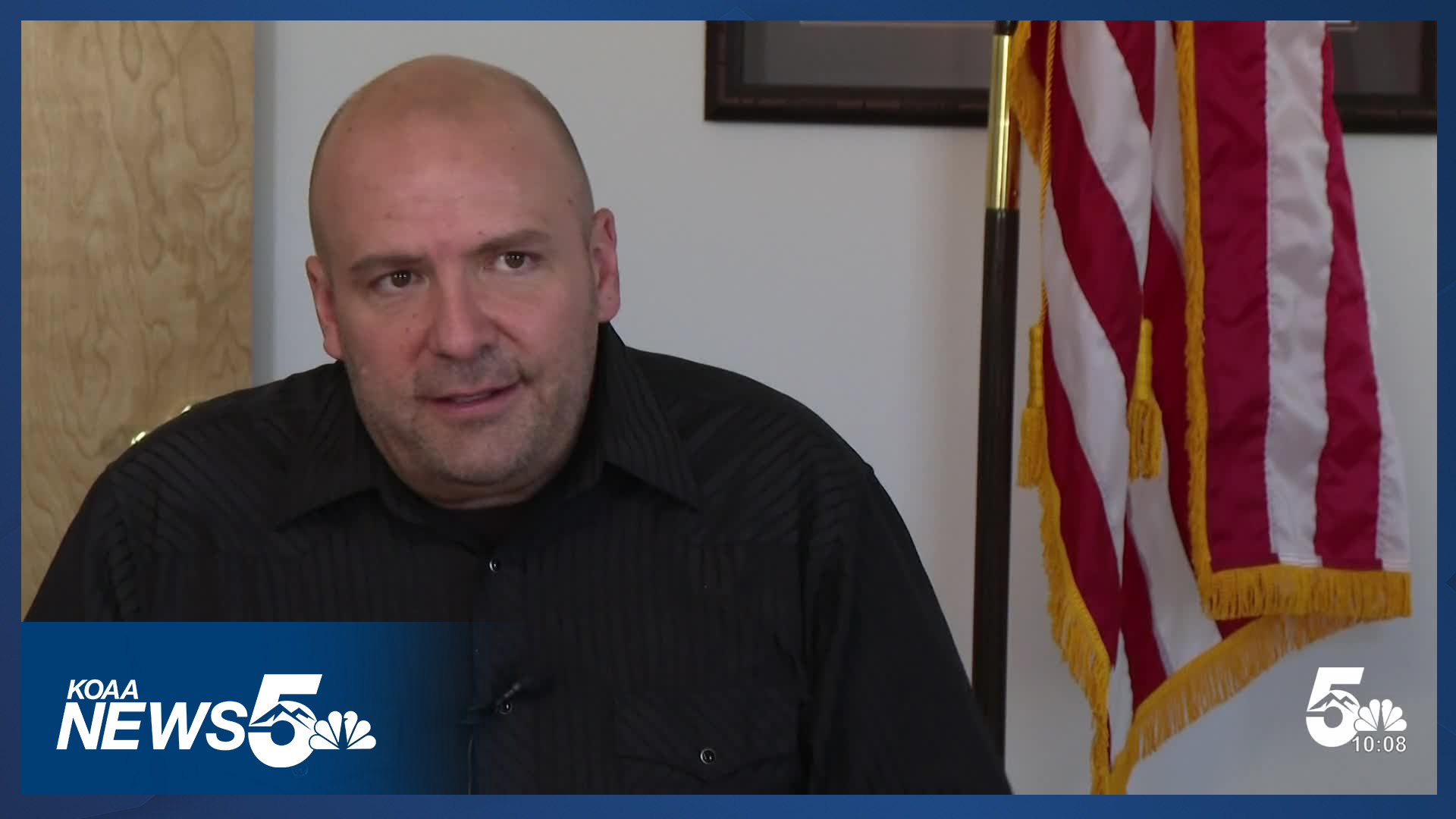


CRIPPLE CREEK — Major Stephen Ramsbottom was injured on the second day of Operation Epic Fury when his unit in Kuwait was hit by an Iranian drone attack.
25 servicemembers were wounded in that attack and six were killed. It’s the deadliest Iranian attack on US troops since the war began Feb. 28.
Last week, Teller County officials and community members gathered to honor Maj. Ramsbottom after his long return journey home to Colorado. He lives in the Cripple Creek area with his wife and children.
An Army engineer and reservist, he was part of the 103rd Sustainment Command and shipped off to Port Shuaiba, Kuwait last September.
In a one-on-one interview with KOAA after Teller County commissioners honored his service and sacrifice, Ramsbottom detailed the March 1 attack and the resulting chaos and broken down systems as he sought evacuation and a return home.
THE MARCH 1 DRONE ATTACK
After US and Israeli attacks commenced on Iran on Feb. 28, Maj. Ramsbottom said there wasn’t a clear picture of what danger they faced in Kuwait.
He said his Army reserve unit was one of two in the region, with the other focused on warfighting while his was more logistical with ensuring everyone had supplies and anything they’d need.
“The war just grew bigger than we had initially anticipated,” Ramsbottom said. “We knew we were in danger. But pretty much everywhere in Kuwait was in danger at that moment.”
On Feb. 28, the first day of the war, Ramsbottom said the majority of the unit was in a secure bunker as Iran fired ballistic missiles in retaliation. At that point, only about four or five people were still above ground monitoring things, he said.
On March 1, he said close to 50 or 60 people were back to work at their desks in the command post.
“We would go to the bunkers when the active threat was there, but this threat didn't get detected, so we didn't go to the bunkers,” he said. “We didn't. We were just there working at our desks.”
The attack, from an Iranian drone, slipped through any detections. It struck their building in the middle of the day. The unit was working with protective gear, but many, like Ramsbottom, weren’t wearing helmets.
“I was turned away from the center of the building and I had a big old monitor in between me and where the blast was,” said Ramsbottom. “The blast, I think some shrapnel–like metal, bad shrapnel–hit my monitor and just busted it and shattered it.”
“And then all my wounds were actually from the monitor glass going into my head, which was good because it didn't crack the skull or anything like that,” he said. “I got stitched up and it's healed pretty well. I had effects of a concussion for a few weeks and those were my wounds. Other people were much worse.”
Six of Ramsbottoms’s unit were killed and 25 injured in that attack. It remains the deadliest Iranian attack on US forces since the war began.
His NCO (non-commissioned officer) was also shielded by a “giant TV” and came over to help Ramsbottom to his feet in the dizzying aftermath.
Ramsbottom said he could feel something sticking out of his head and tried pulling it, but it wouldn’t come out.
He then put his helmet on in case there was another attack.
“I put my helmet on and I think it helped slide the–whatever it was sticking out of my head–farther down my neck,” he said.
The two then began trying to help everyone else in the unit in what he described as a “mass casualty situation,” but he said they were overwhelmed.
We could have been a medical unit and we wouldn't have had enough doctors or medics around,” he said. “It's just not enough people to help everybody that needs to be helped, and you just help as many as you can.”
The sequence of events remains difficult to fully remember, he said. But he said he remembers waves of relief every time he’d find someone he knew who was still alive.
He said had they gotten hit by a ballistic missile, they likely all would’ve been killed.
“It doesn't always make sense. I don't know why some people were badly injured and other people were barely injured,” he said.
WAS THE UNIT PROPERLY FORTIFIED?
One point of contention since the attack has been how well-fortified was the tactical operations center at Port Shuaiba where the 103rd Sustainment Command was working.
Outlets like CBS and MSNOW have recently reported on unidentified soldiers in the units pushing back against the Department of Defense and Secretary Pete Hegseth’s characterization of the attack.
“Every once in a while, you might have a squirter that makes its way through,” Hegseth said about the attack, according to reporting from the outlets.
Though Maj. Ramsbottom didn’t push back as forcefully as his fellow unit members speaking anonymously, he did admit the location wasn’t properly fortified for the modern warfare they’re facing.
“It was well fortified if–you know, a lot of the legacy threats were explosive laden vehicles, someone trying to shoot mortars at us, something like that,” he said. “So it was well fortified for that type of thinking from pre-Russian invasion of Ukraine. It was a pretty well fortified base. But it wasn't well prepared for the type of fight that we're getting into.”
In a CBS interview with someone from Ramsbottom’s unit, the unidentified soldier said the attack was preventable.
In a March 3 post on X, Pentagon spokesman Sean Parnell said the 103rd’s command post was a “secure facility” that was “fortified with 6-foot walls.”
But according to the reporting from CBS, MSNOW, and the firsthand account from Ramsbottom, the characterization from the Pentagon doesn’t match.
“This deployment, it was just–in the light of the Russia-Ukraine war–it was just a totally new environment,” said Ramsbottom. “We knew there was danger. But I don't think anyone knew exactly how to respond to the danger and be prepared for it.”
THE CHAOTIC JOURNEY HOME TO COLORADO
In the aftermath of the attack, Ramsbottom and others weren’t evacuated for days or even weeks. He said the most severely wounded were evacuated first as they were able and seats were available.
“I was basically just hiding out for one-and-a-half, two weeks until they got room on a plane for us,” he said. “They actually strapped us to the floor of the plane because they used up all the seats.”
That plane he strapped to was a C-17 that first flew them to Europe, where they spent about a week in Germany.
“Because everything was so broken, a lot of the medical work paperwork didn't get transferred, so we had people who should have probably still been in the hospital in Kuwait under ideal conditions who were just being moved with us, you know, getting thrown on planes and flown around the world,” said Ramsbottom.
“And that it kind of shocked all the medical communities everywhere we landed. In Germany, like, ‘What do you mean you guys are wounded?’” he said. “And guys are like, ‘Hey, I'm picking shrapnel out of my head still. See, it's right here.’ And the doctors are just like, ‘Wait, it's not supposed to work this way.’”
Once all the reservists were flown to Fort Hood, Texas, he said the medical reception was much the same. He said doctors told them only healthy troops should be seeing them at that point in the process.
But the haphazard return journey perhaps signified a US military system unprepared for the casualties of Operation Epic Fury in the initial stages.
Ramsbottom said he hoped it would serve as a learning experience for the military in the future.
“I think everybody's getting the medical care they need now. And it's one of those lessons learned,” he said. “It's never pretty and it's always a little confusing. And hopefully another group won't have to go through what we went through on not getting the care they needed right away.”
Since reservists are brought together from across the country, Ramsbottom also reflected on the “loss of brotherhood” by not being together in their recovery.
The military prefers to put them in hospitals closest to their home of records rather than the base they came out of.
Another point of criticism regarding Ramsbottom’s return home was the lack of counsel he received, according to Teller County Commissioner Dan Williams, who’s an Army combat veteran himself.
He said Ramsbottom was given brief group counseling and then sent on his way. Now that he’s back home in Colorado, Williams said Ramsbottom will have a community of support behind him.
THE SIX KILLED
“It's just so tragic. It was something that if things would have gone slightly different and we'd gotten hit in the same way, possibly no one would have died,” said Ramsbottom. “You can always second guess. You can always have hindsight to say ‘Well we should have done this or should have done that.’”
In the chaos and confusion after the drone attack, Ramsbottom said he witnessed a lot of “self-sacrifice” and “dedication” from people trying to save someone they’d “only known for six months.”
“For these people, like most of the unit, as reserves typically deploy, over half a unit is usually just podged together from people you find and put them on the deployment. So a lot of us never even met each other until August of last year,” he said.
Still, Ramsbottom reflected heavily on the six soldiers killed from his unit. He knew them all personally and delivered anecdotes about each one during his public remarks in a Teller County Board of Commissioners meeting last week.
His remarks about each of the six killed are below:
Maj. Jeffrey O’Brien, 45, of Waukee, Iowa
“There's a Major Jeffrey O'Brien, who had small kids, young kids. And our stories are always about what our kids were doing. And it's just sad to me that he did not make it home.”
Capt. Cody Khork, 35, of Winter Haven, Florida
“And then my other peer, there was a Captain Khork, who–he'd been switching so much between the active and reserve components that he kept on missing all the boards for Major.
So he should have been promoted to Major a long time ago, but he was a captain there. He was a force protection guy.
He was engaged to another soldier actually in the unit, and they were planning on getting married after the deployment. And just a really great guy, really compassionate guy, and we lost him too.”
Chief Warrant Officer 3 Robert Marzan, 54, of Spotsylvania, Virginia
“And then there was Chief Marzan CW 3. He was like the grandpa of his section. The mentor for all his people, and he was just a really great guy who would take any time, any day, and just sit down and talk to–especially enlisted soldiers–and talk about how they can make their lives better. Things they could do after we returned from the deployment to better themselves.”
Sgt. Declan Coady, 20, of Des Moines, Iowa
Working for them was a sergeant Cody. So he had actually made the E5 list on March 1st, and we were trying to figure out a time we could promote him out there. And then he died on that day.”
Sgt. 1st Class Noah Tietjens, 42, of Bellevue, Nebraska
“And then there was a Sergeant 1st Class Tietjens. He is a martial arts instructor. He had a 13 year old kid.
He was just tracking all the maintenance, all the vehicles for the whole theater, you know, so the generals would know what the status of all this equipment was. And he passed away.”
Sgt. 1st Class Nicole Amor, 39, of White Bear Lake, Minnesota
“And there's also a Sergeant First Class Amor. She was a transportation NCO and she was just moving stuff, working tirelessly for months, making sure that the supplies that were needed in the rest of the theater got to be, you know, where they needed to be.”
“Those soldiers, those six soldiers were just amazing people,” said Ramsbottom during his public remarks. “And it's very sad that they're not here, we're not still over there doing our jobs. But I just want to leave you with the thought of them and their families and the communities they have also.”
HOW HE ENDED UP IN KUWAIT BEFORE EPIC FURY
He had initially applied to join a reserve unit that would be concentrating on the fight against ISIS, but was reassigned to the 103rd right before his orders were issued. His unit arrived in Kuwait in September.
With Army Reserve units, Ramsbottom said they come from all over the country. And though many had only known each other a few months, he said they all sacrificed their safety and “bodies” to protect each other after the attack.
At the start of the year, Ramsbottom said it became evident that conflict was increasingly likely in the region as the US military presence continued building.
“In January we realized oh wow this could turn into a bigger war and we might have to be doing a lot more work,” he said.
Ramsbottom joined the Army in 2004. He is also a veteran of the wars in Afghanistan and Iraq.
He separated from active duty in 2019 and shifted to a reservist. He was based in Los Angeles at the time, but said he could find the same work in Colorado for a lower cost of living.
Their family moved to the Cripple Creek area that same year and settled into the high country Colorado life.
TELLER COUNTY COMMUNITY HONORS
Maj. Stephen Ramsbottom returned home to Colorado on April 3, which was Good Friday.
Teller County leaders quickly moved to recognize and honor Maj. Ramsbottom during the public Board of Commissioners meeting in Cripple Creek on April 9.
- Watch News5's coverage of the meeting below:
“I don't have to tell you that for most of us, we don't expect that there's no parade, there's no crowd, there's no welcome home,” said Teller County Commissioner Dan Williams, a veteran himself. “This guy landed in the Colorado Springs Airport and saw Pike's beak and teared up and said, ‘I just want to go home.’”
The meeting, which leaders said typically have very few community members present, was a standing room only event with local veterans and others present to hear from the major.
He was given tokens of gratitude including a unique Purple Heart Quilty, a combat knife and challenge coin from Commissioner Williams, and a certificate of Congressional recognition from Colorado Congresswoman Brittany Pettersen (D).
Ramsbottom used the majority of his time to discuss the six lives lost in his unit during the attack and to highlight the Purple Heart he received.
His box was worn and faded since it was part of the initial batch made during World War II in anticipation of mass American casualties if the country invaded Japan.
“It just shows that, you know, the country is committed to supporting us,” he said of the Purple Heart.
Kassidi Gilgenast, a Woodland Park resident and school board member, is married to a Green Beret. She said it was important to attend the meeting and show her support for Ramsbottom.
“This community cares about our veterans,” she said. “We want to come around them with open arms and welcome them home, and I was really proud to see the ceremony.”
When he got home, Ramsbottom said his 19-year-old daughter came running up to give him a giant hug, which he described as “awesome.”
He then went to pick up his other children at their various activities. Then, not a week later, the community honor was notable for him.
“I wasn't expecting this at all. I was expecting just to come back to work, go to my doctor's meetings I usually go to, and slowly, quietly just reintegrate back,” he said. “But Teller County's been great on welcoming and I just appreciate all the support I'm getting.”
“SOLDIERING IS NEVER EASY”
Major Ramsbottom said he’s out of the Army Reserve while he fully recovers and the Army typically won’t have him back for at least a year.
“Fortunately for me, my brain is still working,” he said. “Some of my friends, they can't really form sentences yet and things like that. And I feel really bad for them and I just feel lucky that I can actually go back to my job.”
Ramsbottom recalled a quote about soldiers not going to war to die for their country, but for each other.
He said they were and are out there “trying” to execute their job to the best of their ability while looking out for each other.
“Soldiering is never easy. The people that do it aren't doing it because of any grandiose philosophies usually,” he said. “Usually, they just want to serve and they just want to help other people.”
13 soldiers have been killed and 391 wounded so far in Operation Epic Fury. The six troops killed in the attack on Ramsbottom’s unit were the first US soldiers to die in the war.
Staff Sgt. Benjamin Pennington from Fort Carson was the seventh servicemember killed after a March 1 Iranian strike on the Prince Sultan Air Base, Saudi Arabia. He died from his wounds on March 8. Fort Carson held a memorial service for Pennington on April 2.
- Watch News5's coverage of Sgt. Pennington's memorial service below:
___

Southern Colorado communities are being evacuated as a wildfire explodes
Neighborhoods and the Town of Beulah have been evacuated after a wildfire burning along Highway 165 has exploded in size.
____
Watch KOAA News5 on your time, anytime with our free streaming app available for your Roku, FireTV, AppleTV and Android TV. Just search KOAA News5, download and start watching.
