

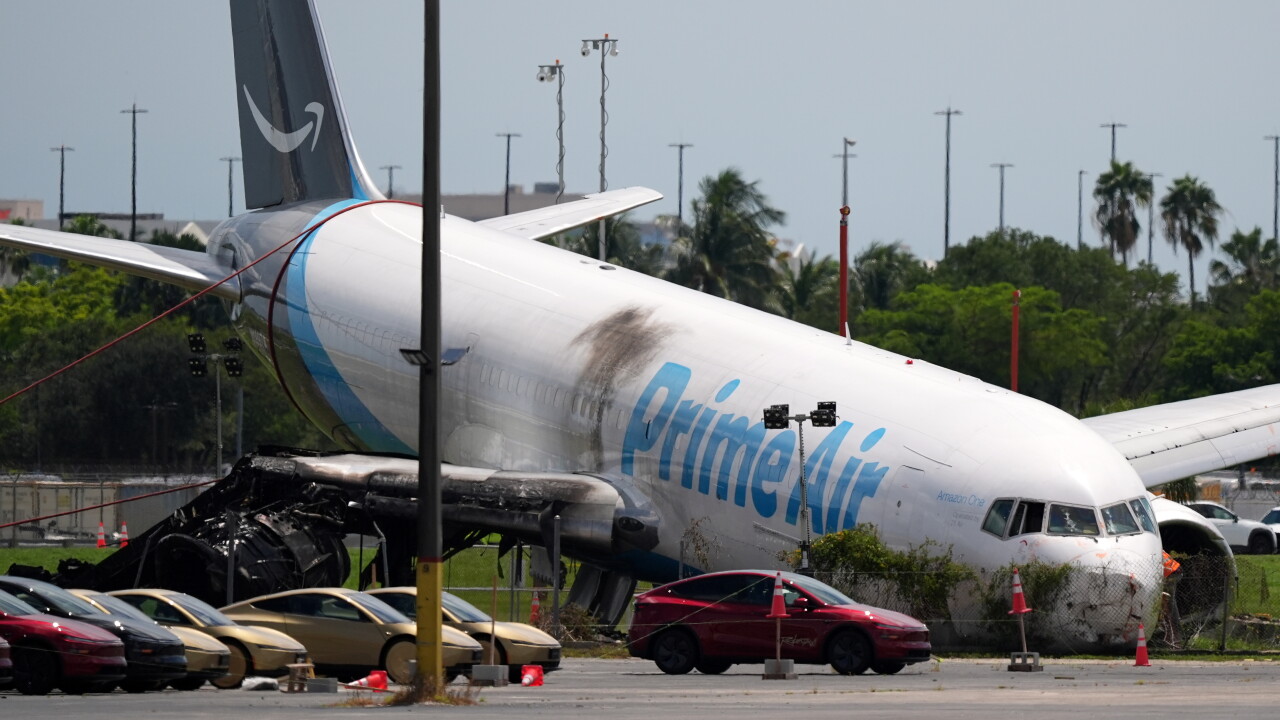


DENVER — One of the two pilots injured when an Amazon cargo jet overshot a runway in Miami and plowed into two vehicles, killing five people on the ground Sunday, has been identified as a man from Colorado.
Joseph Carroll, 55, of Lafayette, was among the injured when a Boeing 767 hit a van on Miami International Airport property before ramming through a fence and hitting an SUV on a public street, according to ABC News. Carroll’s co-pilot, Jaime Molina, 37, a Miami resident, was also injured in the crash.
Watch the latest on this story from Scripps News in the video below:
The five people killed were all in a van owned by Professional Ocean Service Corp., a company that cleans planes. The company said it wouldn’t comment on the crash out of respect for the families who lost loved ones.
The Miami-Dade sheriff identified the deceased as Rolando Aleman Leon, 55; Yoel Rodriguez Naranjo, 53; Julio C. Pineda, 75; Carlos Acosta Fajardo, 53; and Javierkys Reyes Quevedo, 47.
Jet spent a long time over the runway before touching down
Investigators with the National Transportation Safety Board are examining whether the cargo jet touched down too far down the runway to stop safely before the crash, and are raising broader questions about runway safety, pilot decision-making and weather conditions during landing.
Video of the landing showed the plane hovering above the runway for a long time without flaring the nose to force the wheels onto the ground. Experts said it appeared a strong tail wind propelled the plane far past the point where it was supposed to land. Air traffic controllers also had not changed the approach to the runway to allow the plane to land into a headwind. Investigators will want to know how quickly the winds shifted.
The NTSB will look at Miami’s lack of a special system to slow and stop speeding jets at the end of runways. But investigators will examine everything that may have contributed. About 120 airports in the U.S. have the lightweight, crushable material that the Federal Aviation Administration says has saved around 500 lives.
Even without a runway excursion system, Miami’s airport appears to be compliant with federal rules because it has a 1,000-foot safety buffer at the end of its runways, experts said.
The cargo plane was landing after a two-hour flight from Puerto Rico as storms brewed around the Miami airport.
The Associated Press contributed to this report.
Denver7 is committed to making a difference in our community by standing up for what's right, listening, lending a helping hand and following through on promises. See that work in action, in the videos above.
