

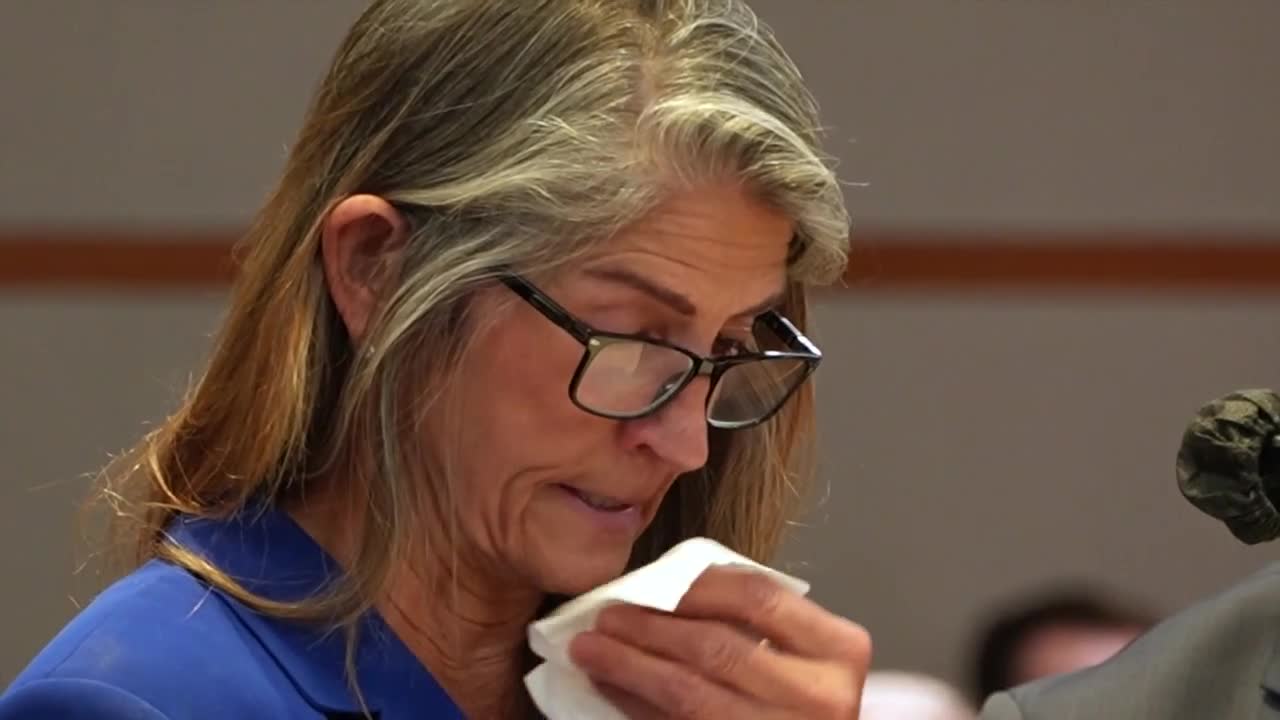


JEFFERSON COUNTY, Colo. — Inside a crowded Jefferson County courtroom on Tuesday, Yvonne "Missy" Woods, the former Colorado Bureau of Investigation forensic scientist charged with manipulating evidence for years, was sentenced to 10 years in prison.
Woods pleaded guilty in June to four counts in Jefferson County Court. The plea agreement reversed course from Woods' original not guilty plea in February, following multiple delays in the case.
The charges she ultimately pleaded guilty to include cybercrime, perjury, attempting to influence a public servant and forgery.
Judge Andrew Poland handed down the 10-year prison sentence as punishment for the cybercrime charge. The other three charges received prison sentences as well, but those will be served concurrently.
Woods also received three years of mandatory probation on the cybercrime charge.
For the first count of cybercrime, the punishment range was between eight and 16 years in prison. Almost 100 remaining charges were consolidated into two of the counts as part of the plea deal — the attempt to influence a public servant and forgery counts.
Chief Deputy District Attorney Darren Kafka began his presentation on Tuesday morning by explaining a number of cases prosecutors believe demonstrate Woods' misconduct in lab reports.
"The convoluted way in which Ms. Woods managed this deception is striking and concerning," Kafka said. "Ms. Woods was asked to do her job, and to do it on the most basic level, telling the truth. She failed. Failed miserably.”
In one of the cases described by Kafka, he said Woods was “content to ignore the lack of certainty in results." In another, he said it was "appalling to consider how cavalier" Woods was when it came to seeking justice for a victim in a rape case.
According to the First Judicial District Attorney's Office, investigators identified more than 50 cases that contained false statements made by Woods.
District Attorney Alexis King explained the impact of Woods' misconduct during a press conference following the sentencing hearing.
"Ms. Woods derailed many of these cases at the very early stages of DNA testing and investigation. As a result, many of them never reached a point where DNA could be used for identification or comparison," King said. "Instead, Ms. Woods played God. She substituted her own judgment for the evidence and the investigative process by deleting DNA so early in the DNA testing, and then issuing false reports. She eliminated chance for follow-up and further investigation.”
Prosecutors played a video to the courtroom, showing a portion of an interview between Woods and investigators. In that clip, Woods says “what’s going on in my brain that’s making me do this? Because… I don’t really know why I was doing it.”
During the sentencing hearing, Kafka said that because of Woods' actions, countless others will ask “can we trust our criminal justice system? Or even to some, can we trust science?"
“Sowing this doubt will be Missy Woods' legacy," Kafka added.

On the other side of the case, defense attorney Thomas Ward requested Woods receive eight years behind bars, arguing that his client has accepted accountability in this case. Ward told the courtroom her misconduct was not equally spread among her career, which spanned almost three decades, and instead was clustered close to the end of her time with CBI.
Ward continued to tell the court that Woods' identity became "fused" with CBI. He argued she broke the rules, but that her motivation to do so was ensuring CBI was processing cases as quickly as they could. Ward told the court that productivity within CBI was not an informal expectation, but an explicit requirement.
Calculations done by the defense team estimated Woods processed an average of 338 cases a year, but attorneys noted there were a handful of years where that average was essentially doubled.
Woods made choices knowing they were wrong, according to Ward, but this "did not happen in a vacuum."
Her defense team told the judge Woods was diagnosed with Post-Traumatic Stress Disorder (PTSD) after being exposed to repeated details of traumatic evidence that included rape, homicide, and child abuse.
"The things she did in this case are serious, and merit punishment... but they do not erase all of the good things she did," Ward said.
Ward concluded his comments by saying Woods is "extremely remorseful."
The defense team also called a handful of character witnesses for Woods, with one saying she is a great human being but "humans make mistakes."
One character witness for Woods said "no one is writing articles about all the good she did. No one is writing articles about the fact that she helped us get this murderer off the street, who was at that moment trying to isolate another victim, or that she was able to help clear out the cases of this guy who's repeatedly sexually assaulting college students.”
Woods also addressed the courtroom, emotionally saying she knows she failed in her responsibility and for that she was deeply sorry.
"For many years, I was entrusted with evidence that could have profound consequences for defendants, victims, families, and the courts. I failed that responsibility. I'm deeply sorry for that failure and for the consequences that followed," Woods said. "My job was to give you answers that you could trust, instead I gave some of you reasons to doubt the results you already had, and I gave others of you no answer at all.”
While Woods said she cannot undo her actions, she said the consequences of her conduct are constantly on her mind.
"When a scientist breaks the rules, it's not just their own cases that suffer. Every juror who must decide whether or not to believe the next scientist and who takes the stand, every detective who must reassure a victim, and every family that must ask whether the answers they got can be trusted, suffers. I did that to the agency I spent my whole life serving, and I did it to the people that the system exists to protect," said Woods.
Judge Poland considered the lack of a criminal history and the letters in support of Woods as part of the sentence he imposed, but said that institutional failures do not eliminate individual responsibility.
"Heavy workloads do not authorize a forensic scientist to disregard established procedures. Inadequate supervision does not relieve a professional of the responsibility to perform their work honestly," Poland said during sentencing. "Ms. Wood's life is not defined entirely by these offenses, and the court will not treat it that way. Nor was every case she worked on affected. But, those circumstances do not erase the seriousness of the conduct, because this was intentional misconduct by a highly trained professional, occupying a position of extraordinary trust."
Woods, 66, was originally charged with a total of 102 felonies: 52 counts of forgery, 48 counts of attempting to influence a public servant, and one count each of perjury and cybercrime, for misconduct that impacted more than 1,000 cases between 2008 and 2023.
An affidavit for an arrest warrant outlined those 58 criminal cases, which included homicides, sexual assaults (including two involving a child), arson, child trafficking, robberies, burglaries, missing persons, and more in Denver, Wheat Ridge, Englewood, Lakewood, Jefferson County, Black Hawk, Boulder, Boulder County, Loveland, Lafayette, Arapahoe County, Adams County, Broomfield, Arvada, Aurora, Longmont, Fraser/Winter Park, Westminster, Thornton, Larimer County, Greeley, Fort Collins, Colorado Springs, Pueblo, Fremont County and El Paso County.
Woods was first charged in January 2025, following a CBI announcement in late 2023 that she was no longer employed at the agency and was facing a criminal investigation after anomalies in her work were discovered. Woods worked with CBI for 29 years.
The state has allocated about $7.4 million to CBI to address the fallout of the investigation, Denver7 Investigates found.
The affidavit read that Woods' alleged misconduct cost more than $11 million.
The discrepancies found in her work, as outlined in the affidavit, included:
- Some of Woods' cases were listed as having a certain value for part of the DNA extraction process, but the actual number was missing. Once that DNA is extracted, it is assigned a "quantification value" automatically. A scientist would need to manually delete it.
- Several instances where Woods manipulated data "by lowering the quantification value to make it appear that either no DNA was present, or the amount of DNA located was too minimal to be amplified."
- Woods appeared to have re-run entire batches of DNA through equipment, but did not provide documentation about doing this process. The tests had values on the first round, but were manipulated when it was processed a second time.
- Woods deleted specific values on sexual assault DNA samples, indicating no male DNA was found on the sample, when it was there.
Once a scientist finishes analyzing a DNA batch, their workbook is submitted for a "technical review," the affidavit reads, and officials at CBI said had it not been for that review, most of the discrepancies in Woods' work would not have been found.
A forensic scientist who worked with Woods found that Woods purposefully deleted specific values in the DNA testing "in order to skip the 'amping' of that particular sample," the affidavit reads. When that forensic scientist told Woods that she would not sign off on the review and explained what she had found, "Analyst Woods didn't say anything and had a 'befuddled' look on her face," the document reads. Another forensic scientist reported that she had noticed inconsistencies with Woods' work back in March 2014. That person's manager instructed Woods to correct the errors, and she "did not ask any questions or provide any explanation as to why the data was missing when confronted," the affidavit reads.
Woods left the agency in Nov. 2023, just before CBI's announcement about the anomalies.
CBI announced that day in 2023 that they had started an internal affairs investigation in Sept. 2023.
The results from that were completed and publicly shared in March 2024. The report reads that Woods altered, manipulated, or deleted data in DNA testing in hundreds of cases. She omitted material facts in official criminal justice records, tampered with DNA testing results by omitting some results, and violated CBI’s Code of Conduct and CBI laboratory policies, CBI reported, adding that the manipulations appear to have been intentional, but no motive was named.
Since her arrest, one conviction in a 1994 Boulder murder case was thrown out as a result of the investigation into Woods. Michael Clark, who was sentenced to life in prison in 2012 for a 1994 Boulder murder, was released from prison in April 2025. Clark is currently heading for a retrial, as Denver7 first reported in Sept. 2025, but those proceedings are on pause as both sides work through disclosure issues.
CBI has previously said that Woods’ misconduct did not affect the DNA testing in Clark's case.

Boulder
Judge denies request to use JonBenét Ramsey records in other Boulder case
One of the charges Woods pleaded guilty to involved the 2014 murder conviction of Ryan Hicks. In that case, prosecutors said Woods lied on the stand while testifying about DNA evidence during the trial.
The state has allocated more than $7 million to deal with the fallout from the case.
Another case Woods is accused of mishandling is the murder of Roger Dean nearly 40 years ago.
The man accused of murdering Dean received a lighter sentence than typical, and the district attorney said Woods' alleged mishandling of DNA was to blame for the lesser penalty.
Dean's daughter, Tamara Harney, told Denver7 earlier this year that she wants to see justice in the case so she can move forward.
“I'm just ready to get things moving. Just let's get it on, you know, get it moving forward, get it finished, and then finally put this to bed,” Harney said. “[Woods] needs to realize the impact that she had on so many people by her actions.”
CBI released a statement in June stating that Woods' actions "constituted intentional criminal fraud carried out by a single individual. The conduct violated the law and professional standards of the Colorado Bureau of Investigation. It was not reflective of CBI’s institutional practices or mission."

Politics
CBI expected to hit 90-day testing turnaround goal for rape kits 7 months early
As a result of the intensive investigation into Woods, a backlog of sexual assault evidence kit testing at CBI was exacerbated. After Woods retired in Nov. 2023, half of the lab work done in 2024 at CBI was dedicated to reviewing her cases.
According to data from the CBI, over 1,400 sexual assault cases were caught in a historic evidence testing backlog at this time last year. Survivors were forced to wait more than 500 days for their results.
Three million dollars' worth of funding from state lawmakers was granted to CBI to help clear the backlog of DNA evidence and sexual assault kit tests with the assistance of private, external labs.
CBI originally estimated reaching their goal — a 90-day turnaround timeline — by April of 2027. The agency is ahead of schedule, and now reports hitting that turnaround time by Nov. 2026.
In a statement provided by CBI following Woods' sentencing, they said her actions do not reflect the work or integrity of the men and women who work at the agency. Read the full statement below:
Today former Colorado Bureau of Investigation (CBI) forensic analyst Yvonne “Missy” Woods was sentenced for criminal conduct committed during her employment with the CBI.
This sentencing marks an important milestone in a difficult chapter for the CBI and victims, families, prosecutors, law enforcement agencies, defense attorneys, and communities affected by Woods’ actions.
Woods’ actions were criminal and today she was held accountable for her misconduct. It was a violation of the law and a betrayal of the scientific standards and professional values that define the CBI and its forensic laboratories. CBI has taken aggressive action to reform our laboratories to strengthen public trust and ensure that victims, the public safety community, and the state can be confident in the results produced by our hardworking staff.
Her actions do not reflect the work or integrity of the men and women of CBI.
Since Woods’ misconduct was uncovered, CBI commissioned a landmark independent audit confirming that CBI’s forensic laboratories are operating within national best practices and that the bureau has made substantial progress in strengthening its systems and culture. Many findings and recommendations from that Forward Resolutions Audit and Assessment Report [links-2.govdelivery.com] released in July of 2025 are in progress and more are planned for the coming years. CBI Forensic Services was also audited by the Office of the State Auditor [links-2.govdelivery.com] marking a lengthy period of external assessment and auditing over the last two years. CBI is now evolving as one of the preeminent investigative agencies nationwide.
CBI is mindful that behind every case number is a person. The enormous effort undertaken over the past two plus years to rectify Woods’ actions has not simply been about reviewing laboratory procedures. It has been about doing everything possible to provide confidence and answers to the victims who were affected by Woods' misconduct.
“This sentencing does not change the impact of what occurred, but it does mark another step forward,” said CBI Director Armando Saldate. “The actions of one individual never define this organization, and they do not define the dedicated public servants who continued showing up every day with integrity. I am proud of the ways the CBI has improved and reformed our laboratories to ensure that victims in Colorado get answers.”

