
LA PLATA COUNTY, Colo. — The Enterprise Pipeline spill is already considered the largest gasoline pipeline spill in Colorado history, but it could be twice as large as currently reported.
Houston-based Enterprise Products, which operates the interstate pipeline running through southwest Colorado, has previously said the spill is about 97,000 gallons.
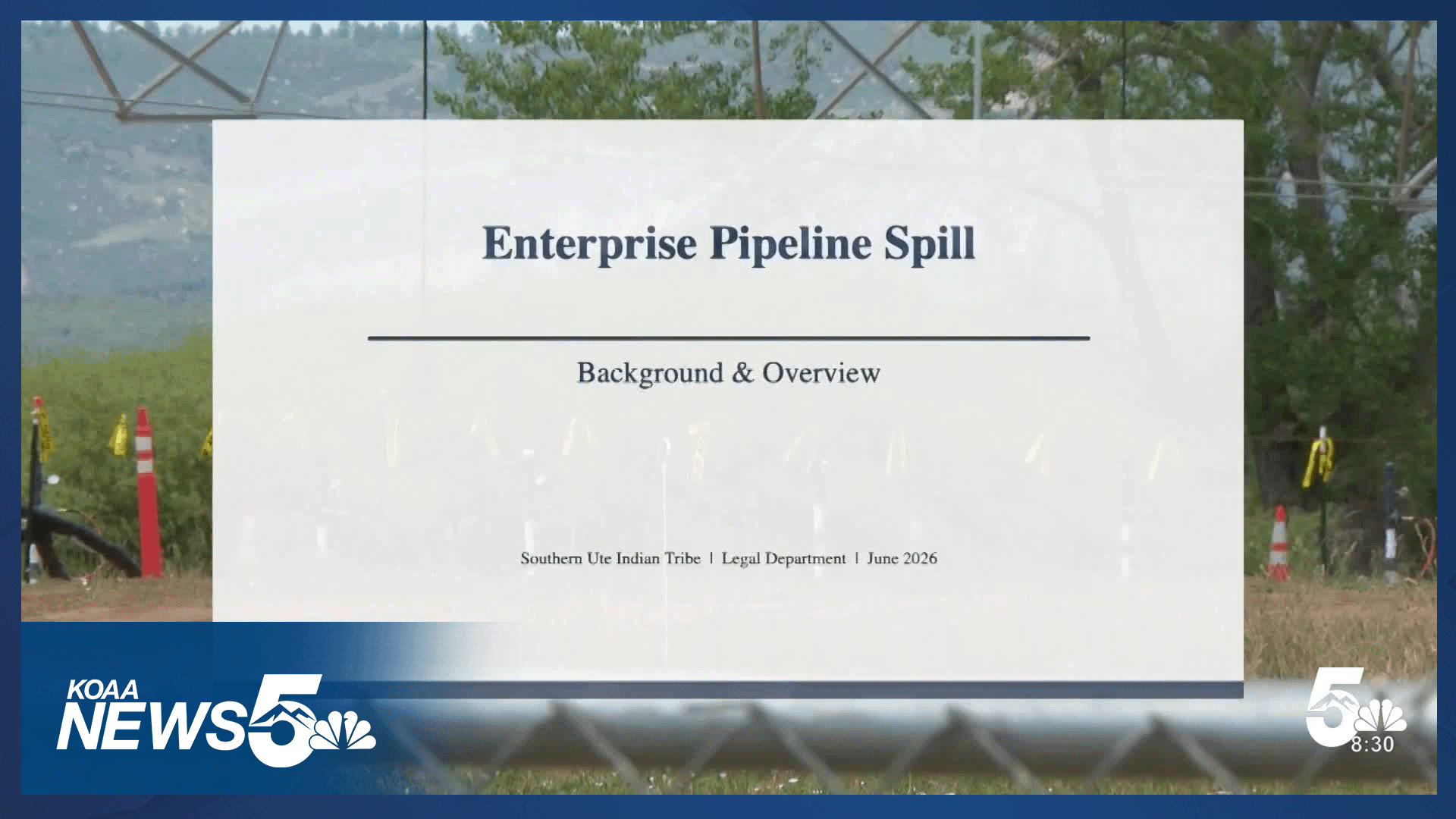
But a new, independent analysis conducted by the Southern Ute Indian Tribe said the actual estimate could be closer to 200,000 gallons.
The spill is just south of Durango on private fee land within the Southern Ute Indian Reservation, just a half mile from the Animas River.
“The alternate estimate of 200,000 gallons is not supported by the operational data at the time of the release, or the operational data we are observing in the field as part of our remediation efforts,” said Rick Rainey, vice president of public relations for Enterprise, in an email. “The 97,000 gallons remains our estimate based on the best available information we currently have.”
This new Southern Ute estimate was presented June 3 by the Tribe’s attorney at a Colorado Counties Inc (CCI) conference during the western district meeting, which comprises 16 counties.
Watch Brett Forrest's full report in the video player below
KOAA reviewed the presentation slides. The Southern Ute Indian Tribe did not respond to a request for comment for this report.

BACKGROUND ON THE ENTERPRISE SPILL
The Enterprise Pipeline spill was first detected on December 5, 2024, though local leaders and residents have expressed assumptions that the spill had occurred earlier and wasn’t detected until then.
La Plata County Commissioner Matt Salka said it’s been frustrating that the spill doesn’t appear to have much awareness elsewhere in the state despite its size.
“We had a La Plata County resident notice some seeping coming out from under the ground. It was fuel. They reported that and what we found was that there was a crack, a leak in this underground pipeline,” said Salka. “The major concern on this is that it is affecting a lot of water wells here, several properties have been bought out because there's no ability to have water here anymore. It's undrinkable. It's a fuel, so it's a carcinogen, so that could create cancer, which is a major concern.”
The pipeline is operated by Enterprise Products and runs from Texas through New Mexico into southwest Colorado and up into Grand Junction.
Before the spill, some nearby residents said they weren’t even aware a pipeline existed in the area.
For its part, Enterprise immediately began repair work and investigated how the spill occurred. The company provided alternate potable water supplies or water filtration systems, and a company spokesman said they are “committed to remaining on site for as long as it takes to fully address the impacts of the release.”
The company has also issued monthly community bulletins describing the spill and efforts to remediate and clean the area.
But the potentially underreported size and apparent expansion of the plume have still concerned the Southern Ute Tribe and the La Plata community.
In its initial estimates in early January 2025, Enterprise said the pipeline spilled 16,000 gallons, which was then revised to about 23,000 gallons by the end of January. In August last year, that number was once again revised to about 97,000 gallons.
That number alone made the refined gasoline spill the largest on record in Colorado. The Colorado Department of Public Health and Environment (CDPHE), which is the lead agency in the state for oversight of Enterprise’s cleanup efforts, said its records only date back to 2016.
The 40-year-old, 10-inch pipeline was converted in 2024 to carry refined products like gasoline, according to the Southern Ute presentation slides. The leak has led to benzene, a known carcinogen in gasoline, being found in groundwater. This has led to impacts on drinking water and agriculture in the Florida Mesa, just miles south of Durango, where the spill occurred.

“I don't want to wake up one morning and discover we've been brushing our teeth with benzene,” said Scott Wallace, who lives near the spill site.
“In some respects, we're already damaged because we now are going to live through a period of uncertainty that will potentially raise questions with lenders, with realtors, potential property value,” said Wallace. “We now are in a position to be one of those homes [bought up by Enterprise].”
Wallace said he believes Enterprise and GHD, the company contracted to help with cleanup, are engaged in good faith.
Regarding the initial handful of properties already purchased by Enterprise, which Salka said displaced residents, the company said in an email that they haven’t determined if it would yet be appropriate to purchase additional properties.
According to the community bulletins and the Southern Ute presentation slides, the plume has indeed expanded underground and migrated southward.

The Tribe said it’s now three-quarters of a mile south of the initial release point and has contaminated over 110 acres of the drinking water aquifer. The plume is migrating approximately 10 feet per day, the Tribe said.
Another environmental concern is the detection of benzene identified within about 650 feet of the nearby Animas River. Enterprise said its geophysical and scientific data showed there is currently no threat to the river.
“We've lived with uncertainty in terms of the variability of rainfall and snowpack and drought and use and whatnot,” said Scott Wallace. “This is just–as a level of man-made–it's hard not to regard it as careless. I mean, somebody, if you're pushing that much gasoline, you ought to have some confidence that your pipeline has integrity.”
A point of local criticism has been the Enterprise's leak detection system failing to identify the rupture.
Commissioner Matt Salka said that’s raised concerns with other nearby county commissioners about trusting there’s no leak underground in their area, too.
“If it broke here, the concern that the commissioners have is that if it broke here, where else has it broke?” asked Salka.
Rick Rainey with Enterprise said their Colorado pipeline system is protected by a comprehensive safety and integrity management program that meets and exceeds all appropriate regulatory requirements.

THE CLEANUP
The U.S. Department of Transportation Pipeline and Hazardous Materials Safety Administration (PHMSA) is still investigating the cause of the incident. Enterprise said it still can’t provide details on when the final results will be available.
At present, Enterprise said they’ve recovered more than 60,000 gallons of gasoline and claimed the extent of the plume and concentration of product are decreasing.
The company immediately began pipeline repairs on Dec. 8, 2024, which were completed Dec. 15. However, it’s worth noting the company has committed to replacing 18.5 miles of pipeline within the Southern Ute Reservation boundaries. So it’s unclear whether the initial repairs were successful enough to not warrant the upcoming replacement.
CDPHE is working with the Southern Ute Tribe and the Environmental Protection Agency (EPA) on remediation efforts. But a full cleanup, if even possible, would still be years away.
“Even though this was 18 months ago, it is in a sense still the early phase of the cleanup because it will take years to complete the cleanup,” said Patrick Cummins, director of Environmental Health and Protection at CDPHE. “And there may be additional actions that are needed along the way.”

Sierra Club, an environmental advocacy organization, said these spills are common and there have been over 10,000 pipeline events across the U.S. in the last 15 years.
“Once it's been released into the environment, it is almost impossible to clean up once it has entered water systems,” said Jasmine Vazin, Deputy Director with Sierra Club’s Beyond Dirty Fuels campaign. “And so, it really is far-reaching and you can't even really quantify the total amount of damage that comes from a single spill like this, just from how far-reaching and long-lasting these pollutants are in the environment.”
SEARCH FOR ACCOUNTABILITY
Throughout the process, despite positive efforts to clean the spill, La Plata County Commissioner Matt Salka is still critical of Enterprise.
“I don't think they're physically hiding it, but I feel that they've done very well on flying under the radar, “ he said.
The county has previously attempted to host public forums to address the spill, but have been unable to do so until this week.
The first public meeting where Enterprise will address community concerns is scheduled to take place on June 16 at the Sunnyside Elementary Gymnasium in Durango. Community members must submit questions in advance with a deadline of 5 p.m. on June 15.
Salka wasn’t satisfied with the meeting having “pre-screened questions,” but he was pleased it’s finally taking place nonetheless.
Additional meeting details can be found here.
As for the 18.5-mile pipeline replacement, La Plata County commissioners said Enterprise would need to request a land use permit. At this time, there is no active application, the county said.
An Enterprise spokesman said the construction for replacement is expected to begin in the spring of 2027 and be completed by late fall next year, “barring any unforeseen delays.”
SUPPORT FROM COLORADO ELECTED LEADERS
Apart from CDPHE’s oversight role in the cleanup, other Colorado elected leaders at the state and federal levels have expressed concern about the spill.
Democratic Senator John Hickenlooper met with Southern Ute and Ute Mountain Tribes at Fort Lewis College last August to discuss tribal priorities, including the spill and cleanup effort.
Senator Hickenlooper’s office said they are working closely with the Tribe and CDPHE to “monitor remediation and cleanup efforts.”
Hickenlooper currently co-sponsors the Gas Pipeline and Leak Protection Act of 2025, which would modernize decades-old federal leak detection and repair requirements.
Senator Michael Bennet, another Democrat who’s currently running for governor, has also been credited by local leaders for lending support for the cleanup effort. La Plata County Commissioner Salka said Bennet and his staff previously visited the site.
“This disaster has seriously impacted the Southern Ute Tribe and the Florida Mesa community, and I want to thank the Tribe and local leaders for dedicating resources to the response,” Bennet said in a statement. “I will continue working with them to push PHMSA and the state to provide strong oversight of the cleanup and fully evaluate this pipeline. We need to get the cleanup done right, hold Enterprise accountable, and prevent something like this from happening again.”
Attorney General Phil Weiser, a Democrat also running for governor, visited the site two months ago. His office said they are monitoring the situation and Weiser is “committed to working with the tribe to ensure the area is protected.”
The office for Republican Congressman Jeff Hurd, who represents the La Plata County area, did not respond to a request for comment.
Offering praise for most elected Democrats, Commissioner Salka, who is himself a fellow Democrat, did express disappointment in Governor Jared Polis for not visiting the site.

“What we're getting a lack of is from the governor. I have not heard anything from the governor. I've reached out to his staff. We've directly reached out to him, asking and letting him know about our concerns, and it's still what we feel has been falling on deaf ears,” said Salka.
Salka said they want more staffing from CDPHE to assist in the cleanup. He recognized Colorado’s budget deficit and federal funding cuts to the state by the Trump Administration, but he said they need more awareness, and a visit from Governor Polis could bring more eyes and reassurance.
When reached for comment, the Governor’s office pushed back on the claim he wasn’t involving himself in the cleanup and accountability efforts.
“Governor Polis has coordinated calls between the tribe and the federal government and has been closely monitoring the spill in coordination with the Colorado Department of Public Health and the Environment (CDPHE),” said Ally Sullivan, Deputy Press Secretary for Governor Polis.
Patrick Cummins with the CDPHE is a La Plata County resident. He’s helped serve as the governor’s “eyes and ears on the ground,” Polis’ office said. He participates in weekly calls with the Tribe and EPA and makes regular site visits to monitor the progress and provide updates.
“CDPHE leads the state’s response to the spill and keeps the governor and his team apprised of progress. CDPHE provides regular assistance and support to ensure the cleanup is getting the attention it deserves,” said Sullivan. “The state participates in weekly meetings with EPA and the Southern Ute Indian Tribe’s environmental programs staff, and performs ongoing oversight and enforcement of the mandatory Corrective Action Plan that dictates the actions Enterprise must take to remediate contamination.”
Email Senior Reporter Brett Forrest at brett.forrest@koaa.com. Follow @brettforrestTV on X and Brett Forrest News on Facebook.
Brett can also communicate via encrypted apps like Signal. Due to the sensitive nature of ongoing reporting from federal actions, he is willing to take steps to protect identities.