




The story of Liam Ramos, the five-year-old pictured in a bunny hat and Spider-Man backpack, put a national spotlight on a family immigration detention center in remote Dilley, Texas, where ICE locked up the boy with his father.
A favorable ruling from a federal judge led to their release, but there are hundreds of other families that ICE has held at Dilley since President Trump’s mass deportation campaign began. Some have remained there for months waiting for clogged immigration courts to take up their cases.
Scripps News traveled to South Texas to hear from parents detained at Dilley with their children.
Even though a court order sets a 20-day limit for children in detention, Aury Cadena spent 50 days at Dilley with her three children, ages 10, 8 and 7.
“They would ask, mom, what did we do? And I'd say, well, I didn't know how to answer other than telling them that we came in here without authorization,” Cadena said.
She arrived in the U.S. in 2023 with her family as a single mother seeking asylum from Venezuela. ICE arrested her in December at a scheduled check-in appointment.
“I had always shown up,” Cadena said. “I have never missed a meeting.”
ICE INC. | The private companies running U.S. immigration detention centers
The government has put the care of families at Dilley in the hands of CoreCivic, a private company with a government contract to operate the detention center. CoreCivic employs the staff responsible for detainee health care.
A Jan. 28 brief filed in federal court by immigration advocates says families detained at Dilley have raised concerns about insufficient medical attention on at least 700 occasions since August.
“The medical experience there in truth, no, it's not good,” Cadena said.
When her children came down with fevers, Cadena said she wanted to take them to see the doctor on site, but that required waiting outdoors to speak with someone in a medical trailer.
"The line was very long,” she said. “You had to go at midnight to get medicine, and that was mostly in December and early January. It meant it was very cold and the wind was strong at that hour.”
Instead, she bought Tylenol at the Dilley store and her children recovered.
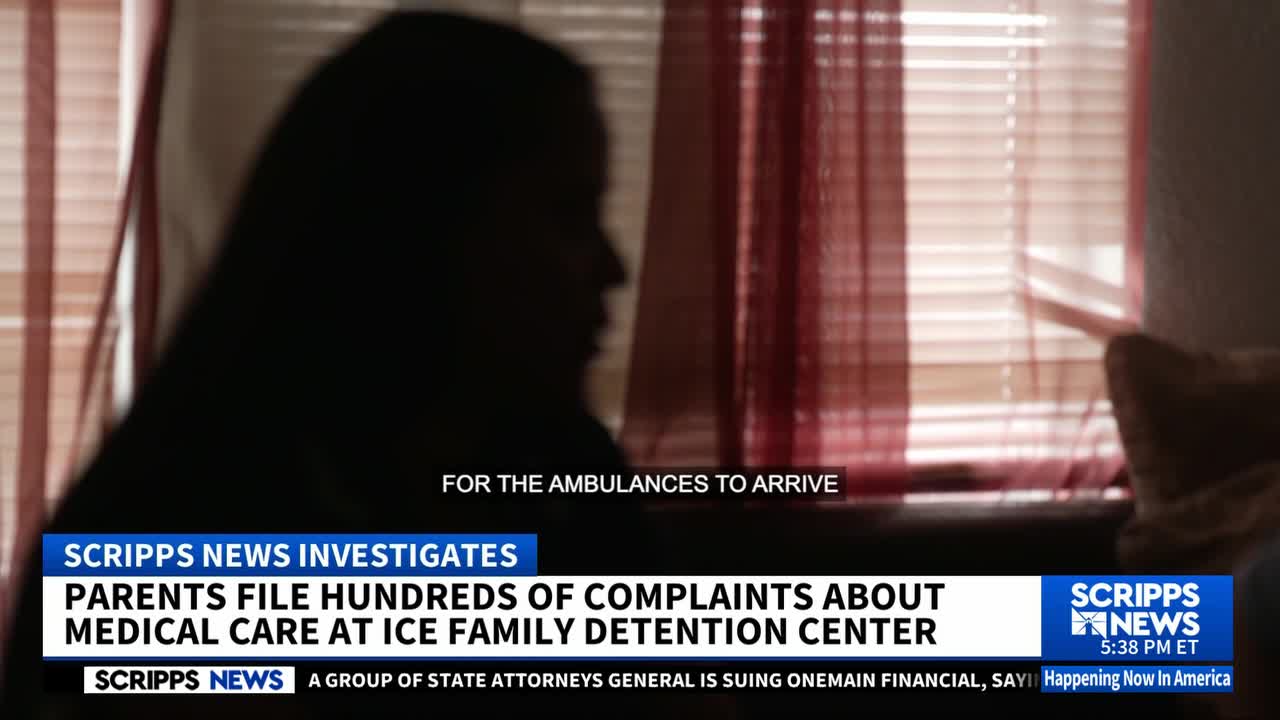
A second mother who spoke to Scripps News spent more than two months at Dilley. She asked not to be identified out of fear of retaliation. She also talked about the long pill line she encountered when trying to get help for her 3-year-old son’s fever.
She recalled a conversation she had with Dilley staff about medical care.
"I did see very sick children and I once asked if a child comes here convulsing, what do you guys do? You have no way to attend to them,” she said. “And they said, we would need to wait for the ambulance to arrive. But a child can die while the ambulance arrives.”
Scripps News obtained 911 call logs and audio that show medical emergencies involving children and pregnant women occur multiple times a month on the campus. It can take a while for an ambulance to reach the detention center, located about an hour south of San Antonio. In one 911 call, a medic requests a helicopter evacuation for a child with low oxygen levels but bad weather makes it impossible to fly.
The Department of Homeland Security says for most immigrants the health care they receive at Dilley is the best they have ever experienced in their lives.
CoreCivic responded to questions about care at Dilley by pointing to a statement on its website saying it offers “comprehensive around the clock care” at Dilley with licensed doctors, nurses and mental health professionals available at all hours.
Cadena said the psychological impacts of detention affected her children more than any physical effects.
“I feel like it hit all of them deeply, but mostly the youngest,” she said. "One day, he was very anxious. He even yelled at me and told me, ‘I want to go out, I want to go out.’ He was screaming, screaming, ‘I want to go out and play, I want to do something.’”
Cadena is one of eight members of the Iglesia Cristiana Roca de Refugio church in San Antonio who have been kept at Dilley.
“Children are being really affected by this,” said Dianne Garcia, the pastor of the church.
She led a 90 mile-walk from Dilley to San Antonio to draw attention to the effects of immigration detention. "
“The children that have been in detention have come back and are different,” Garcia said. “They are quieter, they’re angrier, they're more isolated.”
Aury and her children were let out of Dilley after a judge said ICE could track her whereabouts with an ankle monitoring cuff as her deportation proceedings continue.
The family is back at their home in San Antonio where the children have returned to school and Aury cleans apartments to support them.
"They are doing well, very happy to be going back to school,” she said. “We were left with a lesson. Every day before sleeping, we pray and thank God for freedom, for life, for food. And we also pray for the people who are still being held there. May God give them freedom soon.”
The population at Dilley has been dropping in recent months from 2,400 detainees at the start of the year to 900 in the most recent figures available from ICE.
