

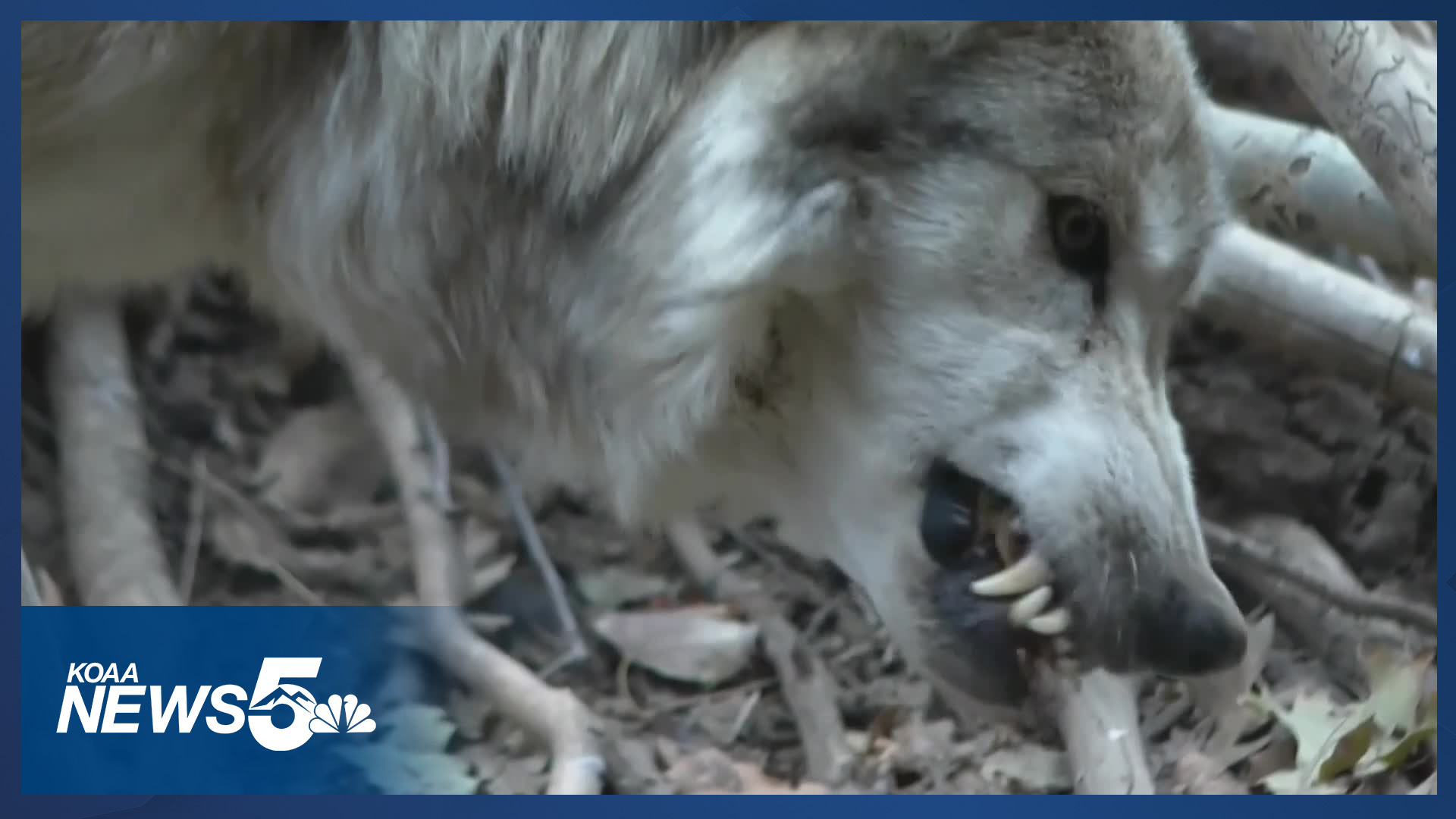



COLORADO SPRINGS, Colo. (KOAA) — Colorado Parks and Wildlife plans to reintroduce more wolves to the state by winter's end.
In the meantime, discussions are being held addressing the reality of the situation. The theme? How can poeple and wolves coexist peacefully in Colorado?
Not everyone is on board. It’s a nuanced situation, and ranchers in particular are concerned about livestock predation.
"Very legitimate concern, and it can be done, but it's a very complicated process to manage wolves and live with wolves," says Lenny Klinglesmith, a Colorado rancher.
Klinglesmith said he hasn't been affected by wolf predation yet, but knows others who have experienced losses.
"The effects tend to be very localized and very extreme," he says.
Colorado Parks and Wildlife says they hope to release between 30-50 wolves in the next 3-5 years. Klinglesmith expressed concerns about the timeline.
"I think we run the risk of outgrowing, growing faster than the speed of the agency," he says.
The state faces challenges in sourcing wolves for the program. Colorado Parks and Wildlife can no longer import wolves from Canada. This comes after the federal government told the state to cease all operations in the country.
CPW’s permit from the U.S. Fish & Wildlife Service does not list Canada as a location they can source wolves from.
To further complicate matters, Washington’s Parks and Wildlife recently voted 8-1 to not provide wolves to Colorado. They are still listed as endangered in the state.
This leaves Oregon, Idaho, Wyoming, and Montana as potential sources for wolf relocation.
No decision has been made public by Colorado Parks and Wildlife.
Karin Vardaman, director of Working Circle, a program focused on reducing cattle vulnerability to predation, acknowledged the challenges ranchers face with new predators on the landscape.
Her team helps identify independent variables that directly influence the vulnerability of cattle to wolves. This includes everything from a ranch’s topography, health, and handling of a herd, fencing, and more.
"There's always a reason why they will take down one animal over another, which usually comes down to some sort of vulnerability factor. So the key is to identify what that is and address it," Vardaman said.
Vardaman says one technique she’s sharing with some ranchers is training their cattle to act more like buffalo, standing strong, face-out, in the event of a wolf attack.
“Wolves, when they’re hunting, are very risk-averse. They’re always weighing risk against vulnerability, and is it worth that hunt?”
Klinglesmith tells me it’s more complicated than that. He says he trains his Border Collies to apply pressure to cattle to get them to turn around and be herded. If cattle were trained to stand firm in the face of a threat, his herding dogs would become obsolete.
“I need my border collie to apply pressure until the cow turns to leave, and then I call my dog off so there's no more stress. The cows learn to move away from that dog pressure,” he says.
Klinglesmith also adds that, while he’s grateful ranchers are compensated when cattle are killed, it sometimes doesn’t add up.
He says wolf attacks in 2025 could lead to financial loss in 2026. This is prevalent in calving. He recounts an instance of a rancher he knows experienced from 2024 to 2025.
“With no confirmed depredations, they still had reduced weight gains because of conception rates that were later, and thus the calves were born later; because the cows were stressed, they didn't breed the first cycle.”
Despite the controversy, advocates hope ongoing discussions can build mutual understanding between different stakeholders.
___

Downtown-goers react to Tuesday's damaging hail storm in Colorado Springs
Twigs, small branches and leaves covered the ground across Downtown Colorado Springs following Tuesday's storm.
____
Watch KOAA News5 on your time, anytime with our free streaming app available for your Roku, FireTV, AppleTV and Android TV. Just search KOAA News5, download and start watching.
