


GOLDEN, Colo. (KOAA) — For Justin Cyrus, CEO and founder of Lunar Outpost, going to the Moon has been a lifelong dream.
“I've been around the space industry since I was a kid. I've had the [domain] name LunarOutpost.com since I was five years old,” said Cyrus.
Cyrus said his dad, who used to work for NASA and was VP at the Lockheed Martin Moon to Mars office in the ‘90s, gifted him the domain.
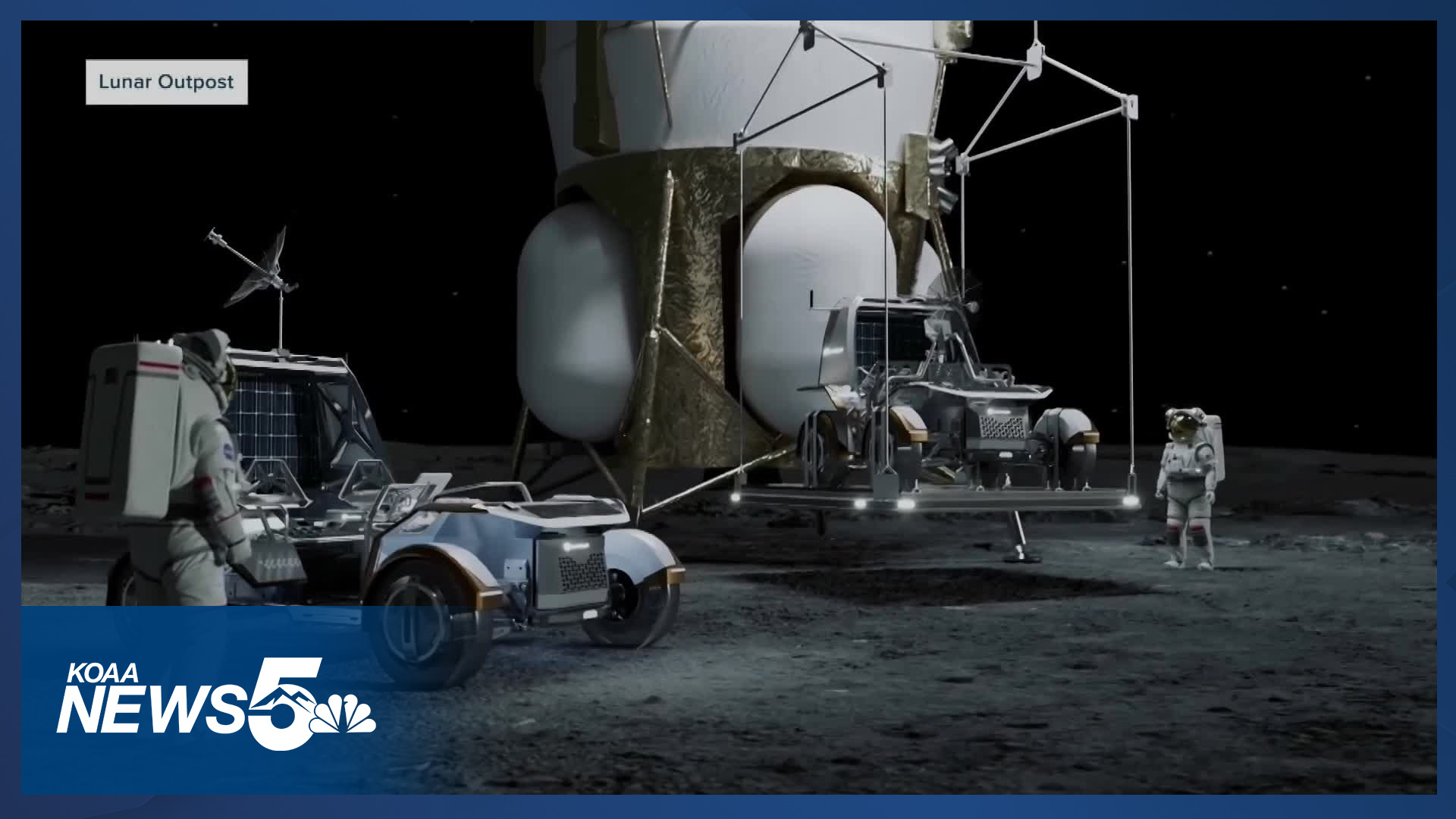
Then, it was perhaps fate, when NASA awarded Lunar Outpost one of two massive contracts last week to deliver their Lunar Terrain Vehicle (LTV) to the Moon’s South Pole.
The LTVs are designed to help transport astronauts across the bumpy, dusty and unforgiving lunar surface. But Lunar Outpost’s LTV, the Pegasus, can also be teleoperated or run autonomously.
That means humans on Earth, at either Lunar Outpost’s Arvada Mission Control or on location at Johnson Space Center in Houston, can send signals to the LTV and control its movement.
“That's critically important as we not only start scaling the number of rovers we have on the Moon, but we start building out the Moon Base,” said Cyrus. “If we have these robotic systems building the habitats, launch and landing pads, the power, and all of the other infrastructure that we need, we are going to need many of these rovers operating on the Moon cohesively and concurrently.”
Lunar Outpost was one of three companies competing for a $4.6 billion NASA LTV contract and its Artemis Missions, which will send humans back to the Moon. Venturi Astrolab in California and Texas-based Intuitive Machines were the competition.

The contract was supposed to be announced in December, but NASA remained mum until last week.
During a Moon Base press conference in Washington, D.C., program executive Carlos García-Galán and NASA Administrator Jared Isaacman announced not one, but two LTV contracts. Astrolab received the other. Each company was awarded a $220 million base contract.
The decision for two contract awards was no surprise for Cyrus.
“NASA historically has tried to have two vendors and usually one of the two vendors separates themselves from the pack,” said Cyrus. “You see one of the vendors deliver, so that way, if one vendor's late or has supply chain issues or doesn't just quite perform, the national space program is still on track.”
That means Cyrus and Lunar Outpost still might see themselves in a competition to become the primary NASA LTV vendor.
Cyrus, of course, admitted his bias and said the Pegasus is the right option to drive astronauts around the Moon, but acknowledged it’s healthy competition.
“We're highly confident in our architecture. We're highly confident in our technology and our partners. We have General Motors, Goodyear, and Leidos, world-class human spaceflight partners that have heritage all the way back to the Apollo era,” he said.
Giving some insight on the days and months leading up to the contract announcement, Cyrus said a NASA Ignition event about six weeks ago gave the companies an entirely new set of requirements for the LTVs.
Up until that point, Lunar Outpost had been focused on its latest generation of LTV called the Eagle. But NASA wanted a lighter, more pared down version.

“Our team went back to the drawing board and designed an entire Lunar Terrain Vehicle and built a human in the loop testing mockup that we had former NASA astronaut John Grunsfeld come out, give us multiple rounds of feedback on,” said Cyrus.
It was a breakneck three-week design effort that culminated in their proposal submission to NASA, which then instituted a blackout period where they heard nothing for a couple of weeks. The space agency said they’d know if they were selected on May 22.
“We had a few days heads up and we were told to fly out to D.C. We couldn't tell anybody, but we got to be in the audience while Jared (and) Carlos, made the announcements for the new Lunar Terrain Vehicles, which was extraordinarily exciting,” he said. “We got the call from NASA, two people were on the call and they told us, and we're doing our best to play it cool. And then, I had to mute the phone and in the background we're celebrating, fist pumping, and everyone was just extraordinarily excited.”
Their contract stipulates a fully flight-qualified Pegasus LTV to NASA by November, 2027 to be integrated into the lander for launch in 2028.
Ultimately, the larger Eagle LTV remains their main goal once the program is settled on the Moon. But there’s plenty of work remaining, Cyrus said, since the Moon’s surface is an unforgiving and brutal environment.
Until then, Lunar Outpost will be building, designing, testing, qualifying and getting ready for the 2028 launch.

Pegasus, like the Eagle, will be tested in southern Colorado at a remote ranch that mimics the Moon’s craters, hills, rocks and dusty terrain.
But the Blue Origin New Glenn rocket explosion at Kennedy Space Center on Thursday could prove to be a hiccup to the ambitious Artemis mission timeline.
At the same press conference, Blue Origin was named as the vendor to deliver the LTVs to the Moon’s surface. But many fear Thursday’s explosion will set the company back months, if not years.
Cyrus said he hadn’t heard of any timeline changes as of Friday, when this interview was conducted.
“We're quite confident that Blue Origin's going to be able to deliver for NASA and Artemis, so we wish them the best,” said Cyrus. “2028 is the expected delivery. As far as we know, no timelines are currently impacted. With that being said, that's something that NASA will handle on their end.”
With the new Pegasus LTV being half the mass and size of their older models, Cyrus said it does provide flexibility for compatibility on many different landers so they aren’t reliant on only one company.
Meantime, Administrator Isaacman and Blue Origin executives remain extremely optimistic.
“Those missions are not until 2028, which should be well within what is possible for pad recovery,” said Isaacman Monday on X regarding needed repairs for the Launch Complex 36 pad, which Blue Origin uses.
“Blue Origin leadership has responded incredibly quickly, and NASA will do all we can to help with root cause analysis and accelerate pad recovery timeframes while staying extremely focused on progressing the lander,” he said.
Dave Limp, Blue Origin CEO, said he was able to better analyze the LC-36 pad yesterday and many aspects weren’t damaged despite the massive explosion.
“We will fly again before the end of this year,” Limp optimistically posted on his X account Monday.

Right to Hunt and Fish? Amendment 83
____
Watch KOAA News5 on your time, anytime with our free streaming app available for your Roku, FireTV, AppleTV and Android TV. Just search KOAA News5, download and start watching.
