

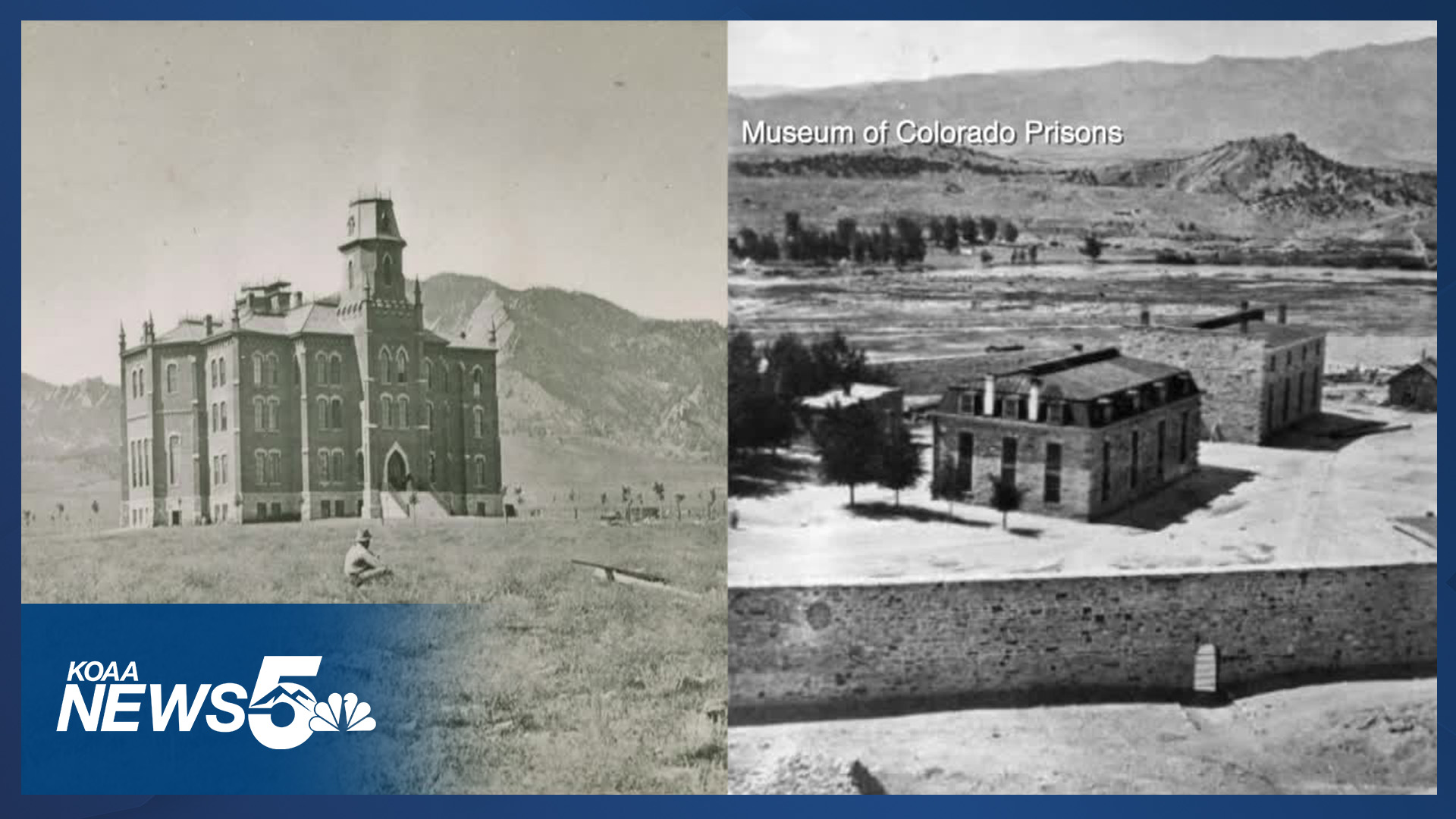

CAÑON CITY, Colo. (KOAA) — For many students and alumni of CU Boulder, they might have heard an urban legend at some point in their collegiate career.
As the legend goes, when Colorado became a state, both Boulder and Cañon City were competing for the new state’s flagship university. The loser of the competition would receive the state prison as a consolation prize.

It’s unclear where it started or why it has so pervasively permeated the dorms, hallways, and quads of the university.
On CU’s own 150th anniversary website, a link under the site’s “More History” tab can be clicked through to a “Brief History of CU Boulder” page.

An excerpt from that page reads:
“...there was some debate about exactly where to put the new university. Two cities were competing for it: Boulder and Cañon City. Boulder beat out Cañon City for a very practical reason: the state needed a new prison, and Cañon City was already home to one. That made it the ideal location for another, since the infrastructure was already in place.”
A request for comment to the site administrator of that page was not returned.
In the large tome titled “Glory Colorado! A History of the University of Colorado 1858-1963” by William E. Davis, the urban legend is mentioned only briefly in one vague paragraph.
“Another account…referred to the fact that Canon City was also agitating for the State University and ‘Uncle’ Dave Nichols, through his efforts, had thwarted that city’s ambitions. The Canon City delegates had only promises to offer the legislative body,” Davis wrote.

The Davis account of the university’s formation is extremely detailed, and yet, this longtime urban legend about the two towns competing is only mentioned just that once.
However, through interviews with three state historians and scholars of Colorado history, their definitive conclusion is that the urban legend is nothing more than just that: an urban legend.
“The consolation prize story is a myth. That is not accurate,” said Sam Bock, director of interpretation and publications at History Colorado. “I was working on my graduate degree at CU Boulder, and I heard this story all the time.”
Bock grew up in Boulder himself. Putting together the History Colorado state history exhibit, he said they dug deep into legislative records and historic newspapers, which led to his realization that the consolation prize story as he was told growing up wasn’t accurate.

“To me, I think, the real story of how it happened is actually way more interesting than the urban legend of who gets stuck with the prison,” Bock said. “Because actually it was a huge benefit to have either the university or the prison.”
Bock said Colorado history is littered with examples of ghost towns and other places that appeared initially promising, only to never develop a long-standing economy.
But a prison or university was both seen as a viable and valuable economic driver.
To understand how the prison and university ended up where they are, historian Derek Everett said it boiled down to statewide disdain for Denver (which some might argue exists to this day).
“The story really has to begin with frustrations about Denver,” said Everett. “Because from the gold rush, earliest days on, Denver had emerged as the economic, the political, the social hub of the state. And there were quite a few people who resented that, who felt that Denver had too much influence, too much wealth.”
Everett is a member of the history department at both Colorado State University in Fort Collins and Metro State University in Denver. He’s already published several state history books and is now writing a new offering titled “Colorado: A History” that will be released this year as part of the sesquicentennial celebrations for Colorado.
In Colorado’s territorial days, the state capital bounced around often.
The territorial government first met in Denver in 1861 under Governor William Gilpin. Due to resentment against Denver, they next met in Colorado City, which is now part of Colorado Springs, in 1862.

But what is now Old Colorado City’s infrastructure was ill-suited for maintaining the legislative body. John Evans, the new governor at the time, refused to travel south for the legislative session.
The capital was then moved to Golden and effectively bounced between Golden and Denver for years.
“In 1867, the territorial legislature decided that this was nonsense–no matter how much resentment Denver had–on a practical level, it was going to be the capital,” said Everett. “There was really no other sensible option.”
When Colorado’s constitution was adopted in 1876, there was a clause stating there would be a statewide vote in 1881 to officially designate the seat of government.

Realizing they would eventually need to sway the populace of Colorado, Denver politicians set out ahead of time to secure their spot as the new state’s capital.
“Through the late 1860s and 1870s, as Colorado is a territory and then eventually a state, Denver politicians realize that the best way to maintain their hold on the seat of government is if they spread out the plums of Colorado's government, if they broaden the largesse to as many communities as possible,” Everett said.
This meant that towns around the state that were, at one time or another, hoping to compete for the capital, were granted various institutions to appease them and avoid any contention that Denver had all the power and prestige.

Everett described a “very well orchestrated effort” to spread out the institutions, including the state university in Boulder, the state agricultural college at Fort Collins (now CSU), the state teacher’s college in Greeley (now UNC), the mental health hospital in Pueblo, the school for the blind and deaf in Colorado Springs, and the state penitentiary in Cañon City.
Stacey Cline, the museum administrator for the Museum of Colorado Prisons in Cañon City, said her research revealed similar political dealings.
None of which, she noted, competed to secure the university from Boulder and only accepted the prison as a consolation.
“Thomas Macon, one of our founders, really got a coalition together that–if everybody voted for Cañon City to become the place of the prison–that that same coalition would vote for Denver to become our capital,” said Cline.

Cline noted a town like Cañon City would want a prison because it was built-in economic activity in terms of there always being a need to house criminals, along with the job security that brought along with it.
She said when she first moved to the area, she heard the inverse urban legend: Cañon City and Boulder were both competing for the prison, whereas the loser would receive the university as the consolation.
However, through the research of the three historians, it appears that both urban legends, though longstanding, are myths.
As for the 1881 vote for which town would hold Colorado’s seat of governance, Denver won in a blowout. Derek Everett said the city secured five times as many votes as the second-place finisher, Pueblo.
“The 1881 election reinforced what had been reality for two decades. Whatever opposition Denverites had inspired, it could not defeat the consensus that the city dominated Colorado, for good or ill, and retaining the capital there made the most sense,” said Everett in an excerpt from one of his writings.
You can watch all of our stories celebrating Colorado's 150th birthday on Sunday, July 5, after the game!