

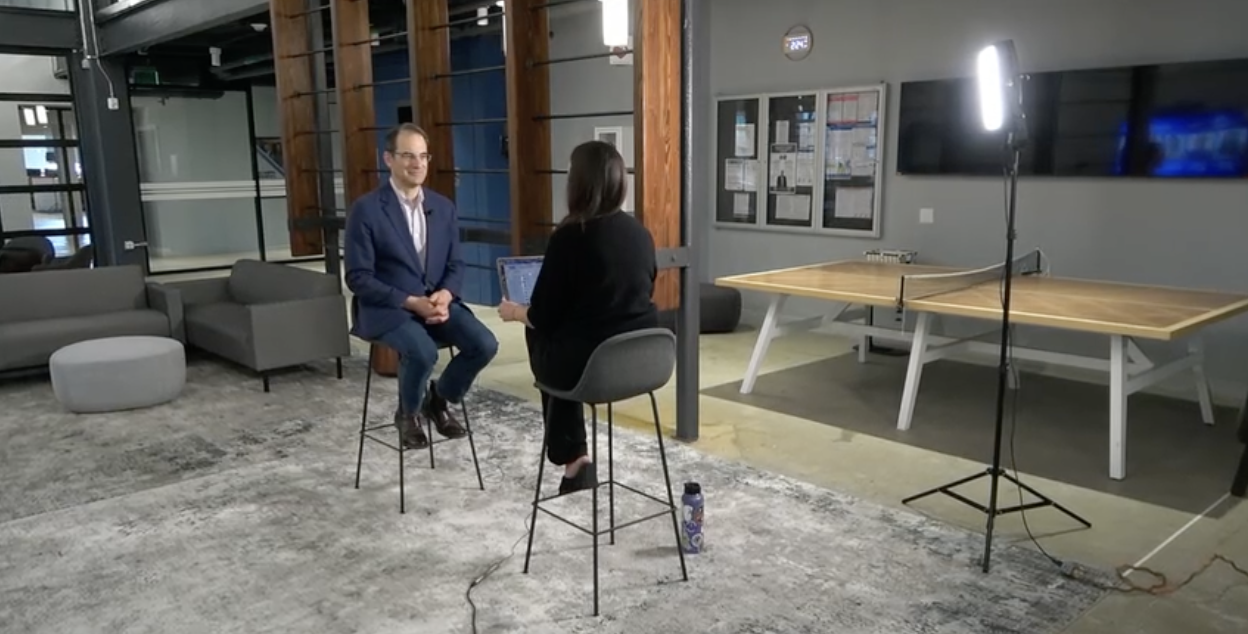


DENVER — With less than two weeks until Colorado voters decide who will be the state's next governor, Denver7 sat down with the Democratic nominee vying for the position, Attorney General Phil Weiser.
The full interview with Weiser, where topics ranged from water issues to the state budget, is transcribed in this article.
Election day is Nov. 3.

Watch the full interview with AG Phil Weiser below:
Note: This video and the following transcript were edited for clarity
Colette Bordelon: I've heard people say Attorney General basically means almost governor or something of the sort.
Phil Weiser: Yes, I've said that. I believe that. I do.
Colette Bordelon: What do you think of that little colloquialism?
Phil Weiser: There's not a better job in state government to understand all the agencies, all the issues, and to work with the people of Colorado directly. Take the opioid crisis, for example. Identified this challenge, saw that big pharma had fueled it, got back close to a billion dollars, worked with local governments, created a framework to make sure that money was spent well, it's been rated the best framework in the U.S. from Johns Hopkins School of Public Health all the way to John Oliver, and over the last couple of years, we've seen over 20% decline in opioid overdoses. That's problem solving. That's my government leadership, and that's type of leadership I've proven I can bring to the governor's office.
Colette Bordelon: It is Saturday, Oct. 10. We are less than a month away from Nov. 3. How are you feeling?
Phil Weiser: I'm feeling both good about the campaign we've run, and disappointed that I'm running a campaign against someone who's not showing up for any debates, any unscripted appearances. We had the one time on stage together, and he got the questions in advance and read the answers. I don't believe democracy is well served when people stay in their own bubbles, when they don't answer questions or engage the public. That's why, in both my primary campaign and my general election campaign, I went all across Colorado with a real simple message: I'm here to listen to, to serve, and get things done for the people of Colorado.
Colette Bordelon: Did you also get those questions in advance?
Phil Weiser: I did.
Colette Bordelon: What was your reaction? Had you gotten questions in advance prior in any of the debates, forums, town halls that you had done?
Phil Weiser: No, no. I've been in forums in Colorado Springs, in Grand Junction. I've been in forums in my primary campaign. I've been in forums in this very studio, and they don't give you the questions in advance. In this case, by the way, I think they also had a moderator change too. All because I take it, my opponent Victor Marx doesn't want to go outside his comfort zone. But here's a problem: If you're governor, you're going outside your comfort zone, and you have to be ready to show up. People deserve to know who you are, deserve answers. That's why my campaign is about showing up, serving the people of Colorado.
Colette Bordelon: You have been campaigning all across the state, but I'm interested to know if you were chosen as Colorado's next governor, how would you work with state lawmakers?
Phil Weiser: My mindset and what is, again, the almost governor part of the AG job is, I've been doing this. Colorado lawmakers have worked with me on a range of laws, and the relationship is fundamentally a collaborative one. My question to lawmakers when they have an idea is, 'What problem are we trying to address? How can we best address it?' When I come to them with an idea, 'I've got a concern about privacy, protecting privacy of Colorado citizens. I've got some ideas on how to address it. What do you think?' That's what collaboration looks like. That's how we get better public policy.
Colette Bordelon: I did an interview with Congresswoman Lauren Boebert, and she said that if you are elected as governor, Colorado will be wishing to have Gov. Jared Polis back. What is your response to that statement from Ms. Boebert?
Phil Weiser: Did she say what she meant by that?
Colette Bordelon: She, I know, on primary night, I also talked to her, and I was curious to know how she was feeling as the results were rolling in, and she was saying she wished [Sen. Michael] Bennet would have had this nomination.
Phil Weiser: I don't know what Congresswoman Boebert is thinking about how I'm going to be as governor, but I would say she's got a bigger problem. She could lose her race because Eileen Laubacher is running an incredible campaign. She's a rear admiral, and she is showing up for rural Colorado, and what I can tell all of the Fourth Congressional District — I will show up for you. I've been showing up for the Fourth Congressional District. The reason she's in a tough campaign is, sometimes, people are sick of the drama. They want people to focus on getting results. Eileen's going to do that. I'm going to do that.
Colette Bordelon: How many lawsuits have you filed against the Trump administration as of today?
Phil Weiser: Eighty-seven. We're bordering on 90 at this point.
Colette Bordelon: I've heard some critiques saying they believe those lawsuits were politically motivated. What is your response to that?
Phil Weiser: Let's say Lauren Boebert says that my lawsuits are politically motivated. I would say to her, 'Which lawsuits should I not have filed?' It's easy... easy to make that statement, but then what's hard? Look down the list. The last one I filed, and it's typical. This federal government is denying us money for unemployment insurance. It's money that we're entitled to. It's money that will help people at a vulnerable point in their lives. Why are they denying it? We don't know. There's no basic reason. There's no justification in law, so if Lauren Borber or someone else said, Phil, why are you doing this? It's political. I'd be like, 'Are you serious? Colorado needs this money. We're entitled to this money.' When I talk to even the most conservative business leaders, I'd make the following point: If you have a contract, and the person you're contracting says, 'You know what? We got the goods from you, but we're not going to pay you for it.' Would you say, 'Okay, we'll give up the money,' or would you say, 'That's wrong? I'm going to fight back for what's right.'
Colette Bordelon: I also did an interview with District Attorney Michael Allen, running for your current spot right now as Attorney General, and I asked him out of the lawsuits you had filed if there would be one that he could point to that he would drop, or that he would not litigate. And at first, he said he didn't want to get into specifics. Then he did point to the Space Command lawsuit, after I mentioned that he had brought it up on Jeff Hunt's show. What do you think about the Space Command lawsuit? Does he have any leg to stand on when he says he would be dropping that because he believes the president has the power to move Space Command, and we shouldn't be involved in that decision?
Phil Weiser: Sadly, if Michael Allen is saying that I am bringing lawsuits that are political, or I shouldn't have brought the Space Command lawsuit, he's making the case why voters shouldn't support him. Let me tell you why: In that same lawsuit, we're protecting NCAR, the National Center for Atmospheric Research. It's a crown jewel for Colorado, and you know what, we've had a successful litigation. NCAR is protected because of litigation, both by us and a parallel lawsuit. Also, in that same lawsuit, you know what we found in discovery? And this is jaw-dropping: A White House meeting called for the purpose of, 'How do we punish Colorado?' So, if anybody, Lauren Boebert or Michael Allen, have an attitude (of), 'we're not going to be a check on a lawless federal government,' my answer is: You're not doing the job to fight for Colorado, because when Colorado's harmed, whether it's threats to our elections or not getting money that we deserve, I believe in standing up for what's right and fighting back.
Colette Bordelon: What would be the primary difference between a Gov. Weiser within the Colorado State Capitol and Gov. Polis? What would be the primary difference between these two?
Phil Weiser: There are probably a few different points. I want to focus on one that's meaningful to me: It's around social media and big technology companies. I have pushed for oversight and accountability of big tech. We know that kids are hurting, and that social media platforms are doing things that hurt our kids, making it easier for kids to get access to guns and fentanyl. I pushed a bill that would have had real accountability and oversight on social media companies. Gov. Polis vetoed that bill. As governor, I'll sign it.
Colette Bordelon: That segues nicely into the Meta settlement. I talked with Lori Shott on the day that that settlement came down, and one of the things that struck me is, she said that you called her before the news broke and you talked to her. Is that emblematic of how you treat people on the other end of these lawsuits?
Phil Weiser: It's really important to bring up Lori and her courage. Lori lost her daughter Anna, who died by suicide, and I've talked to other parents who've lost kids to suicide, or as we talked earlier, about opioids and fentanyl. And what I promise is, when I'm serving the people of Colorado, we need to make sure everyone is treated with respect and that we're partners together. Lori's leadership inspires me. And so, as we think about questions like, how do we make sure the money that we get from that settlement is spent well, how do we make sure we protect our kids, how do we make sure that Meta is following the commitment made, having partners like Lori who see things from the ground? It's essential.
Colette Bordelon: That segues nicely into AI, regulating AI. That was something that we did see lawmakers work alongside Gov. Polis to do. Are there any other regulations you would like to see Colorado take on when it comes to artificial intelligence?
Phil Weiser: I want to make one point on this because it's really important. Artificial intelligence and new technologies can be used for good things or bad things. Here's a bad thing: Helping corporate landlords fix prices, engage in collusion that jack up rents. Say here in Denver, and there was a study from the White House, the Biden White House, that said it was over like $130 per month that rents were going up because of using this technology in a way that's for bad. I would ban that sort of harmful technology. That's the challenge we have with AI. How do we channel it for so much possibility, innovation, new jobs, making life better, and how do we make sure we have the right guard? That we don't do things that make life more expensive in the case of rents going up or harming kids, like through AI chatbots.
Colette Bordelon: We saw also in the state legislature this year two different data center bills that were essentially competing data center bills. Both died. I'm curious, which side of the coin do you fall on when it comes to those different pieces of legislation?
Phil Weiser: My view on data centers is a common sense view, and I've said I want this to be the first bill that we get done because last year we ended up getting close, but we didn't get a bill at all. And there's three critical guardrails we need. First, I don't want communities having data centers shoved down their throats. If they don't want a data center because it's noisy and interferes with community, we don't need to have it there. Second, electricity rates need to be protected. Consumers shouldn't be paying for the energy for data centers. These companies should. And finally, how do we make sure we are consistent with our clean energy commitments, protecting our water? A great example of a data center that could meet those three goals is Northwest Colorado. We're closing coal plants. People in Hayden, people in Craig are going to lose jobs in coal plants. But what if we have a data center powered by geothermal energy, where they can employ those losing jobs in coal plants? That is a win-win opportunity. That's type of data center development that makes sense for Colorado.
Colette Bordelon: If you are Colorado's next governor, you are inheriting quite an interesting predicament with the budget situation, especially when it comes to our state Medicaid program, which is growing at a faster rate than any of the portion of the budget and taking up roughly a third of that cost. I believe it was said in the last meeting with HCPF that if it continues at this rate, it would crowd out most other spending by the year 2040-ish. Are there any ideas you have to ensure that Medicaid spending is reined in while still not hurting the families who rely upon those services?
Phil Weiser: You have put your finger exactly on the challenge. How do we identify where we can save money, where we can operate more efficiently, where we can prevent wasteful spending while recognizing Medicaid supports care, often for the most vulnerable. This is going to be one of the most important and challenging things I have to do. Let me tell you how I'll approach it. First off, the legislature now has this Medicaid commission. They're looking for ideas on how to do this. I will be a partner, like I mentioned earlier — collaborator — in how we figure this out. I'll make sure I'm listening to families on the ground and ask them that question. We get to be transparent. We can't keep Medicaid spending the way it is. What can we do to check this spending so that it doesn't take over our state budget? And then we got to try some experiments to see what works. I am a big believer that if we are listening to one another, we're trying different things, we can take on these challenges. This is going to be a big one for us.
Colette Bordelon: I believe you are in support of Proposition NN, but I'm curious: Some Coloradans are concerned about how that would impact our TABOR refunds, taking them away entirely, and then also with this not being a permanent thing, how it would play out in the future. What would you say to those concerned voters when they're looking at Proposition NN and thinking, "Wait, this is my TABOR money, and what about the government spending, and what's going to check this in a few years?"
Phil Weiser: I've got a few important comments about NN: The first is we have underfunded education in Colorado through what was known as the BS factor, which I know this is a family show. It means budget stabilization. This is a $10-billion hole, a hollowing out of education. We're paying our teachers less than surrounding states do. We've got bigger class sizes, fewer school days, and we've taken away career and technical education or youth mental health services. We got a lot to do to bring our educational system to where it needs to be. That's number one. That's my first reason to vote for it. Second, to your point, I am committed to effective oversight and ensuring that we do get real results that we spend this money smartly, and I'm going to make sure that we build a plan from the grassroots up about how we invest in our kids' future, so that taxpayers know your money is going to our kids' future. I believe, done correctly, investing in our kids' future is the best investment we can make.
Colette Bordelon: The Front Range Passenger Rail issues that we saw on the ballot. I'm curious, why should voters have faith in this system with such a mistake that's been made?
Phil Weiser: I haven't taken a position on Front Range Passenger Rail, and I know voters are asking, does it make sense at a time when I feel squeezed to put more money into it? Those questions are ones that include: Part of it's already funded. Why would you build another fund base before you've actually built out the first part? I understand those questions. I'm asking them. I'm going to come to rest on this issue, but I've not taken a possession on position on that issue yet.
Colette Bordelon: Would you agree to mandatory cuts when it comes to dry years related to the Colorado River?
Phil Weiser: This is an important and subtle question. So I'm not going to go into negotiations, making cuts that are somehow not warranted under the law, or that are us giving up our rights in a way that is disadvantageous. And here is our reality: We have less water than we had 10 or 20 years ago. That's because of climate change. We have increasing population. We can't deficit finance water. So what we need to do, and what my leadership will bring, is a new mindset. Water is a precious resource. We should treat it that way. We shouldn't leave reservoirs open to evaporation loss, we should cover them with solar panels, cutting evaporation loss by as much as 40%. We should be asking: Can we xeriscape more lawns here in Denver so that we're saving water? Can we reuse water again and again in more effective ways? And how do we smartly store water? So, we need leadership on water because we have less of it because it's essential to our lives here in Colorado.
Colette Bordelon: What will be your stance on the Worker Protection Act? I know that's coming back this next session with Gov. Polis having vetoed it twice. Obviously, it would eliminate that second vote in the unionization process here in Colorado. What would you do if this bill came across your desk?
Phil Weiser: What I've said on this is, I do believe we need to change what is an antiquated Labor Peace Act that makes it harder to organize. And the way that we make this change, this gets back to the first point about being collaborative, is to bring the business community and labor together and ask questions, which is, 'What do you need, and what can you give up? How can we work together to get to a better solution?' So that's how I will get to how we change our state labor law, how we deal with the fact that there are real concerns about Colorado's not as competitive as we need to be.
Colette Bordelon: There was a yes or no question I asked during the debate, and I knew you and Senator Michael Bennet really wanted to expand upon it, and I didn't let either of you. So I'm going to let you do it now. Should Colorado continue overriding local control to build more housing?
Phil Weiser: This is a very important point because if you're thinking about my goal to build 40,000 more starter homes, homes that teachers know they can afford to live in communities like Denver or Jefferson County, homes that young people could buy at an earlier age. It used to be, you could buy a home at age 30 or so. That's actually how old I was when I bought my first home in Colorado. Now that number is 40 and rising. So we have an imperative here. There is often this, as you put it, binary choice: Do you override local control or respect it? And it's not quite so easy. There is an intermediate point, which is: Do you create some guardrails, things like allowing people to build ADUs on their homes, or we don't have developers have to have parking minimums. But also, the state can be a leader by showing the way, by providing incentives, encouragement, setting goals. We need to build more of that type of dense housing, think townhomes, condominiums, and we need to make sure it's at a price point that works. So I'm going to provide leadership where I lean in, work with willing localities, and create a culture of, 'Hey, we're working to meet this goal together.'
Colette Bordelon: I'm curious. When you were younger, did you know you wanted to get into politics?
Phil Weiser: No, my younger self would have said, 'I'm committed to public service,' and as recently as 2016, my commitment would be, 'I am rooting for Hillary Clinton to become president, and I'll go join a Hillary Clinton administration,' like I joined a Bill Clinton administration, like I joined a Barack Obama administration. But 2016 for me, like a lot of people, was a game changer. For those who understand the theory of the multiverse, we're in the wrong timeline because for me, the right timeline would have been she won that race. She didn't. I had to think, what do I do to serve, and that's what put me on this journey to run to be attorney general, now running to be governor. And what's been amazing for me is my mindset went from appointed service at the federal level to elected service at the state level, and for that I'm grateful because serving the people of Colorado at the state level in elected capacity is so meaningful. Just like you said for Lori Shaw, I get to know people who are affected by the issues I work on, whether it's social media, the opioid crisis, a proposed merger between Kroger and Albertsons, and I know those people by name. I know their communities. I know who I'm fighting for. This is incredibly meaningful work to me. It's why I want to keep serving in elected office as Colorado's next governor.
Colette Bordelon: Would you have three words to describe what what kind of governor you would be if sent to that seat by Coloradans?
Phil Weiser: I will be collaborative. I will be innovative, and I will always respect the people of Colorado, treating them authentically, transparently, and always honestly, I believe in service. That's my why.
Colette Bordelon: The Department of Justice is suing Denver over what federal government claims is an unconstitutional mask ban targeting federal agents and other law enforcement officers. That ordinance signed into law earlier this year bans immigration officers wearing face coverings. Is that actually an unconstitutional law based off of your understanding of this?
Phil Weiser: This administration is pushing envelopes right and left. The fact that they have law enforcement officers breaking from best practice, wearing masks in almost all cases, really, to me, is a problem from sound law enforcement and undermines public safety. Denver, California did this too. They are taking important safeguards, safeguards that I'm doing my best to defend. There are legal issues that are raised here, and there's public policy issues here as well. My view is we don't want masked rogue agents, we need transparent, trustworthy law enforcement. That's the principle I'm going to keep fighting for.
Colette Bordelon: Do you ever get tired?
Phil Weiser: I have a lot of energy.
Colette Bordelon: I did, during our primary election when we were interviewing with certain candidates in this one-on-one kind of a format, You participated in the debate, so I did not do this with you. I did ask people for a fact that voters wouldn't know about you, like a fun fact.
Phil Weiser: I mentioned before the theory of the multiverse, alternative timelines. What I didn't say then, which I will share with you now, in one alternative timeline, I'd be a sportscaster doing play-by-play, maybe on TV, maybe on radio. That's what I did in college for baseball, basketball, and football. And I'm still a huge sports fan. Things could have gone that way. Instead, here I am in public service.
Colette Bordelon: Also, I think it was CPR a few years back, did a cool piece asking what the mayoral candidates — you know how the mayor has that little spiel that they say on the DIA train. (CORRECTION: The Colorado Sun did the DIA train story)
Phil Weiser: Oh yeah, yeah, yeah.
Colette Bordelon: If you got to do a spiel over, like, an Avs game...
Phil Weiser: Well, can I do Nuggets?
Colette Bordelon: Yeah.
Phil Weiser: Okay. Nuggets fans, we're experiencing the Nikola Jokic experience — it's once in a lifetime. Enjoy this incredible Colorado leader who represents us at our best. We look out for one another. We help others win. We root for one another. Jokic, we love you. Enjoy, fans.

