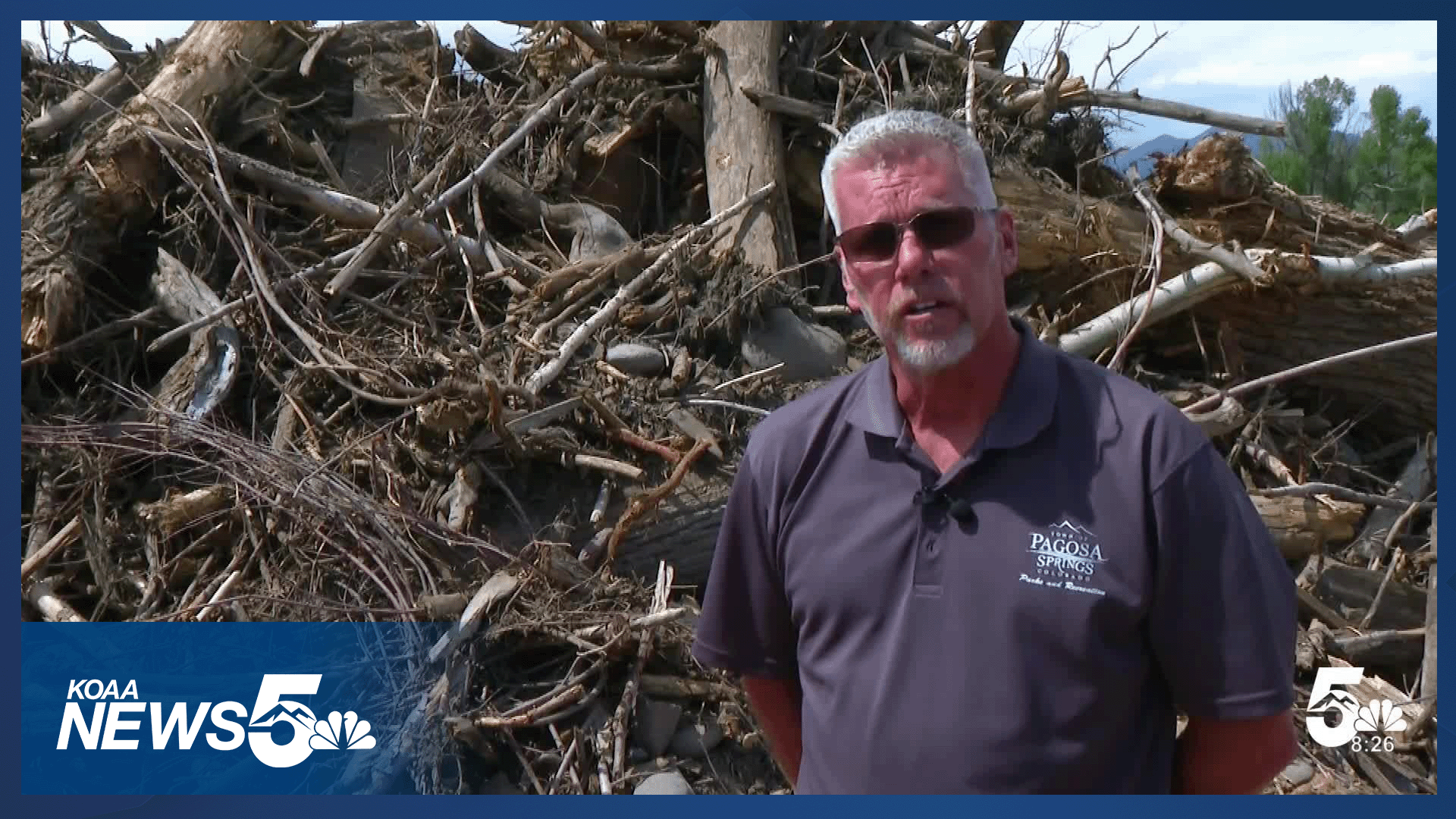

PAGOSA SPRINGS, Colo. — Just outside the main drag of Pagosa Springs, a small town of 1800 in southwest Colorado, sits a large debris pile of downed limbs and tree trunks.
Darren Lewis, the director of parks and recreation for the town, said their first collection was four times the size of what’s there now.
“The flood occurred in October, and cleanup started immediately afterwards, and we're now into June, and this pile behind me is still being added to," said Lewis.
Eight months after record-breaking rain and devastating flooding hit the rural counties of Mineral, Archuleta, and La Plata, the small communities are still rebuilding and repairing damage.
“We've had to reprioritize projects and when they may get done,” said Lewis. “We certainly put off some projects that were supposed to be completed down here that were put off for a year because of the flood.”
The flooding was the result of remnants from back-to-back Tropical Storms Priscilla and Raymond, which hit southwest Colorado in October last year.
According to a National Weather Service summary, the two storms dropped three to eight inches of rainfall from Oct. 10-14, leading to major river flooding in the Vallecito, Piedra, San Juan, and South Fork Rio Grande Basins.

The resulting damage greatly impacted the small, rural communities in the three southwest counties. They’ve said they don’t have enough resources to fully fund their ongoing repairs, which are expected to take years to be completed.
In Pagosa Springs, for example, the surging San Juan River overloaded a sewer line, which now requires a new $3.5 million lift station. A pedestrian bridge set to bring more connectivity had to be redesigned to add 30 feet in order to accommodate the new river bank width after flood erosion, which means increased costs.
Governor Polis verbally declared a disaster emergency on Oct. 12, allowing state funds and relief to be activated.
The state of Colorado provided immediate support, including the deployment of the Emergency Watershed Protection Program (EWP) through the Natural Resources Conservation Service (NRCS).
NRCS and EWP provided a little over $3 million of the $6.5 to $7 million estimate Pagosa Springs needs for relief efforts.
James Dickhoff, the development director for the town, said the Colorado Department of Public Safety and Emergency Management is helping cover part of the EWP funding.
The program addressed immediate threats in the flood impact zone such as removing debris from critical waterways and implementing erosion control measures to stabilize high-risk slopes. But the EWP is not authorized to fund the reconstruction of damaged infrastructure.
Dickhoff said the small town simply can’t afford the repairs, which includes several “large ticket items.” And a lack of federal dollars coming in will only make the issue worse.
“We're looking at borrowing money, which then exacerbates the problem because now we're also paying interest for these large ticket items,” he said. “So we are meeting regularly to kind of decide what needs to be cut from future budgets, which is unfortunate because those are things that need to happen too.”
Polis requested a Major Disaster Declaration from the Trump administration in order to secure federal funding to help support the reeling communities. Such a declaration would unlock federal assistance programs and allow local governments, homeowners, and businesses to secure eligibility for loans, insurance relief, and other assistance, according to the request.
Despite a bipartisan letter signed by all of Colorado’s Congressional delegation urging President Trump’s approval, FEMA denied the request. The agency also denied a request for support from the Lee and Elk Fires in Rio Blanco County last year.
Initial estimates, which Governor Polis said were “FEMA validated numbers,” showed the southwest flooding caused $13.8 million in damages while the wildfires caused $27 million. Those figures were only expected to grow.
“Being denied with FEMA and the federal government for whatever their reasons are, at the end of the day, things still have to be fixed,” said Darren Lewis, Pagosa’s parks and recreation director. “And we've gone through looking for every single grant possible. We've obtained some grants, but it's slowly just draining our budget.”
In an April release, Polis noted in his disaster request that the State of Colorado has thus far invested $57.5 million for last year’s flooding and wildfire disasters alongside other disasters since July 2024.
Polis appealed the FEMA denial for the wildfire and flooding disasters, but both appeals were once again denied in April with little reasoning offered as to why.
Without the FEMA federal disaster support, Polis said the State “does not have the capacity to help these local communities with the recovery efforts.”
Near the town of Vallecito in neighboring La Plata County, Commissioner Matt Salka said one million dollars from other public works projects is being reassigned to repair a mile of county road damaged in the flood event.

“I don't think it's right to play games with funding,” said Salka. “When counties, states are requesting funds, I think that there should be an equal opportunity no matter what color your state is.”
Salka and others in the area said they believe the FEMA denial was politically motivated, suggesting the Trump administration may have withheld funding in part because Colorado did not vote for the president.
“I remain hopeful that maybe there was some deal by the governor and by the Trump administration to say, ‘Hey, look, maybe we could release some FEMA funding,’ but I'm not going to hold my breath,” said Salka.
The White House did not reply to a request for comment regarding a potential reversal of the denial and the alleged political motivations.
In 2024, the Vallecito precinct of La Plata County voted 53.1% for Trump. Archuleta County leaned 56% for Trump while Mineral County favored Trump by over 54%.
“A little disheartening that there was really no reason for the denial,” said James Dickhoff, the Pagosa Springs development director. “We can only assume that the denial was because we have a governor that's a Democrat, which, as a voter and most of the voters in this community, would seem as a really odd thing to hold us captive because of something we're not in control of.”
Darren Lewis, the Pagosa Springs parks and recreation director, said it was ironic as he alleged political punishment, alluding to the town’s red voting demographic.
“Making America great again, it didn't happen for Archuleta County, in regard to this disaster that occurred,” said Lewis. “At the end of the day, the federal government has to look at these disasters and realize the effect, especially on these smaller communities.”
Those interviewed said they hoped FEMA might still consider reverting its disaster funding denial, but the governor’s office said there is no path forward to appeal the denial again.
“Governor Polis and Colorado have taken every avenue to secure a presidential disaster declaration and federal funding to support Colorado communities recovering from these disasters, and each time, President Trump has denied Colorado,” said Polis' Press Secretary Eric Maruyama.
“These denials have left Colorado communities without important federal support to recover. There is not another opportunity for Colorado to appeal this decision and Governor Polis has expressed his deep frustration with the Trump Administration’s denials of this support despite Colorado’s thorough and deserving request,” said Maruyama.
Data from the Climate and Communities program at the Urban Institute shows Trump’s second administration has denied nearly 30% of Major Disaster Declarations so far, which is an almost 90% increase over the average denials for presidential administrations dating back to 2001.

The Urban Institute data also showed Trump is likely to approve disaster declaration requests from states that voted for him by an over 10% margin compared to states that voted for Kamala Harris.
State and Congressional leaders criticized the FEMA denials for lacking reasoning as to why they weren’t approved.
In a response to KOAA, a FEMA spokesperson said it followed the Stafford Act and its regulations to determine if federal assistance is warranted.
“FEMA assesses a number of factors to determine the severity, magnitude and impact of a disaster event,” said the spokesperson.
But the agency’s response still did not specify precisely why Colorado’s two disaster requests were denied, despite KOAA specifically asking the question.

“Major disaster declaration request evaluation factors considered include estimated cost of the assistance, localized impacts, insurance coverage in force, hazard mitigation, recent multiple disasters, programs of other federal assistance, state fiscal capacity and resource availability, uninsured home and personal property losses, disaster-impacted population profile, impact to community infrastructure, casualties, and disaster related unemployment,” said FEMA.
La Plata County Commissioner Matt Salka said they did everything they were supposed to do.
“We documented the damages, responded immediately to protect life and safety, and worked through the proper channels,” said Salka. “What this decision raises is a larger question: Are rural communities being measured by a system that fully recognizes the impacts we face when disaster strikes?”
Leaders in Pagosa Springs also expressed concern if more flooding or a wildfire were to strike the area this year. If last year’s flood damage wasn’t enough to secure FEMA assistance, they worry what it might take for an approval.
Following the FEMA appeal and subsequent denial, Colorado Democratic Senator Michael Bennet introduced the Disaster Declaration Transparency Act.
The legislation would require the president to submit to Congress a written explanation within 24 hours of a disaster request denial. Congress could then fast-track a joint resolution vote to override and reverse the disaster decision.
“Disasters don’t care about state lines or politics, and neither should our President’s response,” said Bennet in an April press release. “The President outright rejected our calls for federal support. As natural disasters increase, Congress must be able to push past political retribution and help our cities and counties meet the challenge posed by these events.”
Bennet introduced the bill alongside Senator John Hickenlooper and Representatives Joe Neguse and Brittney Pettersen.
The office of Republican Congressman Jeff Hurd, who represents the region, did not return multiple requests for comment for this report.
As for the path forward in southwest Colorado, Pagosa Springs, Vallecito, and the other affected towns that rely on tourism and outdoor recreation said they’re open, welcoming to everyone, and urged the public to come visit again.