

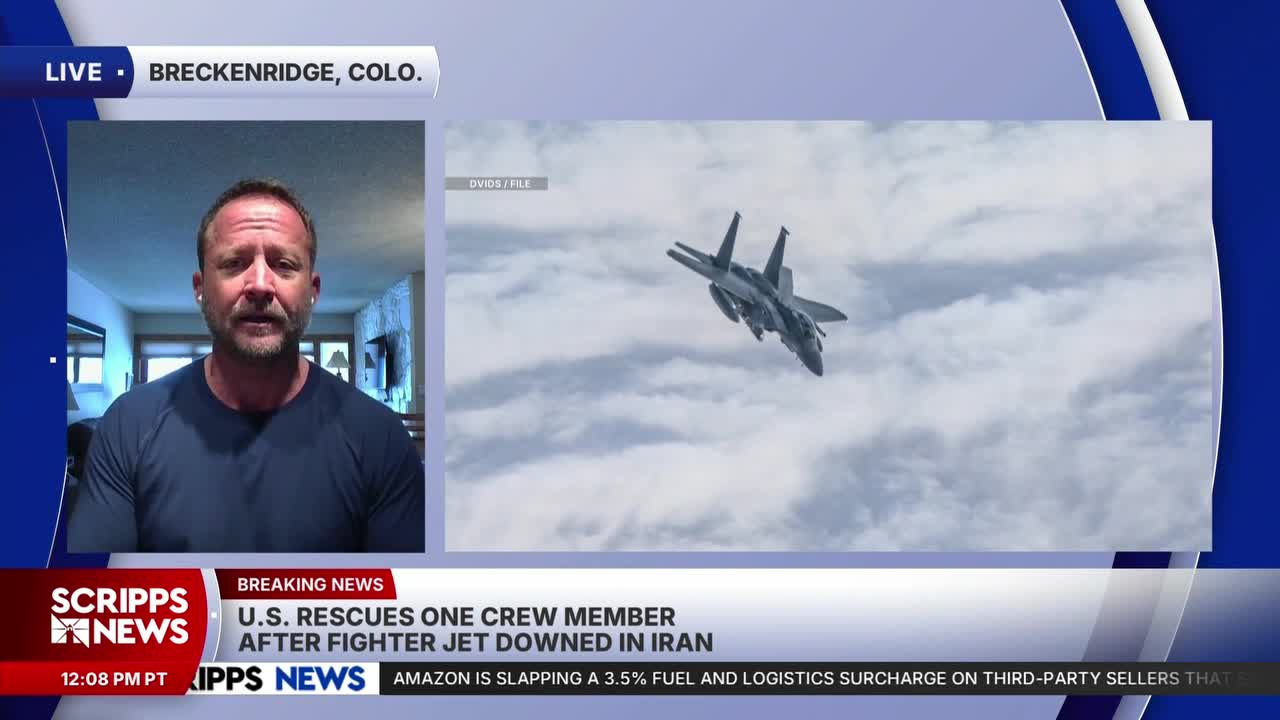


When a U.S. military aircraft is lost behind enemy lines, survival training begins immediately and rescue operations are quickly set into motion, according to former Navy fighter pilot Matthew “Whiz” Buckley.
Once a pilot ejects, the immediate focus shifts to survival and evasion, he said.
“As an aviator, as an air crew, we go through SERE, survival, evasion, resistance, and escape training,” Buckley said.
Pilots are trained to avoid capture while waiting for recovery forces, often in difficult terrain. Buckley said the area where a fighter jet was reportedly lost in Iran appears mountainous, complicating rescue efforts. The Associated Press reported that one crew member who ejected was rescued, while the search continues for a second service member.
RELATED STORY | Crew member rescued after US aircraft shot down in Iran
Buckley said specialized Combat Search and Rescue teams, known as CSAR, are on constant alert and deploy quickly when an aircraft is lost.
“These CSAR folks, the Combat Search and Rescue, they eat, breathe, and sleep this mission,” Buckley said.
Rescue operations involve far more than a single helicopter. Buckley described a coordinated military response that can include HC-130 aircraft, Pave Hawk helicopters, fighter escorts and additional air support.
The scale of that response underscores how seriously the military prioritizes recovering its personnel.
“No man left behind. No woman left behind. We’re going to come and get you,” Buckley said.
Pilots are also equipped with tools to help them survive and potentially avoid capture. Each carries a survival vest and additional gear in the ejection seat.
Buckley added that the equipment is not meant for fighting off enemy forces.
“You’re really not going to gun your way out of something,” he said, adding that pilots also carry specialized gear designed to help them evade capture and signal rescuers.
Pilots may also carry a “blood chit,” a document written in local languages that asks civilians for help and offers a reward for returning the service member to friendly forces.
“It says, I am an American fighting man or woman. I mean you no harm. If you return me to friendly forces, you know, we’ll pay 10 million bucks or whatever the current bloodshed say,” Buckley said.
If necessary, the military may also destroy the downed aircraft to prevent sensitive technology from falling into enemy hands.
“I guarantee you that within a limited amount of time from finding where the crash site was, it’s gone,” Buckley said.
