

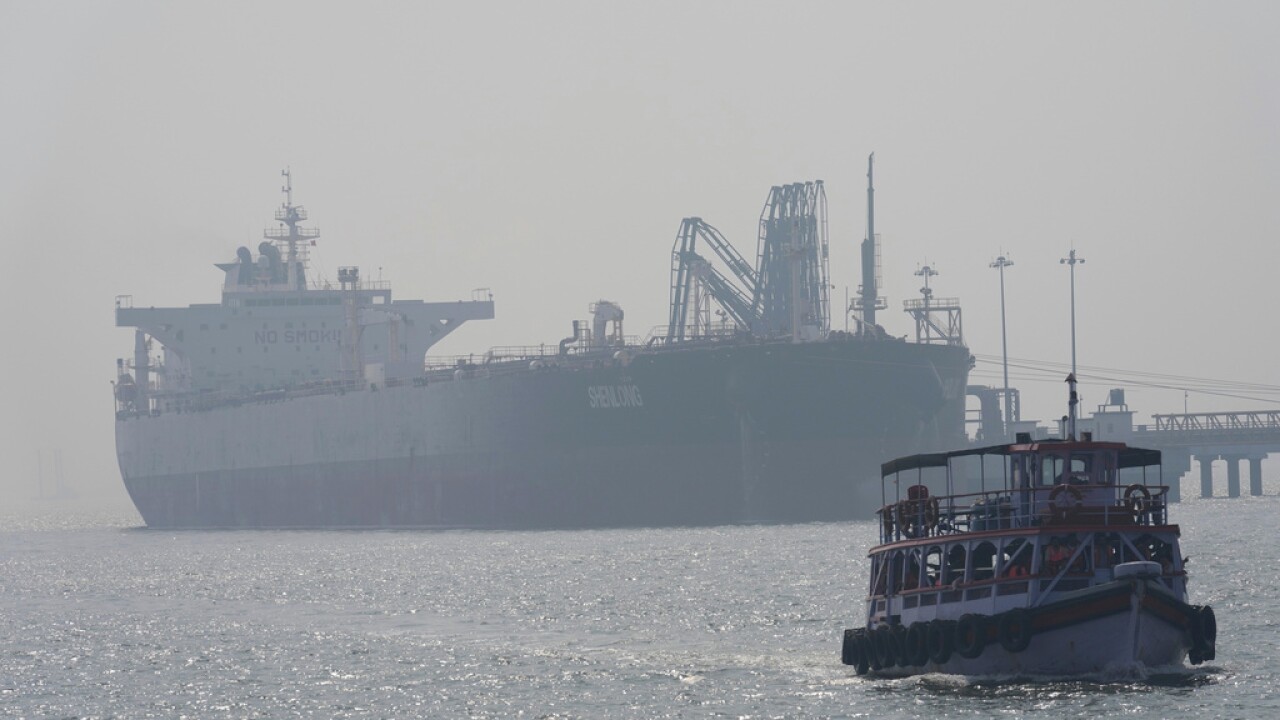

The dueling blockades in the Strait of Hormuz lurched into uncharted waters on Saturday. The United States pressed ahead with its campaign to choke off Iranian ports and Iran reversed an initial move to reopen the waterway, firing on a ship attempting to pass.
Confusion over the critical chokepoint threatened to deepen the energy crisis roiling the global economy and push the two countries toward renewed conflict, even as mediators expressed confidence a new deal was within reach.
Iran’s joint military command said on Saturday that “control of the Strait of Hormuz has returned to its previous state ... under strict management and control of the armed forces.” It warned that it would continue to block transit through the strait as long as the U.S. blockade of Iranian ports remained in effect.
RELATED STORY | Trump signals Iran deal is near as Strait of Hormuz reopens
Two gunboats from Iran’s Revolutionary Guard opened fire on a tanker transiting the Strait of Hormuz, the British military's United Kingdom Maritime Trade Operations center said on Saturday. It reported the tanker and crew as safe, without identifying the vessel or its destination. TankerTrackers.com reported vessels were forced to turn around in the strait, including an Indian-flagged super tanker, after they were fired on by Iran.
Iran announced earlier Saturday it was reimposing restrictions on the strait in response to a U.S. blockade on Iranian shipping and ports. Iran has prevented vessels from crossing throughout the seven-week-long war, except for ones it authorizes.
Ebrahim Azizi, head of the Iranian parliament’s National Security Commission, said that the strait was “returning to the status quo,” which he had earlier described as ships requiring Iranian naval authorization and toll payment before transiting.
The shift came a day after Iran's Foreign Minister Abbas Araghchi declared the strait open while a 10-day truce was announced between Israel and the Iranian-backed Hezbollah militant group in Lebanon. An end to Israel’s war with Hezbollah was a key demand of Iranian negotiators, who previously accused Israel of breaking last week’s ceasefire with strikes on Lebanon. Israel had said that deal did not cover Lebanon.
U.S. President Donald Trump first appeared to take a similar position on reopening the strait before later saying the American blockade “will remain in full force” regardless of what Iran does until a deal is reached, including about Iran's nuclear program.
RELATED STORY | Oil markets immediately drop after Trump and Iran say Hormuz is open
Even as the U.S.-Iran ceasefire appeared to hold, the back-and-forth over the strait — through which roughly one-fifth of the world’s oil typically passes — highlighted how easily it could unravel
Control over the strait has proven to be one Iran’s main points of leverage and prompted the United States to deploy forces and initiate a blockade on Iranian ports as part of an effort to force Iran to accept a Pakistan-brokered ceasefire to end almost seven weeks of war that has raged between Israel, the U.S. and Iran.
A data firm, Kpler, said movement through the strait remained confined to corridors requiring Iran’s approval.
U.S. forces have sent 21 ships back to Iran since the blockade began on Monday, U.S. Central Command said on X.
