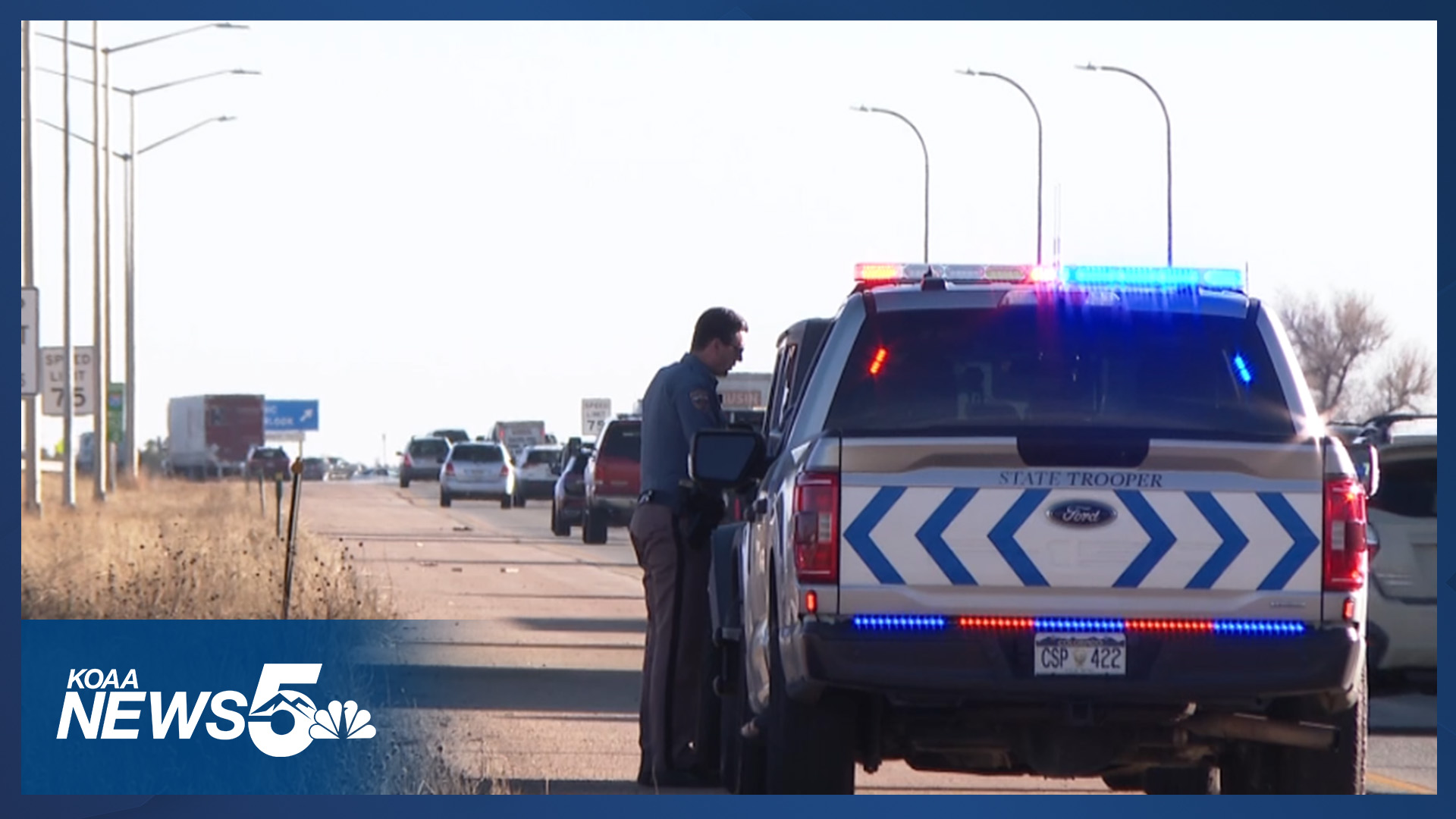


EL PASO COUNTY, Colo. (KOAA) — In the years since Colorado strengthened and expanded its “Move Over” law, Colorado State Patrol (CSP) and the American Automobile Association (AAA) said an increasing number of drivers are in compliance, but the public still needs further education and awareness.
Colorado State Patrol Trooper Joseph Newcomb said he was involved in a struck by incident himself about ten years ago.
“I was covering a rollover crash in snowy weather down on I-25, right at South Academy,” Newcomb recalled. “I had a motorist actually lose control, spin out and hit my patrol car while I was seated in it. Luckily no injuries to anybody involved, but I know what it's like.”
Trooper Newcomb said in the years since Colorado’s “Move Over” law went into effect and expanded, he’s noticed motorists seem to be better about moving over during his traffic stops. But he noted there is still room for improvement.
“Everybody I know has had at least a close encounter and most I know have had some sort of involvement,” he said. “Bad weather definitely adds into it, but if we are able to move over, it just gives us that room and helps us out.”
According to a AAA study released in October, researchers reviewing real-world video of drivers passing by incident scenes showed 64% of drivers changed lanes or slowed down, but 36% of drivers did neither.
All 50 states plus Washington DC have some form of a “Move Over” law, but the third of drivers who ignore the law lead to deadly consequences.
“In 2024, 46 emergency responders lost their lives while at the roadside, including law enforcement officers, tow truck operators, safety service patrol workers, firefighters and EMS personnel, and a road service technician,” AAA said in a release.
AAA helped bring legislation in Colorado to introduce a “Move Over” law in 2017 with additional expansions and protections added in 2019 and 2023.
But according to data from CSP, their troopers are still facing a handful of “struck by” incidents each year, when a motorist strikes a trooper vehicle as it’s pulled over on the side of the road.
In 2022, there were eight struck bys. That increased to 15 in 2023, 17 in 2024, and 10 so far in 2025.
“What we're talking about here might be traffic safety. It might be about complying with the law. Those are sort of the broad principles, but actually what we're talking about is empathy. What we're talking about is the recognition that it's dangerous out there,” said Skyler McKinley, regional director of public affairs for AAA.
“And we really want folks,our neighbors, people who live in our communities, to think about us when we're in a dangerous situation, and I would suggest that's what drivers should do when they get behind the wheel at any time is think about others.”
In Colorado, with the 2023 bill expansion, drivers on Colorado roads must move over a lane for all motorists, including emergency responders, tow trucks, maintenance vehicles, and passenger vehicles with their emergency hazards on.
If a driver is unable to move over, they must slow down to either 20 miles per hour below the posted speed limit in a 45 MPH or higher zone, or slow down to 25 MPH or less in a slower speed zone.
Failure to do so can result in fines up to $150 and three points of a driver license.
“In our research, we saw that drivers are much more likely to move over for law enforcement than for tow truck drivers,” McKinley said. “They're even less likely to move over for individual vehicles at the roadside, which is what the law requires.”
Democratic State Representative Mandy Lindsay, who represents northwest Aurora, sponsored the 2023 “Move Over” strengthening bill.
She doesn’t see a need to add any further protections to the bill for the time being, but said it’s now a matter of further education and public awareness.
“We have been hearing that the people are learning about this, that they are starting to understand culturally–like this is just what we do now as drivers,” she said. “Any time you have a new law like this, I think one of the challenges is like, ‘Oh, how do we let everybody know that this is the new law and this is the new way to do it?”
Rep. Lindsay said younger drivers can learn through formal driver education courses, but said it’s more difficult for adult drivers who still might not be used to the new law.
“If we save one life, it's worth it,” said Lindsay. “There's no reason that anybody should be dying on the side of the road.”
For CSP Trooper Newcomb, he agreed that drivers need further education about the new law. Even so, he’s satisfied with the two-thirds of drivers in compliance.
“It's getting better. The big one is, just make sure you don't have any of those distractions. Focus on driving. Focus on the roadway,” said Newcomb. “It's not just helping us. It could be helping a friend that's stuck on the side of the road. It's also helping you and your family in your own vehicle. By you moving over, you're keeping yourself out of danger.”