

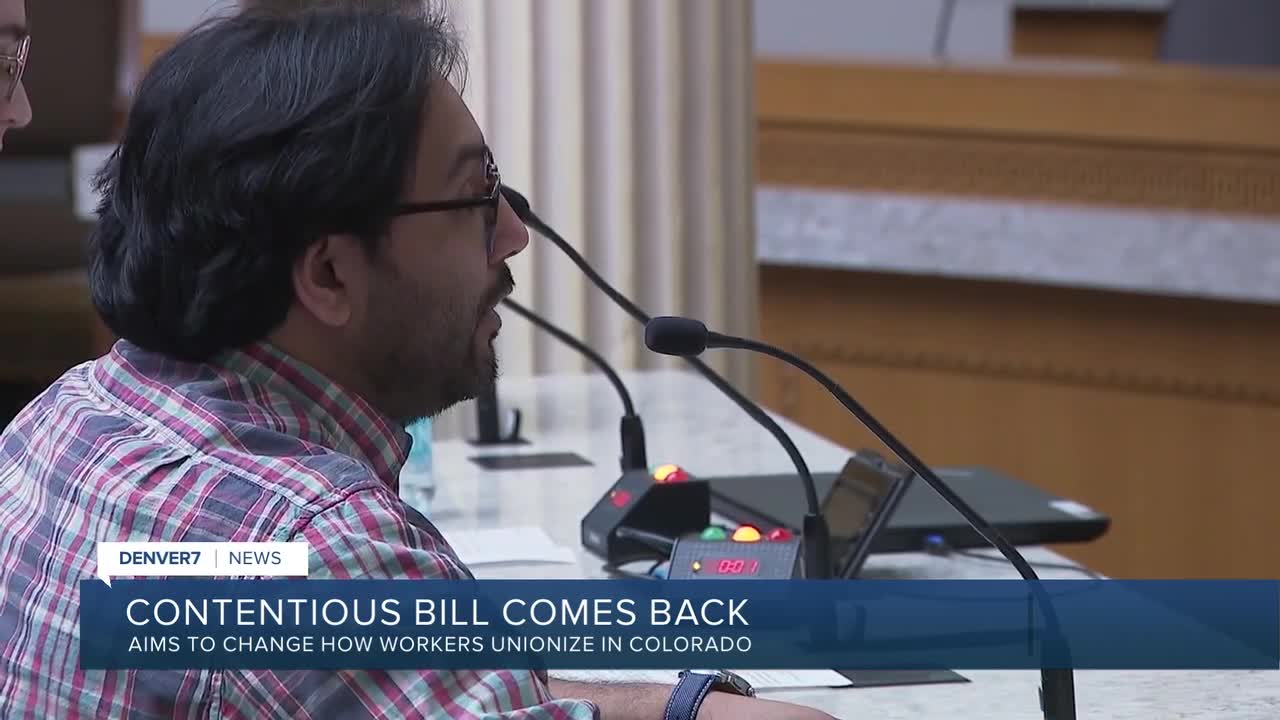


DENVER — On Thursday, Colorado lawmakers heard passionate testimony that spanned roughly three hours related to how workers unionize in the state, and whether or not that should be changed.
If the debate under the Gold Dome feels familiar, that's because it is.
House Bill 26-1005 proposes changes to Colorado's Labor Peace Act, which was enacted in 1943. Advocates claim the modifications would encourage good-faith collective bargaining negotiations, but opponents believe they are trying to fix something that is not broken.
In Colorado, a simple majority vote is needed for workers to be officially recognized as a union. Seventy-five percent of the vote is needed during the second election to negotiate a union security agreement clause with the company, where workers pay for representation.
Colorado is the only state that requires two elections for workers interested in forming a union. The legislation seeks to eliminate the second election.
"The second election provides employers an opportunity to intimidate, to union bust, to make it harder for workers to get together and have a strong voice at the workplace," said State Rep. Javier Mabrey, D-District 1. "I am very excited to be bringing this legislation, because in this moment when we are seeing some of our basic freedoms under attack — the rise of authoritarianism in real time — throughout the history of this country, we have had one silver bullet for standing up to bullies and fighting for collective power for workers, and that's the power of unions."

Politics
Polis vetoes contentious labor bill that would have reshaped unionization laws
Mabrey is one of the prime sponsors of HB26-1005, which he said essentially has the same substance as a bill he fought for last year as well.
Senate Bill 25-005 sought that same elimination of the second election needed to negotiate a union security agreement clause in a collective bargaining process. While the legislation passed out of the Colorado State Capitol, Governor Jared Polis vetoed it.
Within his veto letter, Polis wrote that "there must be a high threshold of worker participation and approval to allow for bargaining over mandatory wage deduction. And SB 25-005 does not satisfy that threshold, which is why I am vetoing the bill."
Near the end of the letter, Polis said lawmakers "missed an opportunity this year to modernize this outdated law," referring to the Labor Peace Act. The governor encouraged both sides to continue conversations so "we can make progress on this issue."
Scripps News Denver asked Mabrey why he believes the bill this year would be more successful than last year.
"The problem didn't go away, and it's clear that politicians across the country are hearing from their consultants that they need to be talking about affordability, affordability, affordability. Well, this bill is actually about increasing wages. Affordability is two sides of a coin," Mabrey replied. "Yes, it's about the cost of living. Yes, it's about the impacts of inflation, but it's also about how much workers are getting paid. And this policy we know will lead to higher wages, and the governor says he's concerned about an affordable Colorado. The problem didn't go away. So, that's why we're back."
Mabrey said conversations with the governor's office about the legislation typically happen later in the process.

Politics
Hundreds rally in support of Colorado bill that would ease union formation
State Rep. Chris Richardson, R-District 56, did not support the legislation last session, and his opinion has not changed this year.
"In the early 1900s, there was a lot of strife, a lot of violence, unfortunately, and some lives were lost," Richardson said, explaining the history of the Labor Peace Act. "That was the impetus between bringing labor and business together and trying to come up with a way where labor's voices, employees' voices, could be preserved. They could organize, but the violence could end."
Richardson believes the Labor Peace Act has stood the test of time, adding that it protects people's voices and pocketbooks.
"You can organize with a simple majority vote and begin bargaining with a simple majority vote. It's the compelling of dues from other employees that takes the second vote... If this were removed, there's no quorum requirement. It would be only a simple majority to compel other employees to pay union dues," Richardson said. "The mere fact that we're likely going to have a large room full of folks representing those that represent unions would indicate that actually the union movement is alive and healthy, or we would have an empty room of people saying, 'I can't organize.'"
Richardson was correct about having a packed house inside of the Old State Library during the House Business Affairs & Labor Committee hearing on Thursday afternoon. Dozens of people signed up to testify, both in support and opposition of the bill.
The first two people to testify in front of the committee were Josh Reitze and Brennain Degenhardt, who are co-workers at the Alamo Drafthouse Cinema off of Colfax Ave. The two were part of the push to unionize workers at the theater, which they said won their first election in September of 2024.
However, things did not go smoothly with the second election, according to Reitze and Degenhardt. They said the movement lost momentum during the time between the two elections.
"People get other jobs, people move. Just that amount of time — you lose support, just naturally through attrition," said Reitze.
The two claim another huge hindrance was a lack of ballots being sent to certain members to participate in the second vote. Degenhardt said he was one of those employees who never received a ballot.
"It seemed like over time, apathy grew, and by the time we got to our second election and the mail-in vote, we never really had a shot at winning it," said Degenhardt. "Our voices were not heard in that process. And I am personally very unhappy about that, because I very much wanted to vote for this election and to establish union security for us."
The process has come with a lot of highs and lows, but the co-workers told Denver7 they are not giving up.
"It comes down to bargaining power. Sitting at the table, being able to have a say in your workplace and your quality of life," said Reitze. "We deserve a say. We deserve a place in that conversation."
Meanwhile, the Colorado Restaurant Association was one of the organizations that testified in strong opposition to the bill.
The Colorado Restaurant Association said they asked their members not to come and speak at the committee, saying that last year they faced extreme backlash from the public after speaking against the bill. They continued to say that the bill does not protect restaurant workers, but instead harms them by eliminating the chance to participate in a second vote.
Ultimately, HB26-1005 advanced out of Thursday's committee hearing with an 8-5 vote along party lines. The bill heads to the House Finance Committee next.
