

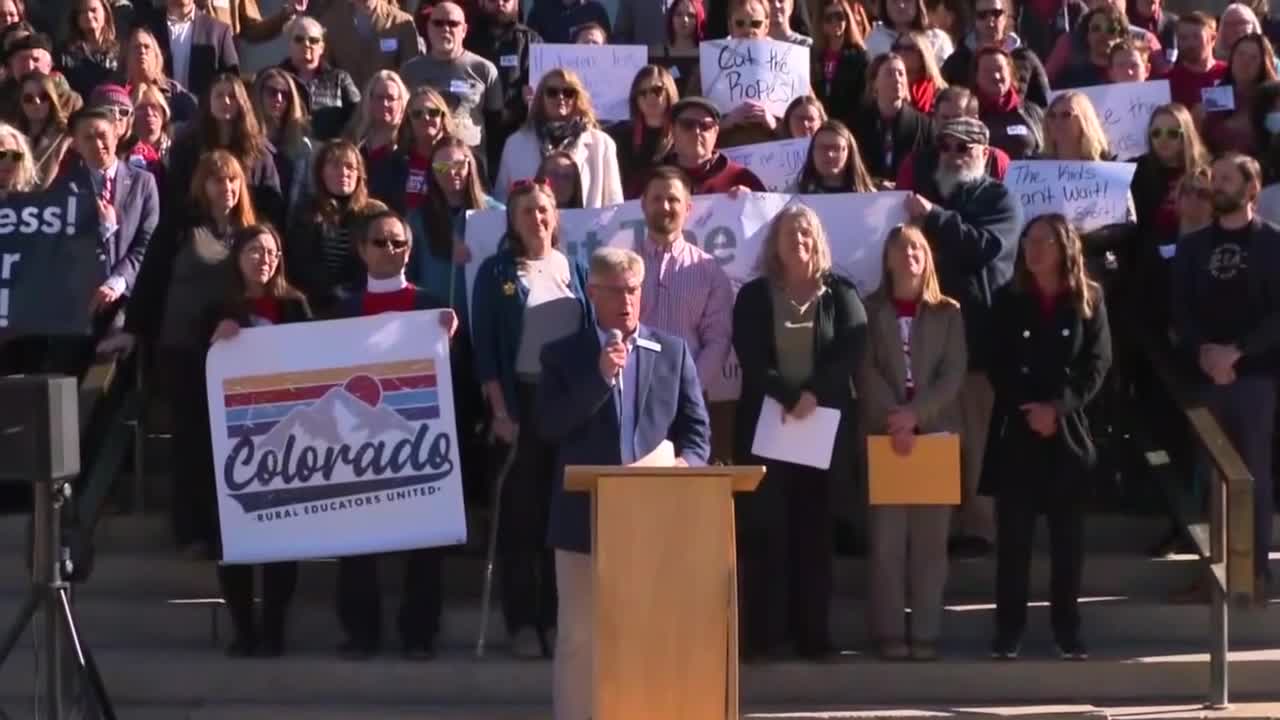


DENVER — The largest union of Colorado educators rallied outside of the Capitol on Thursday, calling on lawmakers to refer a measure to the ballot that they believe is a solution to funding struggles plaguing schools in the state.
The measure that the Colorado Education Association (CEA) is spearheading is centered upon the Taxpayer's Bill of Rights (TABOR), which voters approved in 1992. TABOR limits the amount of money the state government can keep and spend, while requiring voter approval to keep excess funds collected. Without that voter approval, extra revenue is refunded to Colorado taxpayers.
The CEA would like voters to decide if they would like to raise the TABOR spending cap, which was called "outdated" several times during Thursday's press conference. The measure would raise the spending cap by the amount of the current general fund education budget, which tends to fall between $4 and $4.5 billion each year.
"There are a number of years where the state collects excess revenue above what it's allowed to. And then it has to refund those dollars back to taxpayers. What we are asking then is to raise that cap so those dollars can be used for education instead of being refunded," explained the president of the CEA, Kevin Vick. "The ballot measure itself calls for increases in funding for education specifically. So, technically, the cap itself provides a little more space for the state to decide on other priorities as well. But, this particular measure only is talking about education.”
The 2025-2026 CEA's State of Education Report found Colorado faces an annual shortfall of roughly $4 billion in public education funding. According to those with CEA, raising the TABOR spending cap would help fill that gap.
As far as how Colorado stacks up against the rest of the country when it comes to investing in education, the CEA ranked the state as 40th in the nation. The report found that in 2024, 82% of educators knew a colleague who left the profession within the last year.
“We, as a state, have a long way to go. We are $3.5 to $4 billion behind average spending or adequate spending, according to the two major studies that the state commissioned," Vick said. “What we're experiencing right now in Colorado is there is just a tremendous fatigue amongst educators, and many are simply leaving the profession far earlier than they had anticipated, largely because of incredibly low salaries.”
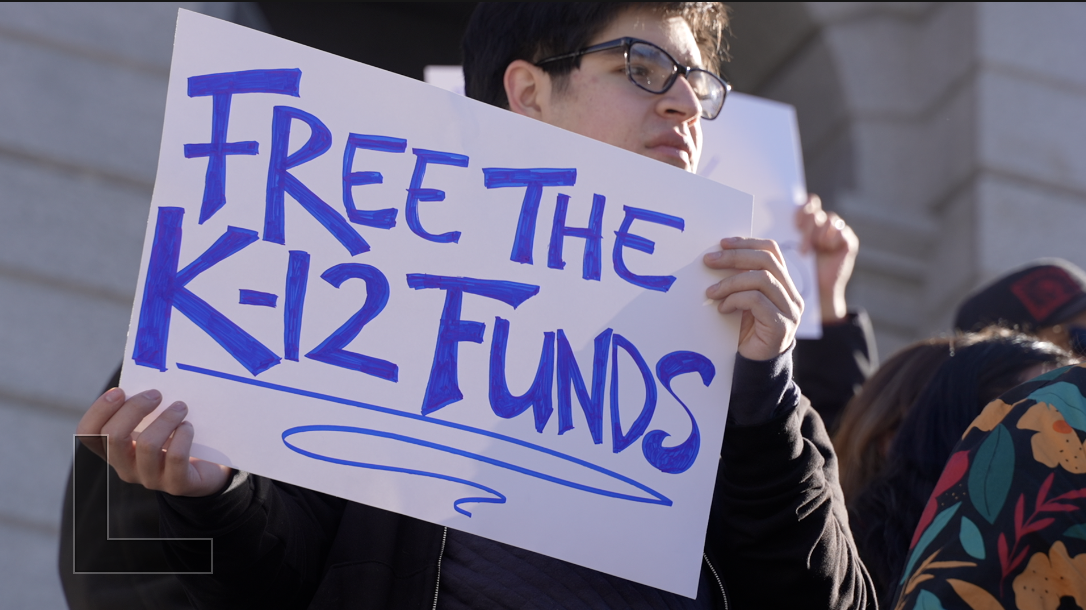
Vick told Denver7 that the last 15 years is a "good illustration" of how restrictive TABOR has been on school funding.
"When the Great Recession happened, there was a massive downturn in tax revenue that created an artificially low ceiling," Vick explained. “Because of the metrics of TABOR, which is inflation plus population — both of those rates grow at a very, very low rate, traditionally — and so it took us to manage that situation in the state budget overall. That was the creation of the Budget Stabilization Factor that literally cut $10 billion out of education over the last 15 years.”
The Budget Stabilization Factor, known as the "BS" Factor, was recently eliminated by the state legislature.
“That experience, I think, is one of the reasons why we feel this is so important for the State of Colorado to raise the cap by the equivalency of public education — so that, at a minimum, that experience doesn't happen again," Vick said. “This past school year was actually the first year that, technically, we were fully funded, even though the funding rates were basically the equivalent of 1989 funding levels.”
Vick stressed that the potential ballot measure would not increase taxes in Colorado.
“Depending on how much revenue is retained, people would see a lower amount or not see a TABOR refund in those particular years," Vick said. "What our polling shows, however, is people are so concerned about education and the lack of funding in education that they're willing to have their refund dollars go towards it by a two-to-one margin.”
Republican State Sen. Barbara Kirkmeyer disagreed with Vick's explanation of the proposal.
"I'm not in support of raising the TABOR cap. That does raise people's taxes," Kirkmeyer said. "If you raise the cap, that means less money being refunded back to the people. So, that's an increase in taxes.”
According to Kirkmeyer, the issue with funding education in Colorado lies in years of one-party control.
"They want to claim that it's because of TABOR? No, it's because of poor budgeting and accounting practices here at the State," said Kirkmeyer, adding her colleagues across the aisle are to blame. "They need to get real here. They need to get serious. We need to cut our budget. We need to stop overspending. They need to cut their addiction to spending, because that's what it is.”
Watch the full press conference with the Colorado Education Association in the video player below:
Democratic State Sen. Jeff Bridges sits alongside Kirkmeyer on the Joint Budget Committee, and plans to sponsor the legislation once introduced.
“What we're doing is exactly the solution that TABOR has within it. This isn't going around TABOR or removing TABOR. TABOR says, 'If you want to keep more of the revenue that you get, ask the people if you can keep it,'" Bridges said. “There are other proposals out there that are floating that are saying, 'Let's increase revenue. Let's have a graduated income tax.' This is a totally separate question. This is, 'Can we just simply keep the revenue that we are already bringing in and use it to make our schools what it is that everyone wants them to be?'"
According to Bridges, this measure may lead to fewer cuts to Medicaid, the fastest growing part of Colorado's budget in a year where lawmakers must deal with a looming $850 million shortfall.
"We have to bend the curve. States across the country are reducing what it is that they're able to do in Medicaid, because medical costs are growing at just such a fast rate. So, this would allow us probably to invest more in Medicaid, but education first," Bridges said. "It would make the Joint Budget Committee's job a lot easier. We're still going to have to reduce the cost of Medicaid, because they are increasing at such a rapid rate. But it means we're not going to have to be cutting a billion dollars every single year, and the dollars go first to K-12, probably most years.”
Wendy Bergman was one of the teachers who attended CEA's press conference on Thursday. She works as a social studies teacher at Rocky Mountain High School in Fort Collins, and said she always wanted to work in education.
"I love this job. It's a great, great thing to do, but I wish it was easier," Bergman said. “Our students show up every day, ready to learn, but we're operating on essentially half of what we need to adequately fund our schools... We know what's best for our kids, and it's the things we don't get to do because we don't have the funding.”
Bergman hopes the measure from CEA makes it to the November 2026 ballot.
"We want our community to thrive, and our kids are how we get there long-term," Bergman said. "But we're not providing what they need."
