

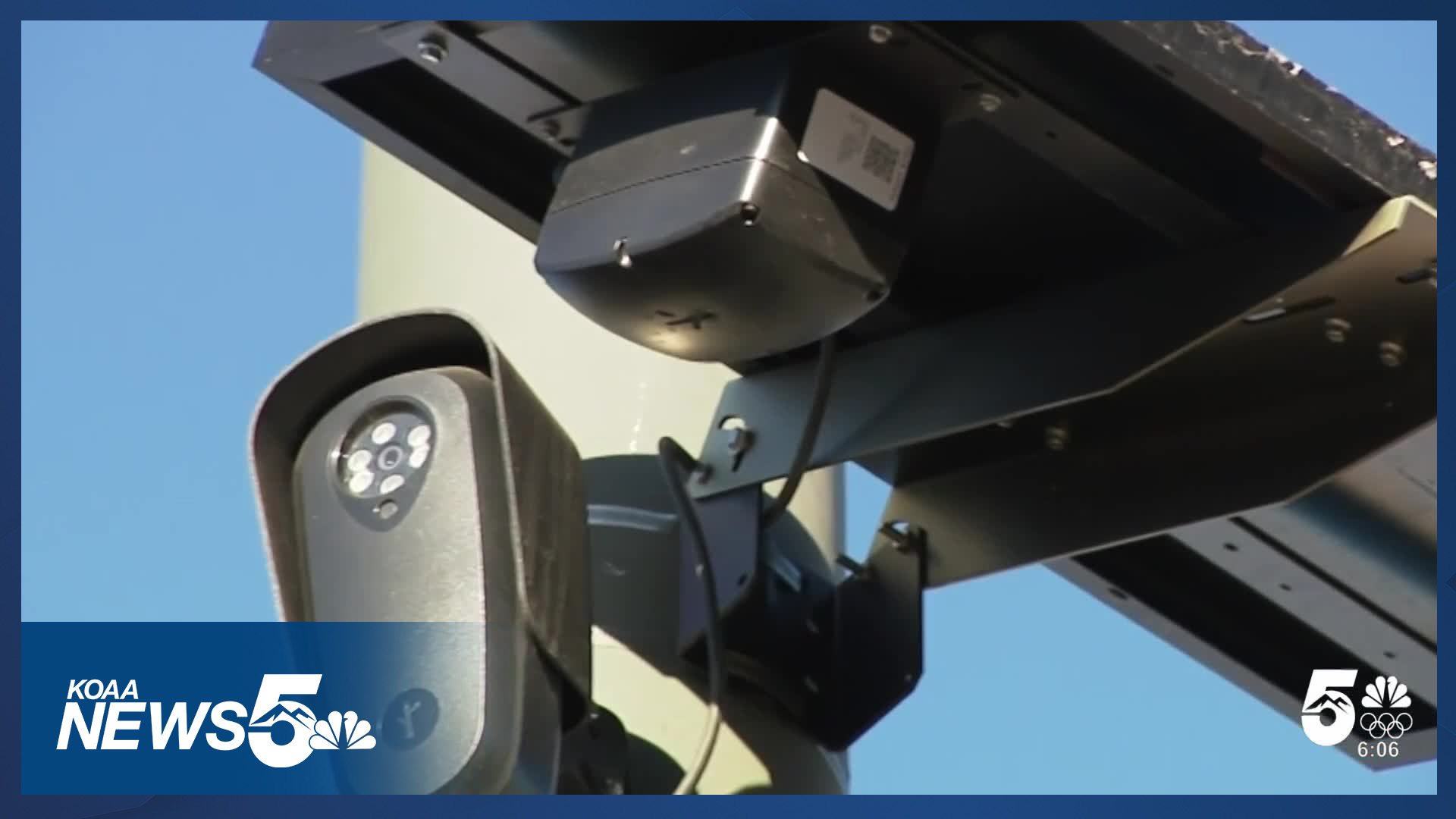


DENVER — Striking the balance between privacy and technology is at the heart of a Colorado bill centered on the data collected by automatic license plate readers, according to those behind the legislation.
Senate Bill 26-070 passed out of the Senate Judiciary Committee on Monday evening after roughly 5 hours of careful consideration, during which an estimated 70 people testified on either side of the issue.
It's an idea stemming from State Sen. Judy Amabile, D — District 18, who first told the Scripps News Group about this proposal before the 2026 legislative session began. The bill is a bipartisan push, with State Sen. Lynda Zamora Wilson, R — District 9, as one of the prime sponsors alongside Amabile.
"This is an area where we can come together. Where we can say, 'Hey, we support law enforcement. We want them to have access to this tool, but we also want people in Colorado to feel safe around their community, and to not feel like we are having mass surveillance.' Because people are worried about that, and for a lot of really good reasons," Amabile said.
"We support our law enforcement. They sacrifice, and they put their lives on the line, and this technology does save lives. And so, we don't want to take that away, but we do want to put guardrails up," said Zamora Wilson.
SB26-070 would require law enforcement to obtain a warrant to search automatic license plate reader databases if more than 72 hours have passed since the organization was alerted to a crime. There are no restrictions on the first 72 hours following an incident — a change from the original version of the bill, which gave law enforcement 24 hours after an incident to search the database.
Amabile said the bill accounts for emergency situations.
Policies would have to be adopted by entities that collect data from license plate readers to maintain compliance with the legislation.
The bill was amended, increasing the time the collected information could be stored from less than a week to a month. There are exceptions for valid warrants and criminal investigations.

Denver
Denver mulls replacing Flock system, begins accepting bids from other providers
The Public Policy Director for the American Civil Liberties Union (ACLU) in Colorado, Anaya Robinson, said the bill recalibrates when and how automatic license plate reader technology is used.
"We believe that without strong guardrails, these systems can and have been misused in ways that undermine civil liberties," said Robinson. "Senate Bill 70 is aimed at preventing unchecked government access to detailed location histories and strengthening privacy protections while still allowing law enforcement to operate within defined legal boundaries."
State Rep. Yara Zokaie, D — District 52, is one of the sponsors running the bill in the House of Representatives.
"As a child of immigrants and just as a legislator that is doing everything in my power to keep our community safe from unconstitutional immigration enforcement from the federal government, I am deeply concerned about local surveillance data fueling federal immigration enforcement in ways that undermine our values and that, quite frankly, violate our laws," Zokaie said during a press conference before the committee hearing. "Our law enforcement must follow the Constitution. What is happening today is not just casual observation. Being able to reconstruct weeks or months of a person's movement is a search, and the Fourth Amendment is clear that searches require a warrant."
Meanwhile, members of law enforcement spoke strongly against the proposal during Monday's committee hearing.
"This is an unnecessary bill. I think it's a waste of taxpayer funds," said Sgt. Dominic Marziano, who works within the Gun Violence Supression Team at the Aurora Police Department. "If people are worried about us sharing stuff with ICE or DHS or any of that, we don't share that information with them. There's already laws in place from the state level that prohibit us from doing that. We don't do that."
According to Marziano, the technology has helped solve a "vast majority" of cases at the department within the last year. He also said the need to obtain warrants will be burdensome.
"I think there's a misguided fear of what we use this technology for. We use it to target criminals. We're not using it to target the public that's out doing their day-to-day thing," Marziano said. "It's very specific, very narrow scope, and that's it. There is no concern if you're not a criminal."

Denver
Denver bans sharing of Flock camera data with the federal government
Flock Safety, a company that produces the technology at the center of the legislation, has contracts with nearly 100 law enforcement agencies, according to a spokesperson. In a statement, the representative said Flock Safety hopes to see the bill amended "to ensure law enforcement can continue using this critical technology in a responsible and transparent way to keep communities safe."
The statement continued to say the company "strongly supports" laws that promote transparency, foster public trust, and create guardrails for how the data from license plate recognition is used and shared while "preserving the efficacy of this important public safety tool."
Ultimately, lawmakers advanced SB26-070 out of the Senate Judiciary Committee on a 5-2 vote. State Sen. John Carson, R — District 30, and State Sen. Dylan Roberts, D — District 8, both voted against SB26-070.
Carson said he did not believe the issue rose to the level of Fourth Amendment concerns, while Roberts told Denver7 that "we heard loud and clear from law enforcement that crimes are solved and further crime is stopped using this technology."
The bill heads to the Appropriations Committee next, where a significant fiscal note of $1.8 million will be considered. The estimated funding needed for this legislation would be allocated to the Judicial Department, the Department of Public Safety, and the Department of Personnel and Administration.
