



DENVER — Colorado lawmakers returned to the State Capitol on Wednesday with questions about how to balance the budget at the top of their long to-do list for the 2026 legislative session.
Despite the looming $850 million budget deficit legislators will have to deal with, the traditions of the first day of the session shone through as new lawmakers were sworn in and familiar faces greeted each other.
In the House of Representatives, several longtime Democratic leaders will be stepping away from the Colorado State Capitol after this year. One of them is Speaker of the House Julie McCluskie, D — District 13, who delivered her opening remarks to the gallery on Wednesday.
"Colorado is a beautiful place to call home. We're lucky to live here, but the cost of renting or buying a home is making that dream almost impossible for working people," McCluskie said. "This year, we will unlock innovative financing mechanisms to build more affordable housing, make it easier for nonprofits to build homes on land they already own, and continue to reduce property insurance costs.”
McCluskie echoed promises Democratic leaders made to their constituents prior to the start of the session.
“Civil rights are not to be played with. We won't shove our immigrants and LGBTQ neighbors back into the shadows," she said, as Democrats in the House stood and applauded. “Diversity does make our state stronger."
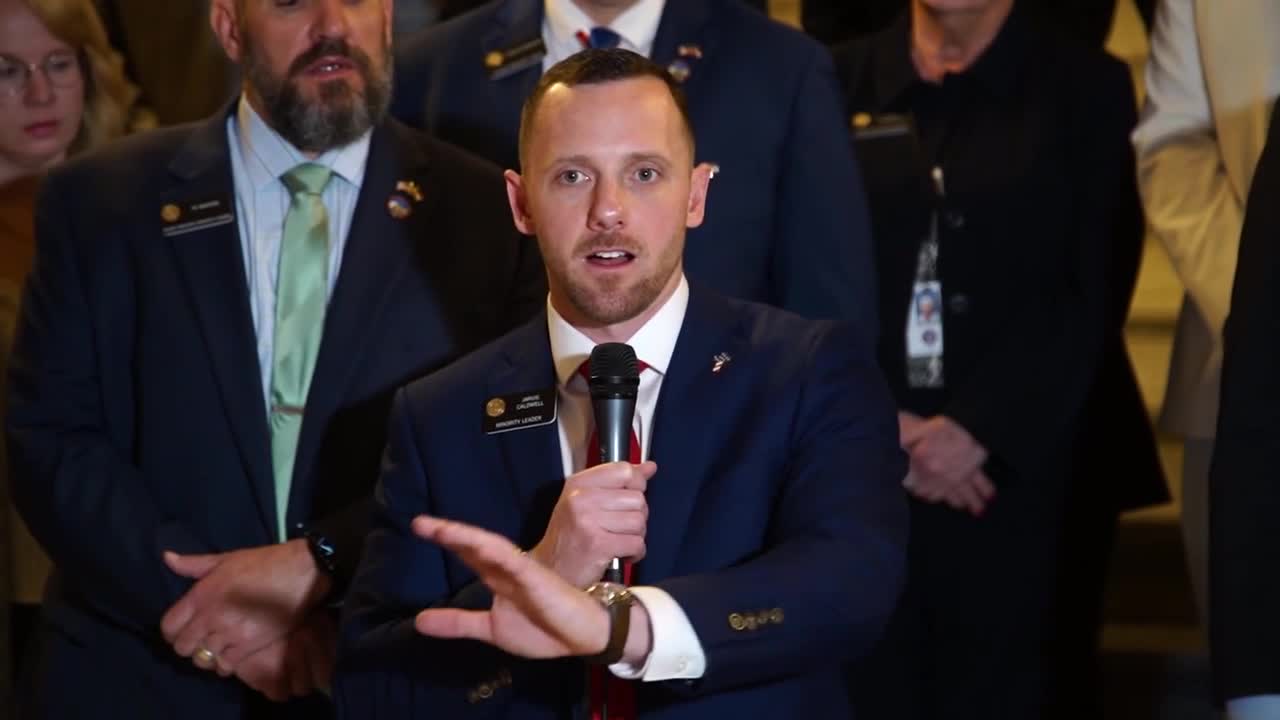
Then, Minority Leader Jarvis Caldwell, R — District 20, stepped to the front of the chamber to deliver his opening remarks.
“No matter our political differences, if you bring me a bill that doesn't violate the Constitution or is good for the people of House District 20 and the people of Colorado, I will gladly put my name on it," Caldwell said.
Prior to the session starting, House Republicans held a press conference to discuss their priorities for the upcoming session.
“2026 is going to be a very unique and interesting year," Caldwell said during the press conference. “The Democrats are going to continually throughout this session try to scapegoat their mismanagement of the state government and put it on the Trump administration, but they've been mismanaging it for years now.”
Watch the full press conference with Colorado House Republicans in the video player below:
Caldwell said that Republicans will focus on topics that include affordability, public safety, education, and parental rights throughout the session.
The new minority leader also spoke to an effort between the parties to take the vitriol out of local politics.
"I do commend the majority for the conversations we've had in the interim about lowering some of the temperature," Caldwell said. "I do appreciate the efforts with them to try to lower that temperature, but we need to be clear that there's a difference between fighting on policy and raising the temperature, or fighting on a personal level. And so we're still going to fight the way we do, and we're still going to represent the people of Colorado, and that shouldn't be confused with lowering temperatures or civility or anything like that.”
Assistant Minority Leader Ty Winter, R — District 47, told the press he wants to see the legislature work to unite both the rural and urban parts of Colorado.
"What we have seen is big city problems, or big city fixes, have exasperated rural problems, and it's really unfortunate," Winter said. "We will fight for small businesses. We'll fight for affordable and reliable energy. We're going to secure our water, and we're going to fight for good jobs, not only for the people in the metro area, but to make sure that my constituents can keep food on the table for their families.”
Senate Republicans hosted a press conference after their House counterparts, where Minority Leader Cleave Simpson, R — District 6, said there must be a "better path and vision" for the state.
"The people of Colorado are pretty clear what they need from us. They want a state that's affordable," said Simpson. “How are we going to make Colorado more affordable? And it feels like every year we go one step forward, and two or three steps backwards.”
Simpson acknowledged that Republicans must work with their Democrat colleagues, who have majorities in both the House and Senate.
“From the minority perspective, we've got to think about how do we engage potentially differently? Because we've not, like — it's been five straight years in my tenure of largely just playing defense," said Simpson.
Meanwhile, State Senator Barbara Kirkmeyer, R — District 23, began by defending the Taxpayer Bill of Rights (TABOR) in Colorado, which requires voter approval for the state to keep any revenue collected that exceeds a Blue Book estimate. Democrats believe it's time for the state to examine the policy.
"TABOR didn't cause overspending. TABOR didn't cause our problems in the budget. Simply put, TABOR protects taxpayers from overspending. It ensures that we limit government. It ensures that we have a safety net in place for our taxpayers, and that we try to really, truly, work on affordability," said Kirkmeyer. "It's time for our colleagues across the aisle to quit placing blame on others, to quit placing blame on TABOR, and to get down to work.”
Watch the full press conference with Colorado Senate Republicans in the video player below:
A number of bills were introduced on the first day of the 2026 legislative session, with the HOME Act as the very first one read across the table in the House.
House Bill 26-1001 is sponsored by Democrats, who believe it could be a solution to more affordable housing in Colorado.
State Representative Andy Boesenecker, D — District 53, is one of the sponsors of the HOME Act. The legislation aims to allow schools, nonprofit organizations, and transit districts to use "underutilized land" for housing.
“When I talk about this bill, I'm talking about building housing where it makes sense. Building housing that teachers can afford, building housing that first responders, firefighters, police officers can afford," said Boesenecker. “When we solve that issue and we build housing near transit, or we build housing where there's already infrastructure, it's sort of two birds with one stone.”
Boesenecker said one of the key provisions within the legislation is using an administrative review process for eligible entities that would like to build housing on their property.
“We know that when we use an administrative review process for some of these things, as opposed to the traditional land use development review process, we cut the timeline by 28%. Now, think about what that means in terms of a project," said Boesenecker. “It means lowering the cost. It means providing predictability in terms of bringing that project to market. And it also means that at the end of the day, investors and developers know that they have a predictable pathway to getting this done. What that means for the average consumer has a lower price point in terms of rent or housing that they can afford.”
This is the last legislative session with Jared Polis serving as Governor of Colorado, and he will present his final State of the State address on Thursday.
In an unusual move to a standard process, members of the House of Representatives voted to change a resolution sent over by the Senate which sets the details for the State of the State address. Within that resolution, Polis is referred to as "his excellency," which members from both sides of the aisle in the House voted to strike and exchange with "honorable."
State Representative Ken DeGraaf, R — District 22, specifically referenced the "No Kings" rallies seen across the country within the last year as a reason for doing so.
The change within the resolution will be voted on by the Senate on Thursday, before the State of the State address.
