


DENVER — It's been four years in the making, but a judge has finally made a ruling in a class action lawsuit against the Colorado Department of Corrections (CDOC) and Governor Jared Polis, finding they violated the state's constitution by forcing prisoners to work.
The order came down Friday from Denver District Court Judge Sarah Wallace.
She agreed with the plaintiffs, ruling the state and CDOC are violating the Colorado Constitution.
It goes back to the 13th Amendment which has a clause that states, "Neither slavery nor involuntary servitude, except as a punishment for crime whereof the party shall have been duly convicted, shall exist within the United States."
That clause has previously allowed forced labor in prisons, but in 2018, Colorado voters amended the state's constitution making slavery, or forced labor, illegal with no exceptions.
When Colorado passed Amendment A, it became the first state in modern history to end the 13th Amendment's exception clause. Rhode Island banned slavery without exception in 1842. At least five other states have made the same ban including Utah, Nebraska, Alabama, Oregon and Vermont.
Previous coverage: Lawsuit against Gov. Polis claims forced labor still exists in state prisons, despite passing of Amendment A
"CDOC’s unconstitutional coercive policies include: the threat and use of segregation and isolation, including through Removal from Population, Restrictive Housing, Housing Restriction Sanction, Restricted Privileges, and any other sanction that results in isolation in a cell for more than twenty-two hours a day for more than two days (three if over a weekend) for failure to work," the order states.
CDOC and the governor's office disagree said they did not believe CDOC had forced labor. CDOC provided Denver7 with the following statement:
The Colorado Department of Corrections (CDOC) is currently reviewing the Denver District Court's ruling on the state’s prison labor practices. We respect the judicial process and continue to evaluate the full legal and operational implications of the court’s decision to determine next steps. The Department of Corrections agrees that slavery and forced labor are wrong and illegal and do not believe we have engaged in either. CDOC programs are designed to provide essential skills, vocational training, and rehabilitative opportunities that support successful reentry into the community. The Department remains committed to upholding the Colorado Constitution, and believes we have been despite the ruling. We are also committed to ensuring the safety and security of our facilities, staff, and the incarcerated population.
The governor's office also said it was reviewing the order "to determine next steps."
"Governor Polis strongly agrees that slavery and forced servitude are wrong and illegal," a spokesperson for the governor's office said in a statement. "The Department of Corrections does not engage in either and is always interested in how prison reforms can better ensure that this never occurs in Colorado."
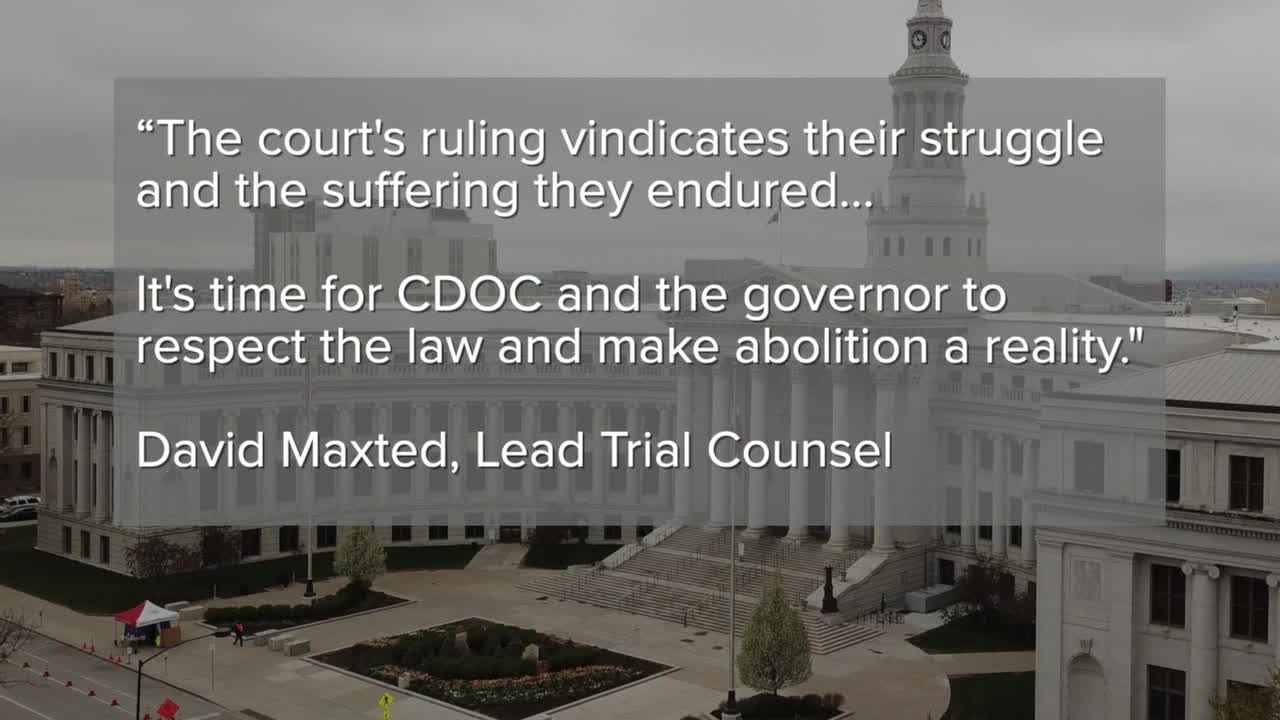
In a statement, lead trial counsel David Maxted said, "The Court's ruling vindicates their struggle and the suffering they endured."
He goes on to say, "It's time for CDOC and the Governor to respect the law and make abolition a reality."
The court has now ordered them, among many things, to stop threatening and using segregation and isolation and stop the policy that allows "double charging" inmates who don't work.
Editor's note: This story has been updated with statements from CDOC and the governor's office.

