

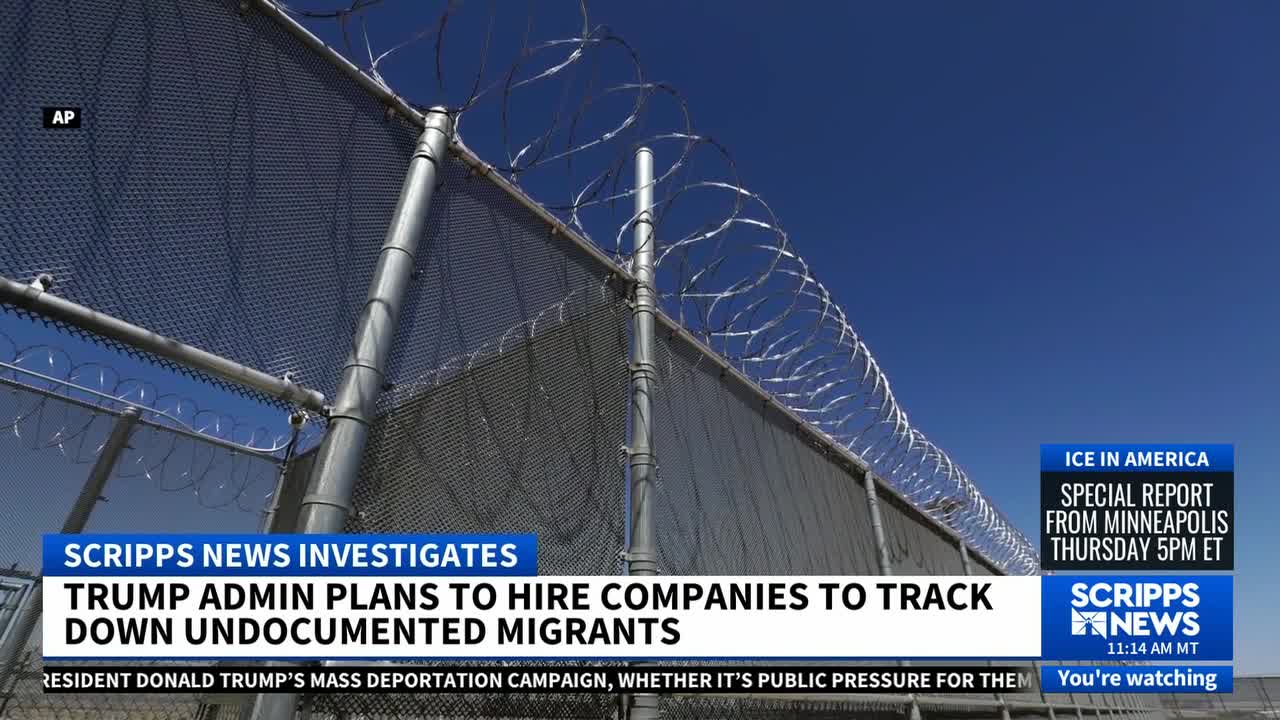



The Trump administration has offered open-ended contracts to 13 private companies for help verifying where suspected undocumented immigrants live and work.
A Scripps News investigation found that some of the companies have no record of previously doing business with the government. Some also list post office boxes or residences as their main office addresses, raising questions about their qualifications to handle sensitive personal data and to conduct in-person surveillance of migrants.
Just before Christmas, Immigration and Customs Enforcement awarded contracts potentially worth a combined $1.2 billion for the companies to provide "skip tracing services nationwide" during the next two years, according to federal contracting records reviewed by the Scripps News investigative team. The records show that most of the companies have not yet received any payments.
The Department of Homeland Security published a document in October saying ICE had an immediate need for skip tracing, a process described as using government data, the web, and physical surveillance to confirm the location of targeted immigrants.
The companies would be expected to send ICE a collection of photos and documents confirming the person's residence and/or place of employment.
RELATED STORY | As ICE puts immigrants in 'Lone Star Lockup,' companies quietly cash in
The contractors also may be asked to deliver official government documents to persons of interest, the document states. There is the possibility of monetary bonuses. The more undocumented immigrants they find, the more money the businesses can make.
The companies are essentially ICE bounty hunters, said Sharon Bradford Franklin, former chairwoman of the U.S. Privacy and Civil Liberties Oversight Board.
"It's the same kind of incentive situation," Bradford Franklin said.
Some of the awarded contractors are linked to large corporations, like a company run by the GEO Group, which operates private ICE detention centers for the government.
Other grant recipients are much smaller companies, still able to make millions of dollars from the contract.
A business named Fraud Inc. is run out of an apartment in Conroe, Texas. Reached by phone, the company's president said he runs the business from home. He said that his aim is to find as many undocumented immigrants as possible to take advantage of the bonuses offered by the government.
Fraud Inc. could earn more than $25 million, according to contracting records.
Gravitas Professional Services LLC is an Ohio company that lists a post office box as its main address.
RELATED STORY | Private prisons see record revenue growth under Trump administration's immigration surge
YouTube videos show Gravitas had been focused on much smaller jobs, including tracking down a client's biological father and catching people allegedly committing workers' compensation fraud.
"Gravitas is mostly in the insurance world but we've been known to locate people through infidelity and corporate investigations," owner Adam Visnic says in one video posted to YouTube.
The business could earn over $32 million searching for immigrants.
A.I. Solutions 87 is an LLC with an address of a single-family home in Wisconsin. The LLC could make more than $48 million dollars through its contract.
ICE did not respond to Scripps News' questions about how the agency picked the entities that won contracts.
The companies are required to follow federal, state and local laws, but because the contracts themselves aren't public, there are no published details about rules to protect government data and civil rights.
"When the government outsources this type of surveillance, it increases the risk of abuse," Bradford Franklin said. "There is even less ability to have oversight. There are rules that simply don't apply."
