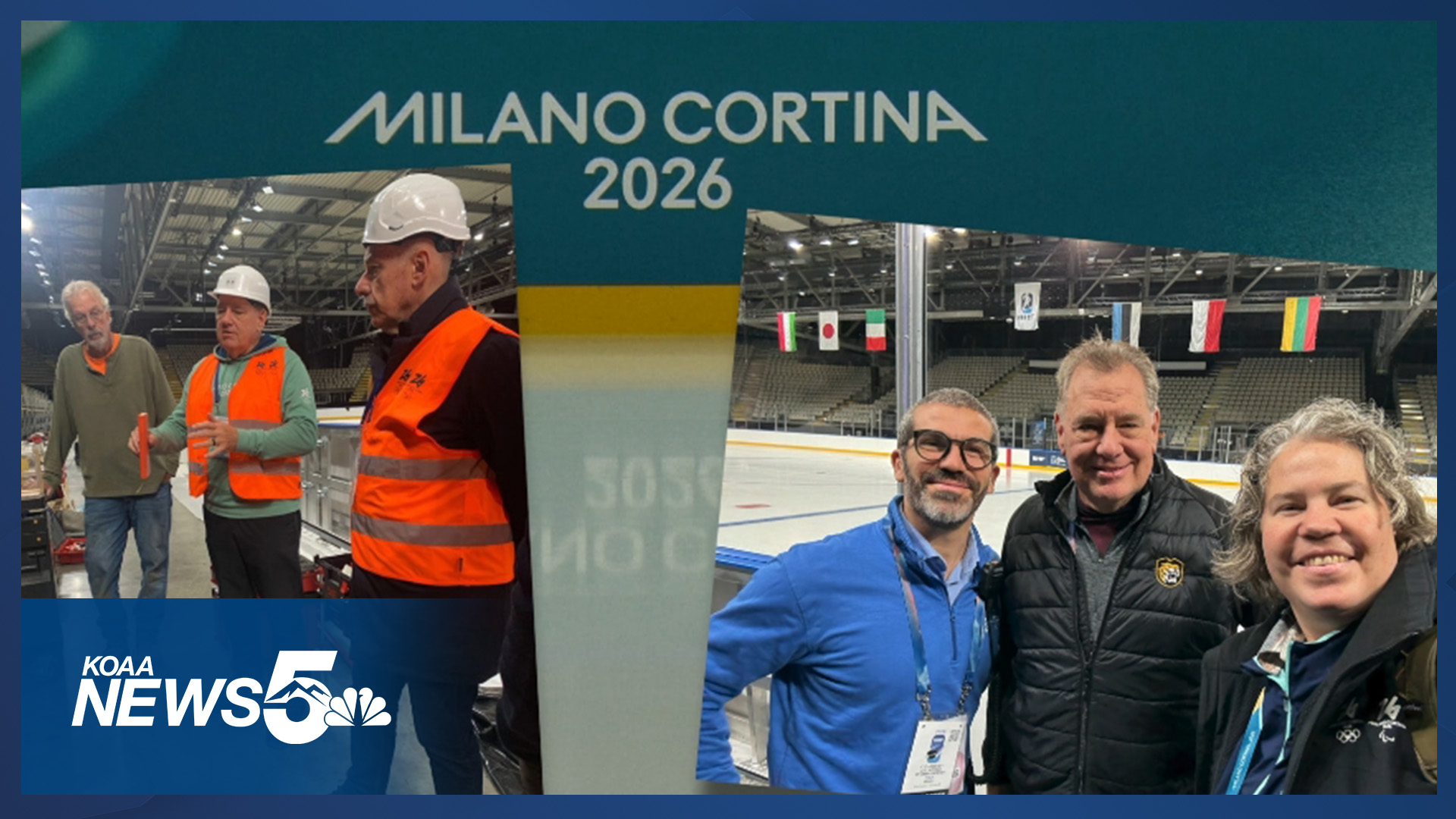


COLORADO SPRINGS, Colo. (KOAA) — Colorado Springs resident Don Moffatt describes his role at the 2026 Winter Olympics as Chief Ice Maker, while others have called him the “ice master.”
The ice is seeing three games a day for weeks on end from the best ice hockey players on the planet. Being able to sustain that level of play is what makes Moffatt so good and sought after for his work.
“It's in the way we build it. That's really the key,” said Moffatt. “I tell people that ice is kind of like a muscle. You need to break it down first to make it stronger. When you first put ice in, it's under intense pressure. We're freezing it so it’s contracting. It's constantly under pressure. The first time we put the heavy Zamboni on the ice, it will crack the ice.”
He officially arrived in Milan late last year and was, by and large, a one-man band leading up to the games. His assistant was held up in Texas with visa and passport issues, so Moffatt had to handle much of the initial ice-making duties by himself.
For the last several years, he said he’s visited Italy and put on seminars to recruit local workers for the Olympics. During his mid-January interview with KOAA, he had 24 Zamboni drivers at that point and was set to have more help as the games started up.
He’s staying in an apartment near the Milano Santagiulia Ice Hockey Arena, the main ice hockey arena for the 2026 games. But he’s also in charge of the ice in the practice rinks and the secondary stadium where the women are primarily playing.
While the Santagiulia faced its share of criticism and concern for the last-minute construction on the arena, Moffatt stayed focused on what he could control: the quality of the ice.
“This is my 5th Olympics. It's been by far the hardest, but I've done a lot of special events for the National Hockey League and different world championships and figure skating events and different events. And over the course of the years, I've really learned to not really worry about what I can't control,” Moffatt said. “I'm 100% confident in the field of play.”
Since it’ll become a concert venue, the Santagiulia isn’t designed as a permanent hockey arena. As a result, Moffatt had to put in some extra work to make the rink playable.
He described the science behind his work like the Yellow Pages phone books of old, building a thin layer on top of a thin layer that stacks and bonds together into a solid block (or book).
He said the initial sheet he began building in January took four days before he even began to paint it.
“Time and patience and even done it thousands of times, you're out there with a hose, and you're flooding, and you're just thinking there's gotta be a better way, but there really isn't,” Moffatt said with a laugh.
The ice in most ice hockey arenas is only about 1.25 inches thick, he said, but he had to build up a denser base layer this time around due to how the Santagiulia was designed.
“We have a new system, a different system here. So, all these rinks in Milano are temporary rinks. The hockey rinks, none of them are an actual ice rink,” he said. “We had to put insulation down, we put a refrigeration system down, which is a series of pipes on the floor. And then we built the boards and the rink around them. We're going to have total probably 2.5 inches.”
The Canadian-born Moffatt has strong Colorado connections. He helped teach the ice operations at Robeson Arena for Colorado College when the arena first opened. And he’s worked on the Colorado Avalanche ice crew for about 15 years.
Milan-Cortina is far from the first time he’s made the ice at the Winter Olympics. Moffatt first got his start in 1987 after moving to the US in Tempe, Ariz. at a community rink.
He then worked for the NHL and the Arizona Coyotes, where he met a man named Dan Craig from the Edmonton Oilers, whom Moffatt described as the man and team with the best ice in the NHL.
His relationship with Craig led to him being invited to work on the ice at the 2006 Torino, Italy, Olympics.
Moffatt eventually left to work for USA Hockey and then the NHL to help create uniformity on the ice across the league with Craig.
“I was instrumental in creating the first operations handbook for all of the ice guys in the 30 buildings at the time,” he said. “And then just going around and really sharing knowledge and sharing information between rinks at the time and trying to create the same ice in Tampa as it was in Toronto as it was in Colorado.”
Moffatt then helped with the 2010 Vancouver Olympics, and Milan-Cortina will mark his fifth Olympics as ice maker.
His days are long, starting at 9 a.m. and ending around midnight for about three weeks straight, but he’s good at what he does, and the best hockey players in the world are now seeing it firsthand.
As for when Moffatt might get a break, he said he always writes into his contract that he gets the day off after the men’s gold medal game.
“For most people, it's a celebration,” he said. “For me, it's just kind of a relief and a pressure relief. And just kind of let go and have a few beers and sleep pretty much the entire next day.”